In 1965, the year Congress passed the Voting Rights Act, it did not take much detective work to discover how some of the South’s most powerful white politicians felt about their Black neighbors.
Senator James Eastland, a Democrat from Mississippi who wanted to kill the landmark legislation, once openly stated that Black people were an “an inferior race.” During his 1963 inauguration speech, Gov. George C. Wallace of Alabama, a Democrat, infamously declared, “Segregation now, segregation tomorrow, segregation forever.”
These days, such racism, at least when directed at Black people, is rarely openly expressed by white Southern politicians, who consider it to be immoral, bad politics, bad manners — or all of the above.
But a question central to the Southern experience lingers: Has anti-Black racism eased, or has discrimination against African Americans simply become more subtle, disguised as a web of rules embedded in regular partisan politics?
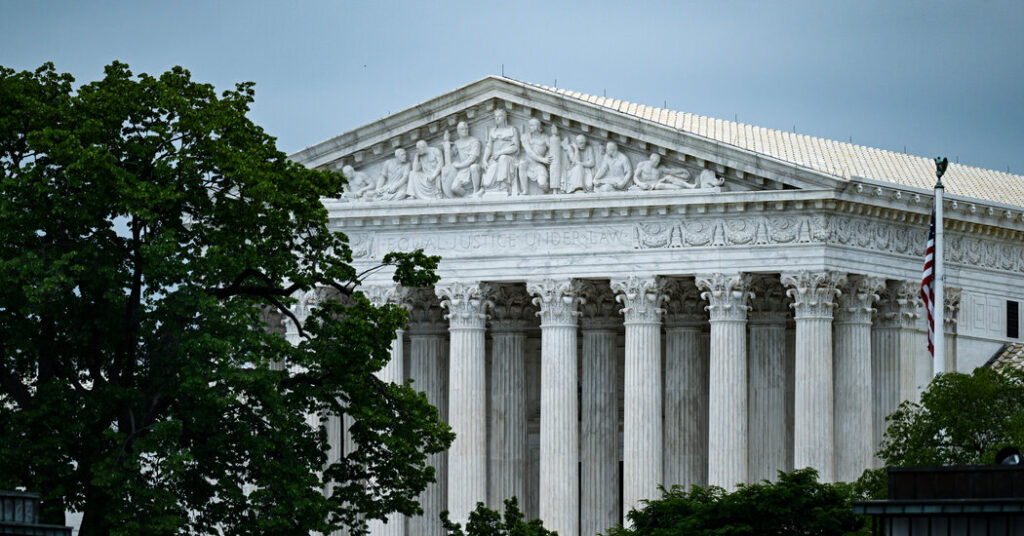
On Wednesday, the Supreme Court strode once again into this fraught territory with a decision that weakened the Voting Rights Act, the law that allowed many Black Southerners to finally participate in American democracy after decades of systemic oppression and exclusion.
At issue was the way in which the courts should determine whether a legislative map is racially discriminatory. Writing for the six-judge conservative majority, Justice Samuel A. Alito stated that from now on, anyone who wished to challenge a map on such grounds must show proof that the map makers had “intentionally” drawn legislative districts to disadvantage a given racial group.
In a blistering dissent, Justice Elena Kagan, writing for the liberal minority, argued that under the ruling, a plaintiff would have to show “that the legislators were ‘motivated by a discriminatory purpose,’” which was contrary to the “clear text and design” of the Voting Rights Act.
Congress has long known, she wrote, that trying to find smoking-gun evidence of racist motives is “well-nigh impossible.”
Indeed, such proof may be harder than ever to find. For Gerald A. Griggs, a civil rights lawyer in Georgia, the old measures of racism — some stomach-turning tally of crosses burned, of people lynched — does not apply so much anymore. Mr. Griggs, who is Black, said that subtler discriminatory forces have “gotten into the system and corroded the arteries of the system,” and will require particularly nuanced legal challenges to “ferret out.”
“What we’re dealing with now is less overt racism,” said Mr. Griggs, a past president of the Georgia N.A.A.C.P.
Some Black Southerners still feel that kind of racism deeply. But proving it in a courtroom is another matter.
The Supreme Court’s requirement that there must be some proof of an intent to discriminate has taken form in other areas of the law — with serious implications in the South and beyond, said Stephen B. Bright, who teaches law at Georgetown and Yale.
Mr. Bright, the former director of the Southern Center for Human Rights, noted that in a closely watched capital punishment case in 1987, the court rejected the appeal of Warren McCleskey, a Black man who had been sentenced to death in Georgia for killing a white person.
Mr. McCleskey’s lawyers presented the court with a study of the state’s justice system showing that a defendant who had been accused of killing a white person in Georgia was four times as likely to receive a death sentence as someone who had killed a Black person. But the court ruled that this was not enough to help Mr. McCleskey. To win his case, the court said, he needed to show that he had been personally subject to discrimination.
The problem of “proving” racial discrimination has also bedeviled the South when it comes to racially lopsided juries, Mr. Bright said. In a 1986 case, Batson v. Kentucky, the Supreme Court established that a judge must find “purposeful discrimination” to determine that racial discrimination had been present in the jury selection process.
“You have to prove that the prosecutor, in using peremptory strikes, intentionally discriminated,” Mr. Bright said. “You can’t possibly know that unless the prosecutor tells you.”
This is one reason, he said, that all-white juries remain common in many parts of the South — “even in places with very substantial African-American populations.”
The Supreme Court’s ruling on Wednesday nullified a majority-Black congressional district in Louisiana, one of two in the state. The district, long and intermittently bulbous, had been created by state lawmakers who felt pressured by the courts to draw a map that carved out two districts with a majority of Black voters, in order to meet the requirements of the Voting Rights Act.
Justice Alito, writing the decision, made the case that the South had come a long way since 1965, particularly on Black voter participation, an assertion that is highly contested.
“Black voters now participate in elections at similar rates as the rest of the electorate, even turning out at higher rates than white voters in two of the five most recent presidential elections nationwide and in Louisiana,” he wrote.
Some conservative African Americans this week welcomed the ruling, viewing it a fitting response to real racial progress in the United States. To them, the Voting Rights Act, which often forced state legislatures to draw majority-minority districts around the country, had merely put Black Americans into archaic race-based boxes.
Among those approving of the ruling was Josh Williams, a Republican state representative of a majority-white district in Ohio.
“The idea that Black Americans need special districts carved out just for them is complete nonsense,” Mr. Williams posted on social media this week, noting that he was currently running for Congress in a district that is also majority-white. “It’s a violation of the law and blatantly unconstitutional.”
Wednesday’s ruling is of a piece with the Supreme Court’s decisions to move to what some justices have called a “colorblind Constitution.” In 2023, the court effectively ended affirmative action in college admissions, with Chief Justice John G. Roberts Jr. writing, “eliminating racial discrimination means eliminating all of it.”
The second Trump administration, meanwhile, has used its executive power to try to eliminate diversity, equity and inclusion programs in the public and private sectors.
The stakes in the voting-rights case, Louisiana v. Callais, are arguably bigger, potentially reconfiguring the very architecture of national political power just as a polarized country is barreling toward the midterm elections. Some states are already considering whether to redraw their maps.
The ghosts of the past still inform Southern politics at the most elemental level. Decades ago, many Black voters migrated from the Republican Party, the party of Abraham Lincoln, to the Democratic Party, impressed by Franklin D. Roosevelt’s New Deal and Lyndon B. Johnson’s campaign to usher in a new era of civil rights. Today, many Black Southerners are committed Democrats.
Many white Southerners were coaxed away from the Democratic Party, starting in the 1960s, thanks in part to a Republican “Southern strategy” that exploited their resentment over Mr. Johnson’s push for civil rights and desegregation. Today, many white Southerners are committed Republicans.
In today’s redistricting efforts, it has been a struggle, at times, to tease out whether a redrawn electoral map is a result of partisanship or old-fashioned racism. Complicating matters is the fact that the Supreme Court, in 2019, ruled that federal judges have no power to hear challenges to gerrymanders carried out purely for partisan advantage.
Stephen Menendian, an academic researcher at the University of California, Berkeley, has described the mess as “the problem of entanglement.” In a 2023 law review article, he warned of a big risk: “that unconstitutional racial gerrymanders will escape judicial review under the cover of partisanship.”
The court’s conservative majority sees it the opposite way. In the opinion, Justice Alito wrote that plaintiffs could challenge a partisan gerrymander by claiming it is actually a racial gerrymander. Mr. Alito warned that litigants should not be able to get around the rules “by dressing their political-gerrymandering claims in racial garb.”
Quin Hillyer, a white conservative opinion writer who lives in Alabama, believes that these days, Republican map makers would welcome any Black voters into a district if it would bolster their party’s strength.
“If there were an enclave, or a neighborhood, that was 100 percent Black, but that voted 80 percent Republican,” he said, “I think that the white Republicans would gladly take those people.”
Richard Fausset, a Times reporter based in Atlanta, writes about the American South, focusing on politics, culture, race, poverty and criminal justice.
The post Behind Voting Rights Case, a Clash Over the Reality of Racism appeared first on New York Times.