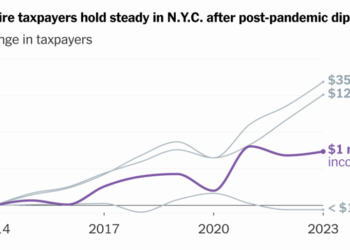
The prongs of the K-shaped economy are being propped up by two dreary economic realities: lower earners are getting hit harder by inflation, and left behind by blockbuster stock market gains.
A new analysis from the Federal Reserve Bank of New York looks at how the US economy slowly morphed into a K-shape where higher earners are thriving, or at least holding steady, and lower earners’ economic fortunes are backsliding. It’s a post-pandemic development, after a robust labor market and pandemic-era stimulus bolstered the economy’s lowest earners. As inflation surges again and the stock market continues its roller coaster ride to the top, lower earners probably won’t be working their way up the K anytime soon.
As lower earners started to see their wages grow at a higher rate in the wake of the pandemic, higher prices were lurking in the shadows, ready to take a bite out of those increases.
“We see that beginning in late 2022, low-income households consistently faced higher inflation than middle- and high-income households did,” NY Federal Reserve researchers Rajashri Chakrabarti, Thu Pham, Beck Pierce, and Maxim L. Pinkovskiy, wrote. “Specifically, the lowest-income households have experienced inflation above the national average, restraining their spending.”
window.addEventListener(“message”,function(a){if(void 0!==a.data[“datawrapper-height”]){var e=document.querySelectorAll(“iframe”);for(var t in a.data[“datawrapper-height”])for(var r,i=0;r=e[i];i++)if(r.contentWindow===a.source){var d=a.data[“datawrapper-height”][t]+”px”;r.style.height=d}}});
Oil shocks and disruptions to traffic through the Strait of Hormuz have erased recent progress on inflation, pushing it to its highest rate since May 2024 in March. Gas prices rose 18.9% year over year in March, the largest increase since August 2022.
Lower earners tend to allocate more of their spending toward gas than the top; Bureau of Labor Statistics data showed 3.5% of spending was on gas in 2024 for the lowest 10% of consumer units by income, compared to 1.9% for the highest 10%.
A report from the Bank of America Institute said “higher gasoline prices are stretching household budgets,” but affecting lower-income households the most.
“Some consumers can cushion higher fuel costs through wage growth or increased use of credit, but this flexibility is more limited for lower-income households, which have the most stretched credit card utilization rates relative to 2019,” the report said.
Boosting the top end of the K is the rip-roaring stock market. The S&P 500 has nearly doubled since the start of 2023. Higher earners tend to hold a higher share of financial assets than lower earners, helping their financial fortunes and net worths balloon.
There’s a distinct K-shaped pattern in real net worth, which measures consumers’ assets and wealth minus their debts. The New York Fed report found that the top 1% of earners saw their real net worth grow by 30% since 2023, while the bottom 20% saw just 13% growth, although that was slightly better than the middle 40%. That’s likely powered by blockbuster — and uneven — gains in financial assets, which include holdings like equity, bonds, or crypto.
window.addEventListener(“message”,function(a){if(void 0!==a.data[“datawrapper-height”]){var e=document.querySelectorAll(“iframe”);for(var t in a.data[“datawrapper-height”])for(var r,i=0;r=e[i];i++)if(r.contentWindow===a.source){var d=a.data[“datawrapper-height”][t]+”px”;r.style.height=d}}});
All told, the K-shape hasn’t necessarily worsened in 2026 — everyone is spending less and feeling the pinch a bit more. Instead, it’s in a holding pattern, rather than recoiling: We’re in a K freeze, and that’s still a disadvantage for the lowest earners in America.
Read the original article on Business Insider
The post Two grim realities are keeping the K-shaped economy alive appeared first on Business Insider.