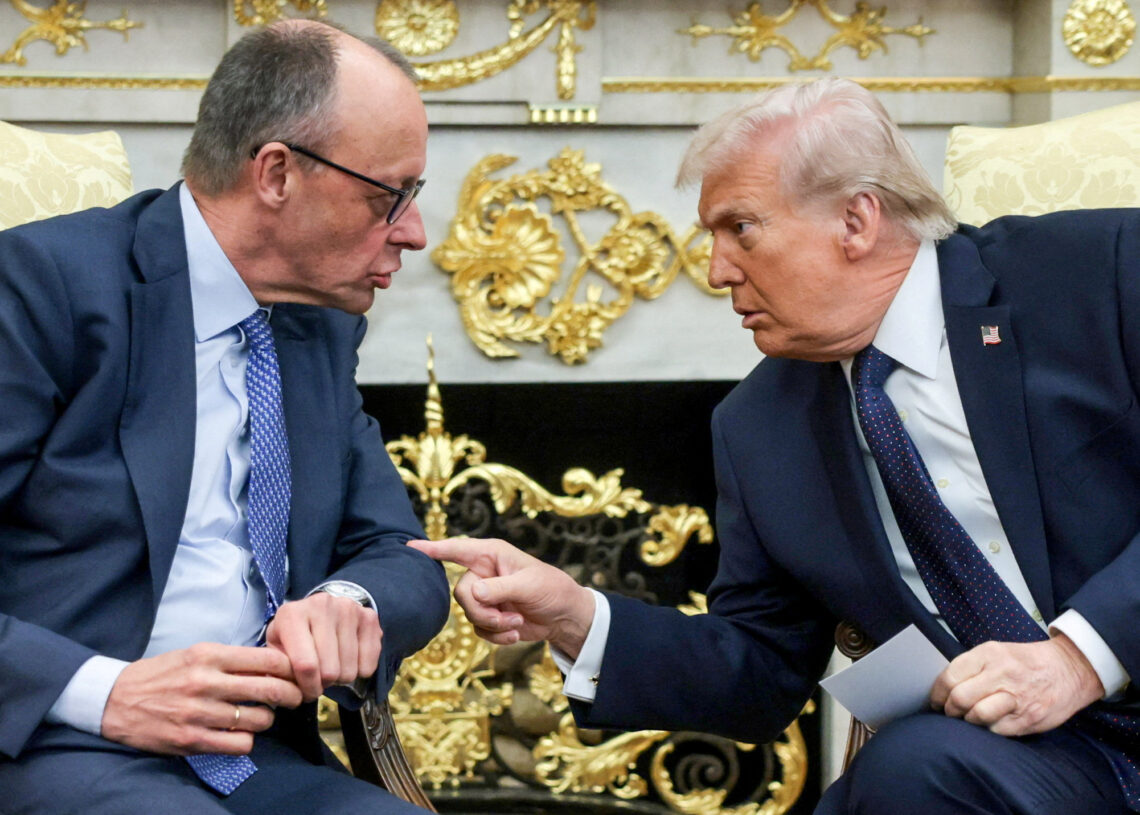
The Pentagon said that it is withdrawing about 5,000 troops from Germany amid a feud between President Donald Trump and Chancellor Friedrich Merz over the U.S. war in Iran. Germany’s defense minister described the move as “anticipated” and said Europe needs to take more responsibility for its own security.
The Pentagon’s chief spokesman, Sean Parnell, announced the move in a statement Friday and said it follows a “thorough review” of the military’s force posture in Europe. “We expect the withdrawal to be completed over the next six to twelve months,” Parnell said.
Earlier this week, Trump posted on social media that the administration was reviewing its military presence in Germany — headquarters to U.S. European Command and U.S. Africa Command — and would make a final decision on any changes shortly.
On Saturday, German Defense Minister Boris Pistorius said the U.S. decision was not a surprise. “It was anticipated that the U.S. might withdraw troops from Europe, including Germany,” he said, adding that there are nearly 40,000 U.S. troops stationed in the country in places such as Frankfurt and the Ramstein Air Base.
“The presence of American troops in Europe, particularly in Germany, serves the interests of both the U.S. and ourselves,” Pistorius said. “One thing is clear: if we are to remain transatlantic, we must strengthen the European pillar within NATO … Germany is on track.”
The president has in recent weeks berated several European allies, including Germany, for what he calls their inadequate support for the war in Iran, which the United States and Israel launched in late February.
Merz has sought a close relationship with Trump, enduring some domestic blowback given the president’s unpopularity with German voters. But the chancellor went off-script Monday while speaking to German high-schoolers, saying that Iranian leaders had “humiliated” the United States.
The Americans “quite obviously went into this war in Iran without any strategy whatsoever,” Merz told the students. “Especially since the Iranians are obviously very skilled at negotiating, or rather, very skilled at not negotiating,” he said.
NATO spokesperson Allison Hart said the organization was working with the U.S. to understand the details of the change. “This adjustment underscores the need for Europe to invest more in defense,” she said in a statement Saturday. “We remain confident in our ability to provide for our deterrence and defense as this shift toward a stronger Europe in a stronger NATO continues.”
The White House referred a request for comment to the Pentagon.
A senior Defense Department official, speaking on the condition of anonymity under ground rules set by the administration, called Merz’s remarks “inappropriate and unhelpful.” The planned withdrawal of forces, this official said, is consistent with the Trump administration’s desire to shift attention away from Europe and toward priorities in the Western Hemisphere and Indo-Pacific region.
“We’ve urged them to take a practical, businesslike approach to building a Europe-led NATO,” the official said. “They didn’t take that advice, and this is the result.”
Friday’s announcement will affect an Army brigade combat team already deployed inside the country, a long-range fires battalion set to arrive later this year and potentially more troops, the senior Defense Department official said.
Officials have not specified how many U.S. troops would remain in Germany, or elsewhere in Europe, once the 5,000 personnel are withdrawn. Tens of thousands of service members are deployed at bases throughout the continent.
Removing the units will return America’s force posture there to levels unseen in Europe since Russia’s full-scale invasion of Ukraine began in 2022 — after which the Biden administration surged forces to the continent in an effort to deter further attacks from the Kremlin.
The change is likely to spur criticism from some lawmakers in Congress, who required the administration to submit a detailed plan before lowering the number of U.S. military personnel in Europe below 76,000. Last fall, when the Pentagon withdrew a brigade from Romania, the Republican chairmen of the House and Senate Armed Services committees issued a rare joint statement opposing the decision.
“We will not accept significant changes to our warfighting structure that are made without a rigorous interagency process,” Sen. Roger Wicker (R-Mississippi) and Rep. Mike D. Rogers (R-Alabama) wrote at the time.
It was not immediately clear whether the withdrawal announced Friday would pass the threshold lawmakers required in law.
In a statement Friday, Sen. Jack Reed (Rhode Island), the top Democrat on the Senate Armed Services Committee, called on Trump to reverse the decision.
“Weakening our military footprint in Europe at a time when Russian forces continue to mercilessly attack Ukraine and harass our NATO allies is a priceless gift to [Russian President] Vladimir Putin and suggests American commitments to our allies are dependent on the president’s mood,” Reed said.
German officials had been encouraged by praise from U.S. counterparts for Berlin’s first-ever military strategy that envisions the country becoming the strongest conventional fighting force in Europe by 2039.
Germany’s top military officer, Gen. Carsten Breuer, visited Washington last week where he discussed the strategy with senior Trump administration officials. “What I have seen was a great appreciation of the military strategy and the way we are doing it,” Breuer told reporters Wednesday.
He added that it was clear European countries needed to shoulder a greater burden within NATO, calling for a “transparent road map to make clear who’s taking over what responsibility and what can be taken over by others to what point in time.” The understanding, Breuer said, “is on both sides.”
The post Pentagon says it will downsize U.S. military presence in Germany appeared first on Washington Post.