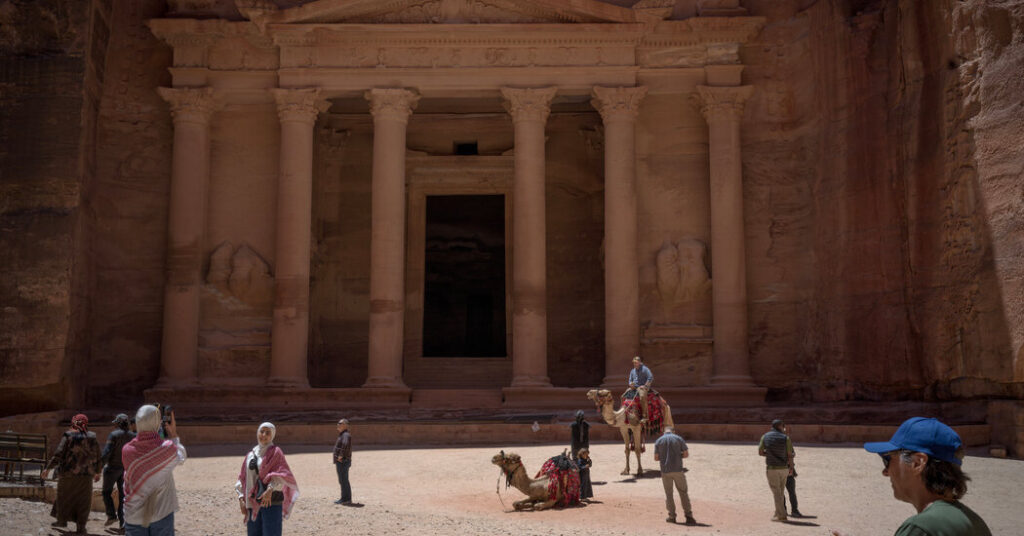
In a normal year, Alyan and Sharhan, the pair of camels that greet visitors as they enter Jordan’s ancient city of Petra, would have little rest. Usually, tourist after tourist climbs on their backs to be photographed in front of the 2,000-year-old Treasury building.
With war engulfing the Middle East for the past two months, tourism in Jordan has now dried up at some sites. The camels have spent much of their time lazing in the sand. Occasionally, one flops on his side for a quick nap.
For the camel owners, this period has been much more stressful — a reminder of just how fragile the country’s tourism industry is, especially when its neighbors are at war and its airspace becomes a transit route for missiles and rockets.
“It’s 1 percent of what it was,” Hussein al-Budool, one of the camel keepers, said of tourism to Petra lately. He came to Petra, a UNESCO World Heritage site in southwest Jordan, every day throughout March and April, even though tourism had slowed to a trickle and did not pick up after a cease-fire took effect early last month.
“Tourism is like a fish in the water,” Mr. al-Budool, 38, added. “Every ripple affects it.” He was dressed in traditional Bedouin garb because tourists often ask to take photos with him.
When the United States and Israel attacked Iran in late February, Jordan’s high season for tourism season was just getting underway. It starts when the weather begins to warm but before blazing summer temperatures.
Though Jordan stayed mostly on the periphery during the five-week conflict in the Middle East, Iran retaliated against many U.S. regional allies, firing nearly 300 missiles and drones toward Jordan. The country cooperates closely with the United States militarily and has one of the Arab world’s only longstanding peace treaties with Israel. It also hosts an important hub for the U.S. Air Force at Muwaffaq Salti Air Base.
Most of those missiles and drones were intercepted, but they had an immediate chilling effect on tourism.
In March, visitor arrivals from Europe dropped 27 percent compared with the same period last year, a figure that was already depressed as a result of the war in Gaza, according to the government. More than 6,000 flights were canceled in March and April, the government said.
Despite Jordan’s repeated public assurances about its safety, uncertainty in the region means tourism numbers are not expected to recover before the end of the high season. Several international airlines have suspended flights until the fall, and tour operators have canceled trips through the end of May.
“The crisis is not over,” said Yazan Mahadin, commissioner of the Petra archaeological park and tourism affairs, “because no one knows what’s going to happen.” Of the local population of about 40,000 people, he said, about 85 percent depend on tourism.
In 2022, the last normal tourist year, Jordan had recovered from a Covid slump and had a million visitors to Petra, he said. But in late 2023, after the start of the war in Gaza, tourist numbers for the site dropped about 70 percent. Airlines cut flights, visitors canceled hotel and tour bookings and the most popular tourism sites like Petra were nearly deserted. Visits had just begun to recover at the start of this year when the United States and Israel attacked Iran.
“The war began on Saturday. By Monday, we had 100 percent cancellations,” Mr. Mahadin said from his office recently. On the wall to his right hung a large map of Petra’s 27 archaeological trails.
Jordan’s government relies on tourism for up to 18 percent of its revenue. The drop in visitors, as well as other impacts of the war, such as higher fuel prices, have ripple effects throughout the economy.
The country imports 95 percent of its fuel, and the higher oil prices cost the government an additional $200 million in March alone, said Mohammad al-Momani, a government spokesman. To offset budgetary deficits, government ministries and institutions were ordered to restrict the use of vehicles and to reduce lighting and air-conditioning.
Jordan has long been a relative oasis of stability and calm in a turbulent neighborhood. But “the whole world sees the region as a region at war” and does not understand that Jordan is different, Mr. al-Momani said. “That’s one of the challenges that we continue to face. Jordan was indeed safe, but no one could see that easily.”
One morning last month on the Jordanian side of the Dead Sea, there were no swimmers floating in its salty waters. One couple sat on beach chairs on an otherwise desolate point along the shore.
Normally, predominantly Christian tourists would be packing the region this time of year around Easter. A few miles to the north is said to be the traditional baptism site of Jesus, on the Jordan River.
In Petra, the park commission deferred rent for local shops and restaurants and asked the government and central bank to defer loan payments. No decision on loan deferrals has been made yet, Mr. Mahadin said.
The government did start a campaign, “Our Jordan is Heaven,” to encourage domestic tourism.
And the Petra commission scheduled an electronic music festival at the archaeological site for this month. A similar party last year — the first time such an event was held — was criticized by those who felt it was tarnishing an important historical site. Mr. Mahadin said the event brought in $1.5 million over two days.
Those who work throughout Petra are mostly local residents whose fathers and grandfathers were also in the tourism industry. Now, many of them don’t want their children to follow them into the business.
As the workers spoke, Mishaal, 4, the son of one of the camel keepers, tried to climb on the back of one of the animals, which didn’t flinch. He ran around, a whip used to prod the camels in his hand.
Natalia Yashnk and her friend, tourists from Russia, strolled around one recent day, fending off restaurant and souvenir shop owners hoping for a sale. When the war began, Ms. Yashnk, 46, an economist, planned to cancel the trip.
But the tour operator assured her it was safe.
Their original flight, on April 14, was canceled, and they ended up catching another one three days later.
“Some of our friends said, ‘You’re crazy,’’” she said. “But we are lucky to be here with so few people.”
Raja Abdulrahim reports on the Middle East and is based in Jerusalem.
The post Jordanians Struggle as Mideast Wars Scare Tourists Away appeared first on New York Times.