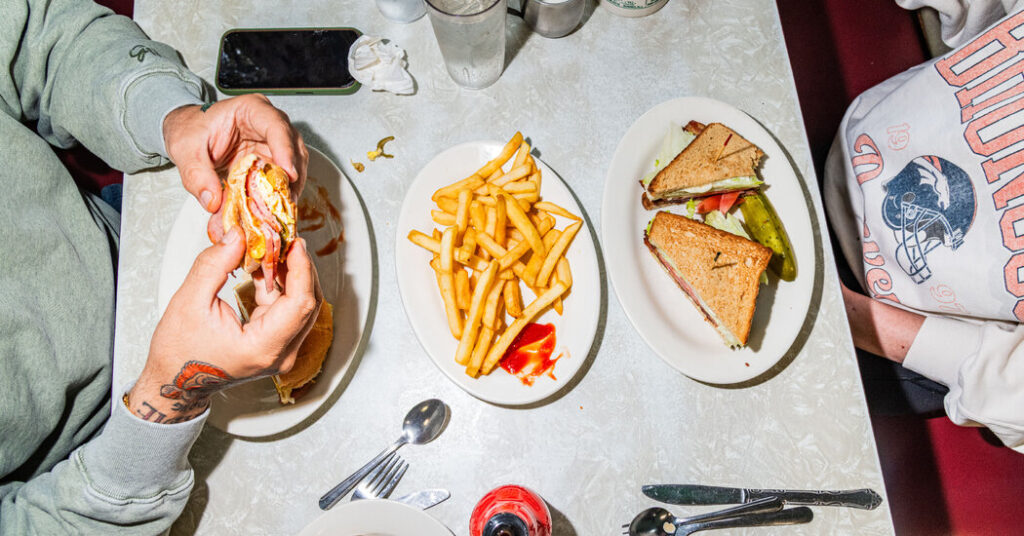
Mary DeLetto, 58, and Lauri Steinberg, 53, are best friends who meet at Summit Diner in North Jersey once a week to catch up. “We walk in and they know — they’re like, ‘Here come the girls,’” Ms. Steinberg said.
“Lauri doesn’t even have to order her order anymore,” Ms. DeLetto said.
Ms. Steinberg confirmed. “I haven’t actually given them my actual order verbally in two years,” she said.
Her order? A spinach and feta scramble — not an omelet — with potatoes so well done they are essentially burned.
This kind of ritual — the friendship, the familiarity, the consistent meals tailored to personal preference — is a staple at diners. But these beloved eateries are in financial trouble — even in New Jersey, the self-proclaimed diner capital of the world.
Many are closing, buried under the weight of geopolitical effects on the economy and the long, Reaper-like grasp of the Covid-19 pandemic. But state lawmakers are trying to stem the tide.
State Senator Paul D. Moriarty and Assemblyman Louis D. Greenwald, both Democrats, have introduced the “Saving Our Diners and Protecting Our Past Act,” more whimsically known as the SODA POP Act.
Under the bill, some diners and family-owned restaurants across New Jersey that have been in continuous operation for 25 years would receive a tax credit of up to $25,000 a year and wouldn’t have to charge sales tax on prepared foods, which is about 7 percent. They would also be designated as “historic,” a marketing move designed to attract more customers, Mr. Moriarty said.
While New Jersey does not specifically track diner closures, it is possible that roughly 100 have closed over the past decade, said Amanda Stone, the vice president of public affairs for the New Jersey Restaurant & Hospitality Association.
Mr. Moriarty said about 500 eateries would qualify for the bill’s benefits, including the vast majority of New Jersey’s diners as well as longtime family-owned restaurants. Mr. Moriarty and Mr. Greenwald hope the bill, which they say has some bipartisan support, will be voted on by June.
“It would be really a shame if these diners just slowly vanished, and we didn’t have these kind of universal places that are part of the DNA of New Jersey,” Mr. Moriarty said.
But what exactly makes a diner, a diner? It’s a complicated question.
Is it a steel-clad exterior, akin to a subway car? Is it Formica counters and red-leather booths? What about steeple-like features reminiscent of a megachurch, this time on houses of worship dedicated to pancakes?
Richard J. S. Gutman, a diner historian who has written four books on the topic, strictly defines diners based on their stainless-steel or colorful porcelain enamel exteriors, and he said he looks for a mom-and-pop place with “good food, good value” that has “been around forever.”
The SODA POP legislation defines a diner as an establishment where customers sit at booths, counters or tables and are served “a wide variety of menu offerings, including but not limited to, hamburgers, salads, sandwiches, soups, breakfast items, entrees, pastries, pies and beverages,” but is not “any cafe, delicatessen, tavern, bar, sandwich shop or other food establishment.”
And while diners might come in all shapes and sizes, for most of them, the pandemic took a toll, said Mr. Greenwald, the assemblyman.
Outdoor dining benefited diners in New Jersey less than it did other restaurants, since many are on main thoroughfares and less suited to outdoor setups, Mr. Greenwald said. After pandemic restrictions lifted, it was difficult to hire staff, and more recently, tariffs imposed by the Trump administration and economic fallout from the war in Iran have caused the price of food to skyrocket, he said.
Ms. Stone, from the restaurant association, said that the group had pushed the lawmakers to expand the bill’s benefits to more restaurants, since many are struggling with the same financial challenges as diners and family-owned restaurants.
“When we saw the first copy of the bill, obviously, our first thought was, ‘Hey, can this benefit all food establishments?’” Ms. Stone said. “But we understand that to give that tax incentive to over 20,000 food establishments would be a significantly greater impact on the state.”
Spiro Hadjiyerou, who owns the Colonial Diner in East Brunswick, N.J., said that “it’s been one thing or another” since the pandemic. While the price of eggs last year was tough to weather, he said, now tomatoes cost over $5 a pound — higher than he could ever remember.
“It’s almost like you want to retire,” he said. “We’ve had enough. We’re mentally, physically, and now we’re getting financially beaten up.”
Jim Greberis, 66, the owner of Summit Diner, said his business, in Summit, N.J., had managed to remain stable throughout Covid and rising prices, mainly because it is small, with only a handful of counter stools and six booths, which fill up quickly most mornings with loyal local patronage.
“My customers are my friends,” he said. “It’s almost like a barbershop: You go in there to confess your sins.”
On a recent Wednesday, when “the girls” were having their weekly meet-up, the diner was filled with other regulars long after the morning rush had subsided.
Patrick Murphy, 25, said he had been coming to Summit Diner from the time he was a baby. During high school, he would even stop there to grab a quick breakfast before heading to class. Christy McCann, 37, said that she stops for breakfast a couple of times a week with her husband, Brennan Shroff, 48, because they love the coffee and the consistency of the food. Ms. McCann said it only took the staff two weeks to memorize their orders.
Memorizing regulars’ orders is a key facet of a diner server’s job, said Karina Henriquez-Dilone, 33, who has worked at Tops Diner in Newark since 2018. Every Wednesday at 3:30 p.m., she said, she can expect Richard Ewers, 75. He gets a decaf coffee, with a refill halfway through, and he needs a salad with whatever he orders to eat. And before he gets water, she brings his coleslaw to the table, so he does not have to ask for it.
“Customers like that, who have been here for years — that’s what makes Tops, Tops,” she said, adding that when she had her daughter last year, many of her regulars brought the baby gifts. “We have a lot of customers that keep coming back.”
New Jersey became the so-called diner capital of the world by building more diners than any other state, according to Mr. Gutman, the historian (who, for the record, was skeptical of the state’s title).
The concept began in Rhode Island, where Walter Scott, a newspaperman, began selling food out of a wagon to his fellow night shift workers, Mr. Gutman said. Those wagons eventually evolved into long, narrow structures made to be moved around — the reason that some resemble trains. Half of the diner-building businesses were located in New Jersey at the industry’s peak, said Mr. Gutman.
“That’s why the diner became an incredible fixture in the landscape,” he said. “And that is really part of the cultural identity of people in New Jersey.”
When Mr. Gutman’s daughter was young, the staff at their local diner would see the Gutmans’ car pull up outside, and the cooks would automatically put a grilled cheese for her on the griddle before the family even walked through the door.
It’s that experience, Mr. Gutman said, that translates all over the world.
“This place is an icon of the American dream, of the work ethic of our culture,” Mr. Gutman said. “This is something that’s good about America.”
Claire Fahy reports on New York City and the surrounding area for The Times.
The post Too Delicious to Die: The Push to Save Old-School Diners appeared first on New York Times.