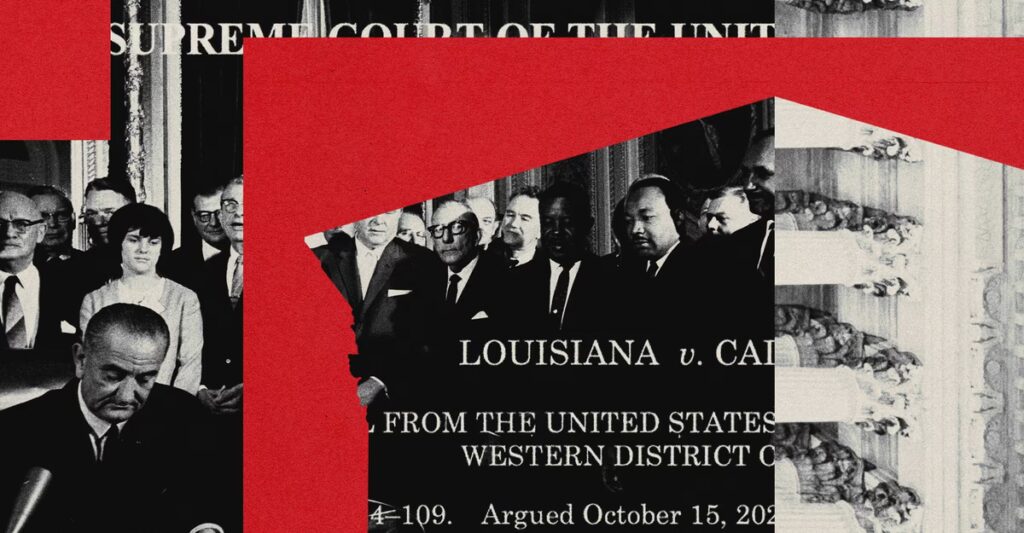
The best things shine bright, but never long. So it was for the Voting Rights Act, the 1965 legislation that protected Black suffrage by neutralizing voter suppression in southern states, and became the foundation for equal ballot access for all Americans. Of the 250 years since the country’s founding, less than a quarter unfolded under the aegis of universal suffrage. Color television, credit cards, and Barbie dolls arrived earlier than the VRA and will survive longer. The reign of Queen Elizabeth II lasted a decade longer than the guarantor of democracy in America.
On Wednesday morning, the Supreme Court’s conservative majority completed its 13-year campaign against the law. In Louisiana v. Callais, the Court limited the use of race in drawing congressional reapportionment plans and the ability of minority groups to challenge potentially discriminatory maps. Writing for the majority, Justice Samuel Alito declared that the only permissible consideration of race in creating new districts is when “present-day intentional racial discrimination regarding voting” can be proved. In doing so, he rejected any practical attempt to remedy past and present racism in redistricting plans.
In the South, voting is intensely polarized along racial lines: White voters generally support the opponents of whomever Black voters support. Gerrymanders that discriminate against Black voters could be justified today as merely offering partisan advantage to Republicans. These and a whole suite of other facially race-neutral changes to voting procedures could be used in southern states to hamper Black representation. The VRA and subsequent case law acknowledged this problem, and recognized that the only practical remedies would have to factor in race.
[Adam Serwer: Voters can be disenfranchised now]
Like previous VRA-related decisions, Callais was “narrow,” in that it did not strike down the law itself. But although the edifice built at great expense—by Fannie Lou Hamer, by John Lewis, by the bloodied limbs of Mississippi sharecroppers and Alabama marchers—has not been entirely bulldozed, only the facade remains. The VRA has not been dealt a “blow”; the decision did not merely defang it. The law is dead, and no matter what happens in the coming elections, politics in America has been forever changed. For most of the nation’s history, the former Confederate states have worked hard to minimize the political influence of Black residents in particular. Now they have full cover to do so again.
The Callais ruling is a sequel to a 2022 case, Robinson v. Landry, in which Black plaintiffs challenged a new congressional map passed by the Republican-controlled Louisiana state legislature. The plan packed Black residents along a corridor from Baton Rouge to New Orleans together into a single district. The remaining lines broke up Black communities elsewhere in the state, and no other district came close to a Black majority. Louisiana has six House members. One third of the state’s residents are Black. The plaintiffs in Robinson successfully argued that this constituted an illegal gerrymander, because it essentially halved Black Louisianians’ voting strength.
The Robinson plaintiffs offered a few maps that guaranteed more Black voting strength, but the plan that was accepted in court was ultimately one drawn by the state’s Republicans, including Governor Jeff Landry, a MAGA stalwart. It created a second Black-majority district by connecting predominantly Black neighborhoods from Baton Rouge to Shreveport—a concession to the court’s ruling that still protected most Republican incumbents, including House Speaker Mike Johnson, from challenges in general elections. But that new map was then challenged by a diffuse group of “non–African American” voters, who claimed that it was an unlawful gerrymander that violated the Constitution by considering race. As the resulting Callais lawsuit rumbled through federal courts, Black voters and civil-rights groups found themselves defending a Republican-drawn map.
Over the past decade, the Supreme Court has given state governments more and more latitude to manipulate maps for political ends. In 2019, the Supreme Court decided that it simply does not have the authority to rule against partisan gerrymandering, so long as lawmakers did not explicitly seek to discriminate on the basis of race.
Until Callais, efforts under the Voting Rights Act to create remedies for racism in reapportionment still took account of race. After the 1970 census, southern lawmakers seeking to dilute the electoral power of Black voters who’d gained the franchise in the 1960s decided to split Black-majority areas into districts where they would be outvoted by conservative whites. In response, Congress in 1982 amended the VRA to create an “effects test,” whereby courts and the DOJ could strike down maps that resulted in racial dilution, even if intent to do so could not be conclusively shown.
Many of the home districts of the longest-serving and most influential Black congresspeople are so-called VRA districts, which states drew under federal supervision specifically to grant Black voters the opportunity to elect representatives of their choice. This system was based on a totality of circumstances—the obvious presence of open bigotry, yes, but also the unmistakable fact that Jim Crow laws and customs had been cast in ostensibly race-neutral language, so as not to run afoul of the Equal Protection Clause of the Fourteenth Amendment or the entirety of the Fifteenth Amendment.
Alito’s ruling in Callais simply waves away that context as irrelevant and takes America back to the willful obtuseness of the Court during the Plessy v. Ferguson days, when in 1896 a blithe Justice Henry Billings Brown wrote that “separate but equal” facilities for Black and white Americans were lawful under the Fourteenth Amendment, despite the plain evidence that segregation was intended to create tiers of citizenship.
Alito follows the path created by Chief Justice John Roberts in 2013. In Shelby County v. Holder, Roberts did not per se erase the VRA’s preclearance protocol, whereby states and counties with a history of racial discrimination needed permission from the Justice Department or federal court to change their voting rules; instead, the chief justice ruled that the formula determining which jurisdictions had to seek advance approval were out of date: The widespread presence of Black elected officials and Black voting in the present day meant that the discrimination in the states and counties covered by the law was no longer as dire. Likewise, Alito, in hollowing out the very provision that made those elected officials so commonplace, cites the difficulty of identifying intentional discrimination as proof that things in America have changed. He technically argues that discrimination is still a problem, but he sets an almost impossibly high bar for proving it.
Since 2013, many civil-rights advocates have held out hope that the VRA might still have some force. Perhaps clever legal strategies might find ways to meet the justices’ new standards, or perhaps experts might come up with new metrics to mathematically prove discrimination, even when intent is vague. Perhaps, as more and more people on the right echo white-supremacist rhetoric, some lawmakers might actually just start saying the thing out loud, and the courts will have to act.
But that optimism now veers into naivete. Through some careful engineering, Roberts, Alito, and their allies have created a trap for voting-rights cases. In the example of redistricting, the perverse logic is clear: If partisan gerrymandering is legal even when partisanship is a solid proxy for race, and if considering race is impermissible in most cases, then addressing disparities or historical discrimination may become not only difficult in practice but generally illegal. More broadly, this same chain of logic turns the Voting Rights Act into a zombie law, a perversion of its intended purpose that now mostly protects white Americans from any attempts to break their disproportionate control of voting machinery.
Justices on both sides of the decision agree that what’s left now is a Voting Rights Act in name only. In his concurrence in Callais, a satisfied Justice Clarence Thomas wrote that although the decision does not outright demolish Section 2—the provision of the law that allows voters to challenge voting laws, including redistricting, on the basis of racial discrimination—it should still “largely put an end to this ‘disastrous misadventure’ in voting-rights jurisprudence.” Writing for the dissenters, Justice Elena Kagan said that “today’s decision renders Section 2 all but a dead letter.” Kagan wrote that the decision was the culmination of “the majority’s now-completed demolition of the Voting Rights Act.”
Many Americans of all political stripes take for granted what a remarkable time the past six decades have been. Much of what passes for conventional wisdom in political science is a recent product, only made possible by the Voting Rights Act. America now prides itself on a relatively low level of political violence—but this was simply not the case when men and women were lynched for registering to vote. Access to the polls has never been adequate across the board, but the relative ease that many people have in participating in politics is a recent invention, based on the VRA.
These structural changes gave us a country where a sense of possibility has been the norm. Indeed, if you are an American, you have likely known people who were subjected to poll taxes or literacy tests, and who lived to vote for a Black president. My grandmother, now in her early 80s, was a grown woman by the time Freedom Summer came to her hometown of Greenwood, Mississippi, and was a mother by the time of the Voting Rights Act. My own generation of Black Americans was the first to grow up under the fully empowered VRA, when politics could be a reasonable, unexceptional ambition for people like us. The Congressional Black Caucus, which did not exist until 1971, now has more than 60 members.
[David Daley: John Roberts’s dream is finally coming true]
Those numbers will change first. Starting with Louisiana, many states with Republican majorities will revisit their old VRA-compliant maps, and will likely gerrymander out majority-Black districts, as soon as this year. Under an authority meant for state emergencies, Landry has already suspended this month’s congressional primaries in order to implement a new map. The next domino might be Alabama, where Governor Kay Ivey has called a special legislative session to redraw the state’s maps less than three weeks before its primaries. In Tennessee, Georgia, South Carolina, and Mississippi, GOP politicians publicly called for special legislative sessions to redraw maps after Callais. Although the changes might not happen this year, it’s all mostly just a matter of time and will. As Kagan writes, districts that survive will “exist only on sufferance, and probably not for long.” Per the current majority understanding of the husk of the Voting Rights Act, any efforts to remedy that sudden decline will be unlawful. The expectation of even a modicum of diversity within the halls of government could disappear quickly.
But representation in Congress was never the ultimate goal of the VRA, nor will that be the primary problem the country faces after its fall. The point of the Voting Rights Act, as stated by Lyndon B. Johnson, the president who signed it into law, was to force the opponents of liberty to “open the gates to opportunity” to all Americans. Voting rights were, to him, a matter of the “dignity of man and the destiny of democracy,” and the law itself was meant to be a proactive guarantor of that destiny. Without it, no American should consider their dignity to be secure.
This is something that Black voting-rights advocates, from Frederick Douglass to Kwame Ture, long understood; that no person’s rights could really be inalienable if any person’s rights were trampled. The Voting Rights Act was the true instantiation of the Declaration of Independence. For centuries, Black people fought for the ballot, not just to have a say in their government, but to demonstrate their own value, both to themselves and to others. And, for a while, they succeeded.
The post A Requiem for the Voting Rights Act appeared first on The Atlantic.