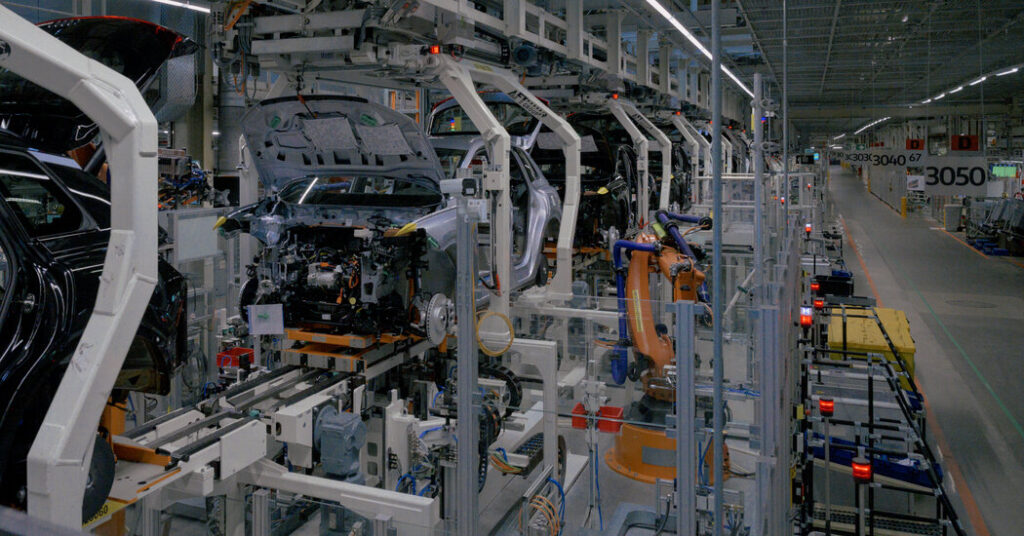
President Trump said Friday that he planned to increase tariffs on European cars and trucks because the European Union was not complying with a trade deal agreed to with the United States.
Mr. Trump said the tariff would increase to 25 percent beginning next week. The United States had lowered auto tariffs for the European Union to 15 percent as part of a trade deal between the governments, but U.S. officials have complained that the European Union isn’t moving fast enough to put it in place.
In February, the Supreme Court curtailed the president’s use of tariffs, saying that he had exceeded his authority in using an emergency law to impose tariffs. But the tariffs on European cars were issued under a separate, national security-related law, Section 232 of the Trade Act of 1964, and are not affected by the Supreme Court ruling.
“The European Union is not complying with our fully agreed to Trade Deal,” the president said a post on Truth Social.
A higher tariff on cars could be devastating to European automakers, which would face more barriers selling in the United States than car manufacturers in Japan, South Korea and Mexico.
The European Commission, the executive arm of the European Union, did not immediately respond to a request for comment.
The European Union has moved toward completing its trade deal with the United States in recent weeks, pushing it through a key stage in the European Parliament. But it still needs to pass through final negotiations before taking effect.
Mr. Trump’s planned tariffs could blow up that fragile process.
“If Trump’s Truth Social is taken at face value, that will mean that the agreement is not going to hold,” said Mujtaba Rahman, managing director for Europe at the Eurasia Group. “This would be a clear violation of the understanding that the two sides had come to. It would suggest we’re at the risk of a very serious trade war starting next week.”
Mr. Rahman noted that the European Union already had retaliatory tariff options drawn up, and that it could enact those in response.
This is not the only trade change Mr. Trump has unveiled in recent days. On Thursday, after meeting with King Charles III of England, Mr. Trump said he would also lift U.S. tariffs on Scotch whisky. The president appeared to be referring to a 10 percent tariff he imposed in February, after the Supreme Court struck down other global tariffs he issued last year.
That 10 percent tariff was issued using a legal provision, Section 122 of the Trade Act of 1974, which allows the president to issue tariffs to address balance of payments issues. But Peter Harrell, a visiting scholar at Georgetown, said that Section 122 allowed the president to make exemptions “because of the needs of the United States economy.”
“I did not have ‘tariff reductions as a gift to the king’ on my bingo card,” he said. “I think the whiskey exemption is probably lawful, assuming the entire 122 regime is lawful.”
But for the 27-nation European Union, to which the United Kingdom no longer belongs, the direction of travel is less positive.
Mr. Trump and Ursula von der Leyen, president of the European Commission, struck a trade deal in July in Turnberry, Scotland. The Turnberry deal has caused angst in Europe, where officials see it as unfair to their interests. It grants the United States access to European consumers at low tariffs, while many European exports to the United States face 15 percent levies.
European trade officials have said they were balancing other geopolitical concerns when they struck the deal. Notably, the European Union was trying to keep the United States at the table with support for Ukraine. Europe is also militarily dependent on America, both for protection through NATO and for key technologies.
Still, concerns over the trade deal have slowed its ratification, as have blowups between the United States and its global partners.
Lawmakers suspended work on the deal when Mr. Trump threatened to take over Greenland, which is an autonomous territory of Denmark, an E.U. member. They took another break when the Supreme Court said Mr. Trump’s across-the-board tariffs were unconstitutional, and it was unclear how the Trump administration would react.
And for months, the United States continued to threaten Europe over its digital regulations, which are costly for big American technology companies.
But recently, negotiations toward finally putting the Turnberry deal in place had been chugging along, albeit with some proposed amendments. The European Parliament’s version included a new stipulation that the deal would reverse if the Trump administration reneged and put new tariffs on the European Union.
Mr. Trump’s tariff announcement comes at a moment when trans-Atlantic trade relations had, briefly, looked more settled. The United States and Europe just last week announced an agreement on critical minerals, as both try to develop more secure supply chains.
But tensions have remained.
Mr. Trump pushed Europe to help with the war in Iran, including by reopening the Strait of Hormuz, something European nations resisted. And in recent days, tensions between Germany — a major car producer — and Mr. Trump have ratcheted higher.
Mr. Trump said that he was “studying and reviewing the possible reduction of Troops in Germany,” in what appeared to be retaliation for comments by Germany’s chancellor, Friedrich Merz, that Iran had “humiliated” the United States.
“The question now is how Europe responds,” said Mr. Harrell, the trade expert from Georgetown. “Will Europe offer an offramp, such as speeding up their implementation of the trade deal, or will they retaliate, in which case this could escalate further on both sides?”
Ana Swanson covers trade and international economics for The Times and is based in Washington. She has been a journalist for more than a decade.
The post Trump Threatens Higher Tariffs on European Cars appeared first on New York Times.