By watching their peers, dolphins learn to capture fish in empty conch shells, then ferry the shells up to the water’s surface in order to eat. Octopuses can master experimental tasks by watching their tankmates in the laboratory. Crows follow the cues of others in their flock to attack specific humans who have harassed fellow crows in the past.
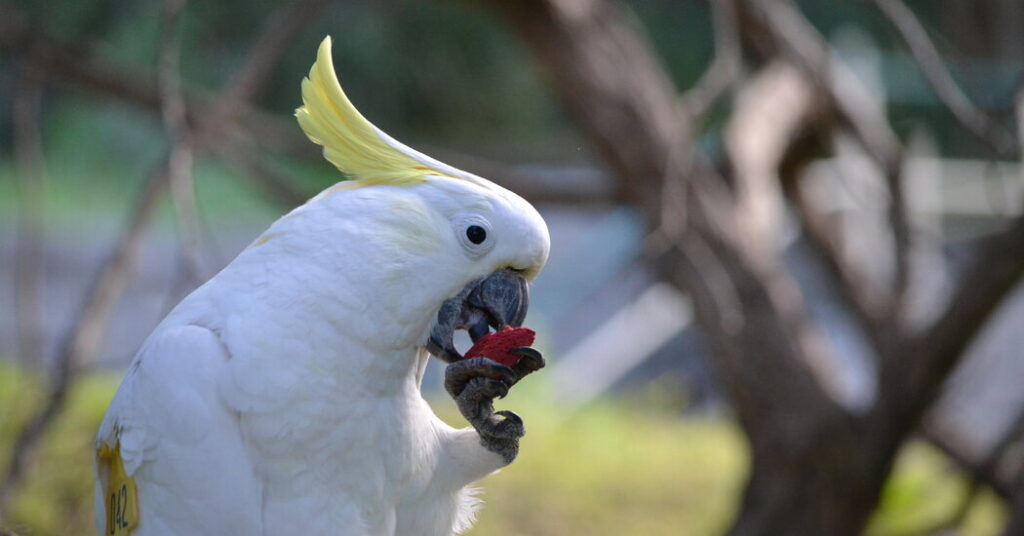
Scientists call it “social learning,” and it essentially means monkey see, monkey do, an adage that turns out to apply to many animals beyond just primates. Now, a study of Australia’s sulfur-crested cockatoos shows that the birds employ social learning to understand whether unfamiliar foods are safe to eat.
In more forested areas of the cockatoos’ native range in Australia, New Guinea, and Indonesia, these mohawked parrots eat plant roots, seeds, fruits and insect larvae. But the birds have learned to thrive in urban environments. “They’re everywhere in Sydney,” said Julia Penndorf, a behavioral ecologist and lead author of the study in PLOS Biology, who encountered the birds as a postdoctoral researcher at the Australian National University in Canberra.
In urban areas, the birds have expanded their diets to include nonnative plants and nuts, including almonds and sunflower seeds people offer to them, and they can be seen prying the lids off garbage bins in order to forage.
“The big issue with urban birds is, they kind of eat everything,” Dr. Penndorf, who now works at the University of Exeter, said. This expanded diet is high-risk, high-reward: the birds have more options for food, but there’s always a chance that strange new snacks might be poisonous.
Dr. Penndorf and her colleagues wondered if the highly intelligent cockatoos might owe their varied urban diets, and, in turn, their takeover of the city of Sydney, to social learning.
The research team devised an experiment in which they observed 705 wild cockatoos roosting in colonies around Sydney. To aid in her observations, Dr. Penndorf gave each bird its own unique markings with nontoxic paint.
“They’re the most cheeky birds I know,” said Dr. Penndorf, who recalls being mobbed by curious cockatoos while attempting to daub them. “All the paint bottles became a playground for cockatoos trying to balance on them, flying away with them. One managed to make a call on my phone because I left it unlocked on the ground.”
Once the birds had been marked, she trained two cockatoo couples to eat almonds whose shells had been painted either red or blue. While the birds initially balked at the colored almonds, they soon learned to open the shells and eat the nuts inside.
The researchers then set out painted almonds at the birds’ roosts. The cockatoos that had been trained to eat colored almonds chowed down, and then, birds that had observed the trained individuals began to try the strange new food. In just ten days, 349 of the 705 birds had learned to eat the painted almonds. The cockatoos also copied one another’s almond-cracking techniques, which spread from roost to roost as individual birds moved across the city.
Dr. Penndorf observed patterns in how the willingness to eat the colored nuts spread: Males followed the lead of other males, while younger birds tended to be more suspicious of the new foods than their elders in the roost.
Theresa Rössler, a researcher at the University of Veterinary Medicine in Vienna who was not involved with the study, said that the cockatoos’ rapid social learning made sense, based on her experience with parrots. “They sometimes are like little kids. They don’t care about something until somebody touches it, and then everybody wants to play with the same thing,” Dr. Rössler said.
Developing a better understanding of how cockatoos interact and learn from each other could play an important role in bird conservation.
“Cockatoos are doing really well, but there are also a lot of parrot species that are actually not doing that well. We have no idea exactly why,” Dr. Penndorf said. By learning about how Sydney’s cockatoos are able to thrive in a world altered by humans, “then maybe we could help other species,” she said.
The post What’s Safe to Eat? Birds of a Feather Learn Together appeared first on New York Times.