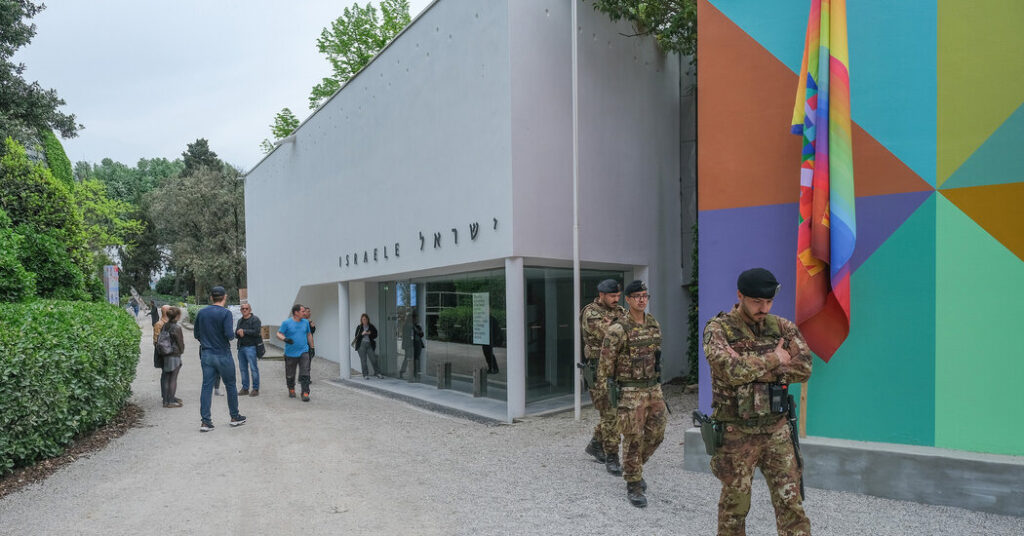
The prize jury for this year’s Venice Biennale, the art world’s most important event, resigned on Thursday — just nine days before the show’s opening — after a furor over its decision to exclude artists from countries accused of crimes against humanity from receiving awards.
In a brief statement posted to eFlux, an art publication, the five-person jury led by Solange Farkas, a Brazilian curator, said simply that it had resigned “in acknowledgment” of its April 23 announcement that it would not give awards to artists from countries whose leaders were being investigated by the International Criminal Court.
The jury did not mention any countries by name in either announcement, but the International Criminal Court has issued an arrest warrant for Prime Minister Benjamin Netanyahu and his former defense minister, Yoav Gallant, on accusations of war crimes for Israel’s actions in Gaza.
The I.C.C. has also issued an arrest warrant for President Vladimir V. Putin of Russia on accusations of war crimes in Ukraine, but the uproar over the ban had centered mostly on Israel.
On Sunday, Israel’s foreign ministry said in a statement on X that excluding Israeli artists had “transformed the Biennale from an open artistic space of free, boundless ideas into a spectacle of false, anti-Israeli political indoctrination.”
Belu-Simion Fainaru, a sculptor who is representing Israel this year, had consulted lawyers about the Biennale jury’s decision. On Wednesday, Italy’s culture minister called Fainaru to express his support for the Israeli artist, according to a news release.
The jury members did not immediately respond to a request for comment on Thursday, but a Biennale spokeswoman acknowledged their resignations in a brief statement.
Fainaru, 66, said in an interview that he was happy that the jury had resigned. “Their decision discriminated against me on a racial basis,” he said.
“I’m an artist and have equal rights and I can’t be judged by belonging to a country or a race,” Fainaru added: “I should just be judged on the quality and message of my art.”
Fainaru said the jury’s initial decision had reminded him of actions taken against his father in Romania during World War II. At that time, Fainaru said, his father was barred from teaching at a university and then sent to a forced-labor camp for three years.
“I didn’t think that discrimination would happen to me or any other artist working in Italy today,” Fainaru said.
Since Israel’s military invaded Gaza after the October 2023 Hamas-led attack, Israel’s presence at the Biennale has stirred controversy. Hundreds of Biennale participants have signed petitions calling on the event’s organizers to exclude Israel. And at the last edition, in 2024, Israel’s representative, Ruth Patir, shuttered her show, saying that she would not open it until “a cease-fire and hostage release agreement” was in place.
Fainaru was born in Romania during the authoritarian rule of Nicolae Ceausescu. He moved to Israel in the 1970s but still maintains ties to his native country, including representing Romania at the Venice Biennale in 2019. He is also one of Israel’s major artists and last year received the Israel Prize, the country’s highest cultural honor.
Fainaru said that much of his career had focused on using art to foster dialogue between Israeli and Arab communities. In 2010, he founded the Mediterranean Biennale, an art event based in Haifa, Israel, which he said had exhibited work by artists from across the Middle East.
In 2015, he co-founded the Arab Museum of Contemporary Art in Sakhnin, a city in northern Israel about 15 miles from the border with Lebanon. Because he is not of Arab descent, Fainaru received some criticism for establishing that museum, but he argued that art should not be restricted by nationality.
Fainaru also teaches at the University of Haifa, where he said that half of his students were Palestinian and that he tried to teach principles of open dialogue.
For the Biennale, Fainaru said he would exhibit “Rose of Nothingness,” an installation that will include a water dripper used to irrigate fields. Its water will pool on the floor, Fainaru said, in part representing the coming together of people from different communities.
Alex Marshall is a Times reporter covering European culture. He is based in London.
The post Venice Biennale Jury Resigns Amid Tension Over Awards Ban appeared first on New York Times.