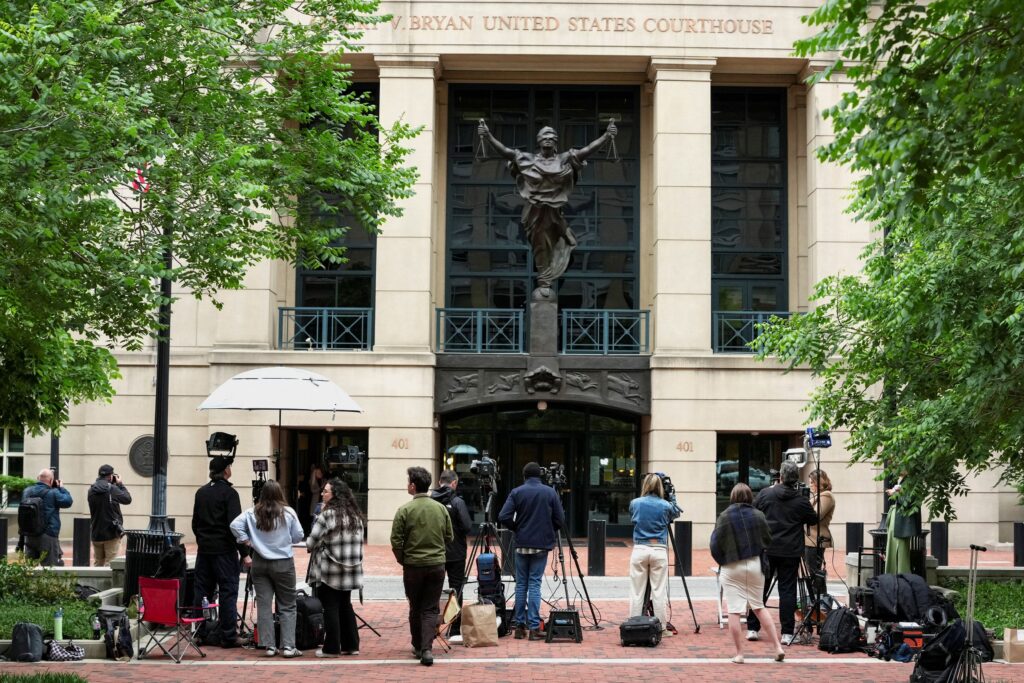
The criminal indictment of former FBI director James B. Comey for allegedly threatening President Donald Trump appears to fall short of a standard articulated by Chief Justice John G. Roberts Jr. in a 2015 opinion, when the Supreme Court pointedly distinguished a genuine threat from mere speech, legal analysts say.
Roberts, along with a majority of the court, ruled in the 2015 case Elonis v. United States that prosecutors seeking to convict someone of sending a dangerous message must prove the person intended to make a violent threat — or at least knew there was a substantial chance it would be viewed as threatening.
Tuesday’s indictment cites a different legal standard, one that does not require an understanding of Comey’s mindset at the time.
The charges focus on a photo that Comey posted last year showing seashells on a beach arranged to spell out “86 47.” Because 86 can signify “to get rid of,” and President Donald Trump is the 47th president, prosecutors say the shells’ arrangement means “a reasonable recipient” would interpret the message as “a serious expression of an intent to do harm” to Trump.
But that language is from an older, lower legal standard, one that the Supreme Court explicitly overruled in the 2015 case. Eight legal experts interviewed for this article said the Comey indictment fails to provide evidence that the former FBI director intended his social media message as a genuine threat to the president.
Under court rules, prosecutors are obligated to shape the language of their charges to conform with the current state of the law.
Mary Anne Franks, a George Washington University professor who specializes in First Amendment law, said the Comey indictment fails to do that.
“It not only should be dismissed outright, it should also mean sanctions for any lawyer who signed off on it,” Franks said. “I cannot think of any possible evidence that would make this particular phrase a threat.”
David Cole, a law professor at Georgetown University, agreed that Comey’s attorneys could ask the court to dismiss the case because prosecutors failed to state a criminal offense.
“The indictment lacks an essential element of a true threat crime — mainly that the speaker intended to threaten violence, or acted in conscious disregard of the substantial risk that their communication would be viewed as threatening,” said Cole, a former national legal director of the American Civil Liberties Union. “They don’t allege any of that in the indictment.”
An attorney for Comey declined to comment.
“Comey will be afforded every right of the due process guaranteed by the Constitution to all American citizens, including challenging the sufficiency of the indictment during pretrial litigation and the evidence supporting the charges at trial,” Justice Department spokeswoman Emily Covington said in a statement.
At a news conference announcing Comey’s indictment Tuesday, acting attorney general Todd Blanche said he understood that prosecutors need to prove intent, and he said they would do so at trial. While such evidence is typically included in an indictment, Blanche said it would be unfair to Comey to reveal the prosecution’s case in the charging documents.
“You prove intent with witnesses, with documents, with the defendants if that’s appropriate,” Blanche said. “That’s how we will prove intent in this case.”
Comey is a longtime political foe of Trump’s who, as FBI director, was involved in investigating Trump’s 2016 campaign’s ties to Russia. Trump fired Comey over his involvement in the probe.
The indictment against Comey landed as the nation’s attention was focused on the genuine perils facing Trump and other political leaders. On Saturday, a man was arrested for bringing a weapon into the gala White House correspondents’ dinner, where Trump was in attendance, with the alleged intent to assassinate the president and members of his Cabinet. The alleged gunman, 31-year-old Cole Tomas Allen, was arrested and charged with multiple crimes, including one count of attempt to assassinate the president.
Comey, who posted the photo of the arrangement in May 2025, removed it after receiving criticism that it could be seen as advocating violence. He has said stumbled upon the “86 47” message as he was walking on the beach, suggesting he didn’t create it himself.
The Justice Department on Tuesday charged the former FBI director with two crimes: one count of making threats against the president and another of transmitting a threat across state lines.
The Supreme Court has spent decades honing the definition of a threat under the statutes that Comey is charged with violating. In 1966, a man named Robert Watts said at a protest that he had received his draft letter, and “if they ever make me carry a rifle, the first man I want to get in my sights is LBJ.”
He was arrested and charged with threatening President Lyndon B. Johnson. But the Supreme Court said that Watts’s statement constituted political speech, not a bona fide threat.
The justices concluded that context matters, and they noted in their opinion that the protesters around Watts laughed after he made his statement, suggesting that they did not view it as a serious. That case set a standard that prosecutors must show that a “reasonable recipient” would view a statement as a threat.
In 2015, the Supreme Court had another chance to define what constitutes a threat and what is speech protected under the Constitution — and they set the threshold even higher.
In the Elonis case, which centered on a Pennsylvania man who made potentially threatening statements online, the justices concluded that the mindset of the person who made the comment must be considered. It is not enough for the subject of a comment to view it as a threat, they ruled; the person who made it must have intended it that way.
Eight years later, in Counterman v. Colorado, the Supreme Court reaffirmed Elonis and tweaked the definition a bit, saying prosecutors could also prove that the person making the statement understood that there was a substantial risk the comment would viewed as threatening.
The charges laid out in the Comey indictment, legal analysts said, do not allege that this threshold was met. Instead, the indictment cites the legal standard laid out in the Supreme Court’s Watts opinion, one it subsequently overturned.
“It’s very hard to see this as anything other than a free speech,” said Kevin Goldberg, vice president and First Amendment expert at the Freedom Forum. “Based on the relevant Supreme Court precedent in this area, I just don’t see how this falls into the unprotected category of true threats. The precedent here sets a very high bar.”
The Justice Department strongly disputes this.
Prosecutors appeared to nod to the higher standard in the indictment, alleging that Comey “knowingly and willingly” threatened the life of the president. But legal analysts interviewed said that language alone does not meet the legal standard set by the Supreme Court.
It is unknown exactly what prosecutors told the grand jury when they presented the Comey indictment in a confidential session, but under established procedures, they would have had to read the entire indictment line by line, and that would have included the outdated legal standards.
Legal experts said prosecutors have an ethical obligation to present grand jurors with an accurate and full description of any statute a suspect is said to have violated, including the courts’ current interpretation of it.
Comey’s lawyers have not said whether they intend to challenge the legal case made in the indictment as based on outdated standards. The defense team could request from prosecutors a bill of particulars, which are intended to provide the defense with more clarifying details about claims in the indictment.
At Comey’s initial appearance in court Wednesday, his defense team signaled it intended to file a vindictive- and selective-prosecution claim, arguing that the Justice Department was illegally prosecuting Comey for his criticism of Trump.
Comey’s defense team raised similar arguments last year, when the Justice Department charged the former FBI director in a separate case alleging he had lied to Congress in 2020 over whether he had leaked investigative information to the media. A judge never ruled on Comey’s motion in that earlier case because the charges were dismissed when she ruled that the U.S. attorney who brought them had been improperly appointed. The Justice Department continues to appeal that decision.
When asked about the latest Comey prosecution, Trump told reporters in the Oval Office on Wednesday that Comey’s post “probably” put his life in danger.
“People like Comey have created a tremendous danger, I think, for politicians and others,” Trump said.
Legal experts said the accusation of contributing to a broader atmosphere of danger, even if true, would not be relevant to the statutes under which Comey was charged.
Robert E. Welsh Jr., a veteran criminal defense attorney in Philadelphia, said that even if the Comey case survives a motion to dismiss, prosecutors would have a challenge in convincing a jury that Comey genuinely meant to hurt the president.
“Then what happens at a trial?” Welsh said. “Under Elonis, the jury will have to determine whether James Comey really expressed an intent to kill the president.”
Jeremy Roebuck contributed to this report.
The post The Comey indictment could be upended by this 2015 Supreme Court precedent appeared first on Washington Post.