Iran and the United States are locked in a faceoff over the future of negotiations, with President Donald Trump and the leadership in Tehran each confident they can outlast the other amid mounting costs to the global economy from the blockage of a crucial shipping waterway.
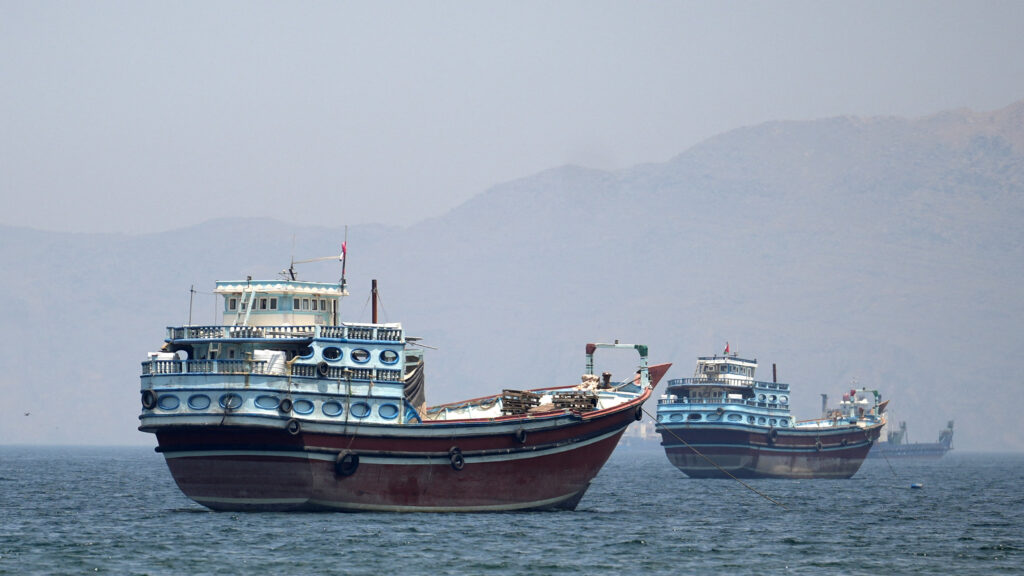
Both sides believe time is on their side as the Strait of Hormuz is closed to shipping traffic, trapping oil, fertilizer and petroleum products inside the Persian Gulf and driving up energy prices worldwide. Oil prices surged to their highest level since 2022, reaching $126 per barrel after Trump said Wednesday that he was prepared to keep up a blockade on Iranian ports until leaders in Tehran “cry uncle,” adding that he was unwilling to strike any bargain that did not restrict Iran’s nuclear program.
Iran’s leadership, meanwhile, has discovered a powerful new weapon it had not tested before the joint U.S.-Israeli attack on Feb. 28 — its ability to grind shipping traffic to a halt using nothing more than drones and mines, low-cost tools that impose high-cost peril on ships that dare to traverse the strait without permission.
Tehran has offered to negotiate over opening the shipping passage first, postponing nuclear talks, an idea Trump says he has ruled out.
The U.S. “blockade is genius,” Trump told reporters in the Oval Office on Wednesday, as he also downplayed the possibility of an early resumption of face-to-face negotiations.
“We’re not flying anymore with 18-hour flights every time we want to see a piece of paper. We’re doing it telephonically, and it’s very nice,” he said. When negotiators fly, “you know they’re going to give you a piece of paper that you don’t like before you even leave. It’s ridiculous. They’ve come a long way. The question is whether or not they’re going to go far enough. So at this moment, there will never be a deal unless they agree that there will be no nuclear weapon.”
That leaves talks on hold, with energy prices skyrocketing. Brent crude oil, the global benchmark, spiked to $126 per barrel — a price not seen since the aftermath of Russia’s 2022 invasion of Ukraine — before falling back to about $121 early Thursday. The average price of gas in the U.S. was $4.30, according to AAA, a nearly four-year high.
There is strong international opposition to Iran’s closing of the strait and its insistence that it has the right to regulate traffic and charge tolls. But while many countries, particularly in Asia, are suffering economic harm, none has offered to help the U.S. military pressure Iran.
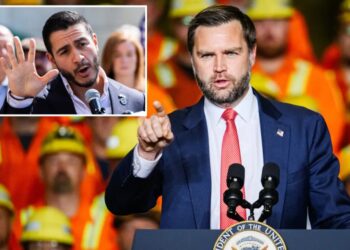
After a first round of talks led by Vice President JD Vance in Islamabad, Pakistan, in early April broke with no agreement, Iran is now pushing for a narrower deal that focuses on ending the war and opening the strait, without addressing the country’s nuclear program.
“U.S. negotiators continue to work towards a deal that will ensure Iran can never possess a nuclear weapon. Thanks to the successful blockade of Iranian ports and crippling impacts of Operation Economic Fury, the United States maintains maximum leverage over the Iranian regime, and progress continues to be made,” White House spokeswoman Anna Kelly said in a statement.
The details of Iran’s offer are unknown. But at a Tuesday meeting of defense ministers of the Shanghai Cooperation Organization — the Eurasian alliance founded by China and Russia — Brig. Gen. Reza Talaei-Nik, Iran’s deputy defense minister, appeared to provide an outline.
Iran, he said, recognizes international concerns about the current restrictions on passage through the strait, which he described as a temporary measure in response to the U.S. and Israeli attacks, according to Iranian media accounts.
“Allowing the smooth transit of commercial ships will be on the agenda after the end of the war,” Talaei-Nik said.
Members of Iran’s security establishment believe they have emerged victorious from the war and don’t support conceding ground on key issues like the nation’s right to enrich uranium, said a senior Iranian official. Iran’s leaders have long said they do not want a nuclear weapon, but they have insisted the country has a right to a civilian nuclear program, including the right to enrich nuclear fuel, which could pave the way for a weapons program.
Negotiators had more room to maneuver on the key issues, including enrichment, during the first round of talks with the United States, but after those talks failed to secure a deal and since the imposition of the U.S. blockade, Iranian officials have yielded to pressure from the country’s military and political hard-liners to deprioritize negotiations with Washington, according to the Iranian official, who spoke on the condition of anonymity because he was not authorized to brief the media.
“The military forces don’t want to lose their achievements,” the official said. “What the United States could gain in those talks, they cannot gain again.”
The official declined to detail the current Iranian negotiating proposal, but said that Parliament Speaker Mohammad Bagher Ghalibaf, the lead Iranian negotiator in the talks with Vance, had arrived in Islamabad for that first round of talks “with full authority” to offer a “trust-building” suspension of nuclear enrichment for not more than five years. It would be “very difficult” for Ghalibaf to make such an offer again, he said.
The official conceded the U.S. blockade of Iranian ports was squeezing Iran’s economy, but said that after decades of surviving heavy sanctions, Iran will find a way to adapt.
“We cannot say that it is not having an impact, but it will not make us surrender,” he said. “We have PhDs in sanctions evasion. We will find a way.”
The result is a painful impasse.
“We just have both sides in a test of wills and a faceoff that is trying to impose as much economic cost on each other’s side,” said Brian Katulis, a senior fellow at the Middle East Institute who focuses on foreign policy in the region. “And the challenge here is that Iran has developed a sort of a hardened resistance to this sort of outside pressure, and the rest of the world has not, especially America.”
Further complicating the situation, weeks of attacks have damaged Tehran’s leadership, Katulis said, but not necessarily in a way that eases dealmaking.
“The reality is that what remains of the regime is probably harder line, more extreme, and also more divided and incapable of coming up with a consensus,” he said. “So Iran has offered some sort of pathway for a continued conversation, and Trump is saying, ‘No, it’s all or nothing.’”
Ordinary Iranians are suffering. Volker Türk, the U.N. High Commissioner for Human Rights, said Wednesday that at least 21 Iranians have been executed and more than 4,000 arrested on national security related charges in Iran since Feb. 28.
The two governments have repeatedly talked at cross purposes, with maximalist demands that have left any hope of successful negotiations at an apparent dead end.
Following the last negotiation round, Trump dismissed the offer Vance had made to the Iranians of a 20-year enrichment moratorium. Days later, the president said that Iran, in indirect, informal communications, had agreed both to give up enrichment and to work “together” with the U.S. to dig up and surrender to the U.S. about 440 pounds of near-weapons-grade highly-enriched uranium buried in underground facilities bombed by the U.S. and Israel last June.
Iran categorically denied it had agreed to either measure.
Trump has denied suggestions, mostly by Democrats, that he is now so eager for the standoff to end that he would settle for something akin to the Obama administration’s 2015 accord with Tehran, which allowed strictly limited, low-level enrichment. Trump labeled the Obama agreement the “worst” deal ever and withdrew from it in 2018 during his first term. That led to Tehran’s move toward ever-higher enrichment.
Rafael Mariano Grossi, director general of the International Atomic Energy Agency, whose inspectors verified compliance with the 2015 agreement, said that deal is no longer possible.
“I don’t think anybody sees it as a point of departure,” he told reporters Wednesday at the United Nations.
“It had its logic 11 years ago. Now … apart from the fact that the United States has rejected it, there are technical reasons for that.” The earlier agreement, he said, “was predicated on a much smaller nuclear program with just one type of centrifuge and a much lower capacity. Now Iran, in the past few years, has had an exponential progress in its programs. … So it’s a completely different ballgame.”
Increasingly defiant Iranian government memes and social media posts have dismissed U.S. claims that the country is near collapse. On Wednesday, the agriculture ministry announced that the country’s stock of goods and food supplies is “even higher than before the war.” At the same time, the state broadcaster noted, “the average price of a gallon of gasoline in the United States is currently $4.17,” slightly below the $4.23 average reported by AAA.
Claiming “total unity” among Iranian civilian and military officials, Ghalibaf said in an audio message broadcast nationwide Wednesday that Trump’s attempts “to weaponize economic pressure and sow internal division,” were designed to “weaken the nation from within or even trigger its collapse.”
“Each and every one of these plots could have brought a nation to its knees,” said Ghalibaf. “But the Iranian people, by the grace of God, have managed to overcome them one by one.”
The next day, Supreme Leader Mojtaba Khamenei released a combative statement on Persian Gulf National Day, promising to protect Iran’s nuclear and missile capabilities. He described the Strait of Hormuz as an asset that has often drawn threats by European and American powers, saying that such aggressors have no place in the Gulf “except in the depths of its waters.”
If the fighting resumes, Iran has “new cards” to play against the U.S., “including in the field of smart targeting” according to Mohammad Akbarzadeh, political deputy of the Islamic Revolutionary Guard Corps navy.
“We do not consider the war to be over. … We have updated our target bank,” Iranian Army spokesman Mohammad Akraminia said.
George reported from Islamabad.
The post Trump, Iran are locked in high-stakes standoff as oil prices hit 4-year high appeared first on Washington Post.