President Trump’s threat on Wednesday to pull American troops out of Germany, following German criticism of the Iran war, might not pack the punch that such threats once did.
That’s because the security relationship between Germany and the United States is not as one-sided as in the past.
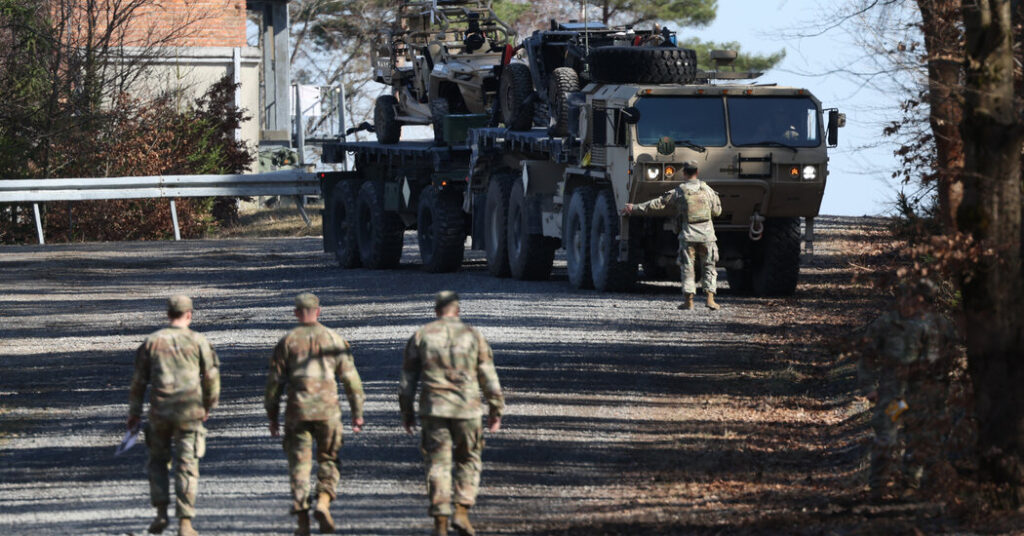
Throughout the Iran conflict, Germany has let military bases on its soil be used to assist American attacks, providing crucial logistical support for Mr. Trump’s war that other European nations have refused to give.
Also, Germany’s military spending has ballooned since Mr. Trump returned to the White House, and it has vowed to create the largest conventional army in Europe, aiming to reduce its dependence on American military protection. That process has proved so successful that a senior Pentagon official recently described Germany as a model for a Europe that takes more responsibility for its own defense.
The menace of Mr. Trump’s warning was also undermined by what happened the last time he made such a threat.
Germany hosts some 35,000 U.S. soldiers, an inheritance of the Cold War. It provides rent-free land for American bases and pays local staff to help the American troops who live there. Most of those troops serve American interests directly — staffing air bases that often send planes to the Middle East, as well as military hospitals that often treat Americans injured on other continents.
In 2020, during his first term, Mr. Trump tried to reduce that military presence, announcing plans to pull 12,000 troops from Germany. He called the country “delinquent” in its military spending levels, for failing to match the agreed-upon goal for NATO members.
Congress blocked the move. Mr. Trump lost the presidential election that fall, and the Biden administration canceled the plan to pull troops out.
Since then, German officials have increased the country’s military spending commitments. Friedrich Merz, who became chancellor a year ago, led an effort to relax government borrowing limits in order to invest heavily in re-armament. Germany helped to push other NATO allies to commit to ramping up spending on militaries, and on related infrastructure, to 5 percent of their economies by 2035, the level that Mr. Trump had demanded.
The efficiency of that effort led Elbridge A. Colby, an under secretary at the Defense Department, to hail German officials on Saturday for their spending and their war support.
“After years of disarmament, Berlin is stepping up,” Mr. Colby wrote in a social media thread.
Nothing has changed militarily in the intervening days. What changed was that Mr. Merz made Mr. Trump angry.
On Monday, the chancellor told a group of German high school students that Iran had “humiliated” America with its negotiating posture in the war. He also questioned how Mr. Trump planned to end the conflict.
“The Americans obviously have no strategy,” Mr. Merz said.
Mr. Trump responded by criticizing Mr. Merz on social media. On Wednesday, he went further and threatened to pull troops. The United States was “studying and reviewing the possible reduction of Troops in Germany,” Mr. Trump wrote.
Shrinking the American military presence in Germany could be difficult because Mr. Trump needs congressional approval to reduce the total number of troops stationed in European countries. The latest National Defense Authorization Act, which passed with bipartisan support last year, stipulates a minimum of 76,000 troops in Europe.
Germany hosts nearly half that number. So if the United States were going to move troops out of the country, it would have to quickly find space for them elsewhere on the continent — or seek congressional support for removing them from Europe altogether.
Visiting troops in western Germany on Thursday, Mr. Merz did not address Mr. Trump’s post directly, but he made a point of praising the alliance with the United States. “As you know, this trans-Atlantic partnership is particularly close to our hearts — and to mine personally,” said the chancellor, who was wearing a camouflage military jacket with his name on it.
Jim Tankersley is the Berlin bureau chief for The Times, leading coverage of Germany, Austria and Switzerland.
The post Trump May Pull Troops From Germany. That Isn’t as Scary as It Once Was. appeared first on New York Times.