Since he had a testy fireside chat about artificial intelligence with the Google co-founder Larry Page more than a decade ago, Elon Musk has had one big fear: that A.I. could eventually destroy humanity.
It was one reason, he has often said, that he started the nonprofit A.I. lab OpenAI with Sam Altman, Greg Brockman and a group of A.I. researchers. They were going to build the technology safely for the benefit of humanity and to protect the world from people like Mr. Page, who didn’t believe A.I. was a threat.
But the nine jurors deciding Mr. Musk’s landmark lawsuit against OpenAI probably won’t hear much about his nightmares. Before he returned to the witness stand for a third day on Thursday, Judge Yvonne Gonzalez Rogers, who is presiding over the trial, told Mr. Musk’s lawyer that she didn’t want talk of A.I.’s existential threat to humanity to seep into the trial.
“We are not going to get into issues of catastrophe and extinction,” Judge Gonzalez Rogers said. When Musk’s lead counsel, Steven Molo, started arguing with OpenAI’s lawyer over the issue, the judge raised her voice, insisting that they stop bickering.
“I suspect that there are a number of people who do not want to put the future of humanity in Mr. Musk’s hands,” the judge said. “But we’re not going to get into that. We just are not going to have this whole thing explode for the world to view it.”
Whether the lawyers can discuss “human extinction” is important to Mr. Musk’s case. His lawyers have gone to great lengths to stress the existential nature of his concerns, in an effort to underscore that he is trying to protect the world from what OpenAI could create, not just hurt a competitor to his own A.I. start-up. Judge Gonzalez Rogers’s decision to eliminate that line of questioning could be a blow to Mr. Musk.
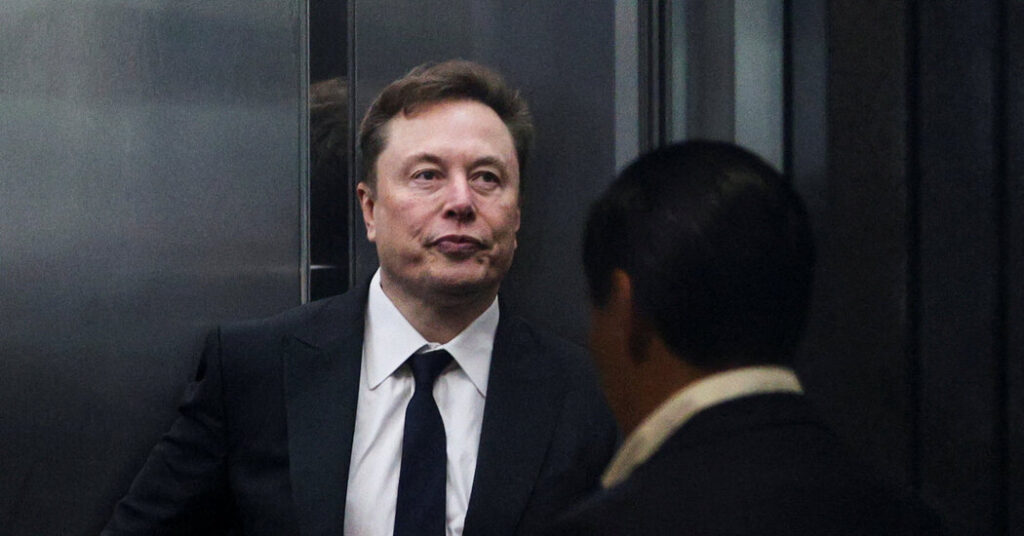
Mr. Musk returned to the witness stand in an Oakland, Calif., federal court for a third day on Thursday in what is expected to be a monthlong trial. He has accused OpenAI and his co-founders of breaching the lab’s founding contract when it started to take on major investments from Microsoft and build commercial products.
He is asking for $150 billion and an order forcing OpenAI to unwind a move it made to become a for-profit company last year. Mr. Musk is also asking for Mr. Altman’s removal from the company’s board of directors.
Judge Gonzalez Rogers’s instruction on Thursday morning cut straight to one of the driving arguments of the tech industry’s A.I. race. For years, researchers and tech moguls have argued over the risks of A.I., not just to white collar jobs like computer programming, but to humanity itself.
Outside Silicon Valley, the debate can sound absurd. But inside many tech companies, it has been motivation for people who believe they are the only ones who can build A.I. safely. That has inspired an extraordinary boom, with projections of $900 billion in spending this year on A.I. data centers, according to research from the investment bank Evercore.
Inside the Oakland courtroom, Judge Gonzalez Rogers kept the debate to more grounded questions. She has consistently told lawyers to focus on the facts about OpenAI and its founding and asked them to stay away from other tangential issues like drug use.
But it was open season for OpenAI’s lead counsel, William Savitt, to challenge Mr. Musk’s trustworthiness.
Mr. Savitt played a video of Mr. Musk’s deposition from last fall that contradicts something he said in court on Wednesday. Last year, Mr. Musk said that he did not read a key OpenAI document. But yesterday, he admitted that he read at least part of the document, Mr. Savitt said.
It might have been a small point, but it was part of a broader strategy to discredit Mr. Musk. Mr. Savitt asked Mr. Musk whether he ever directed the algorithm that controls X, his social media platform, to promote his own account. Mr. Musk said he has not.
There have been incidents where the company has made changes that favor his account. In February 2023, shortly after buying the company, Mr. Musk got upset that a post about the Super Bowl from former President Joseph R. Biden Jr. performed better than his. Mr. Musk demanded that his employees figure out what was wrong, and at one point, they made an adjustment that caused the site’s timeline to feature Mr. Musk’s posts almost exclusively. It later switched back.
Russell Cohen, the lead lawyer for Microsoft, which was also named in Mr. Musk’s suit, asked questions along similar lines. He tried to show that Mr. Musk was well aware of the complex relationship between OpenAI and Microsoft as far back as 2020, but did not decide to sue the tech giant until four years later.
Like OpenAI’s legal team, Mr. Cohen was trying to demonstrate that Mr. Musk sued only after the stakes in the A.I. race escalated, long after OpenAI’s ChatGPT became a global phenomenon.
Mr. Molo, Mr. Musk’s lawyer who started the questioning of Mr. Musk on Tuesday, returned to ask the billionaire a few final questions. He zeroed in on why Mr. Musk did not file a lawsuit years ago.
It’s an important point Mr. Musk’s side wanted to underscore. He has long been adamant that OpenAI should not be driven by a for-profit company.
Mr. Musk, repeating what he said in earlier testimony, said his electric carmaker Tesla did not have plans to pursue A.G.I., or artificial general intelligence, essentially a machine that can do anything the human brain can do. This would seem to contradict a recent social media post in which he said that Tesla would be one of the companies creating that technology.
As Mr. Musk flatly denied Tesla was pursing A.G.I., Mr. Brockman of OpenAI scribbled a note on a small piece of yellow paper and passed it to his legal team.
As his testimony concluded, Mr. Musk still managed to slip in some references to the movie “The Terminator,” a classic film about A.I. nearly destroying humanity.
(The New York Times has sued OpenAI and Microsoft, claiming copyright infringement of news content related to A.I. systems. The two companies have denied the suit’s claims.)
Ryan Mac contributed reporting from Los Angeles.
Cade Metz is a Times reporter who writes about artificial intelligence, driverless cars, robotics, virtual reality and other emerging areas of technology.
The post Is A.I. a Threat to Humanity? Not in This Trial. appeared first on New York Times.