President Trump’s declaration that he is willing to maintain a blockade on Iranian shipping until the Iranians surrender to his demands almost assures that the Strait of Hormuz will remain closed by the time he arrives in Beijing in two weeks.
That is exactly what Mr. Trump was seeking to avoid when he delayed his trip to China six weeks ago. And it vastly complicates a critical meeting with President Xi Jinping, forcing White House officials to rethink how Mr. Trump approaches the effort to engineer a rapprochement with China.
In public and private, Mr. Xi has demanded that the United States reopen the waterway through which China imports about a third of its oil and gas.
When Mr. Trump initially envisioned the trip as the first in a series of carefully scripted meetings, the possibility of a war with Iran was not on the radar of most administration officials. When he delayed it in early April, he was confident the war would be over quickly.
At the time of that decision, members of Mr. Trump’s national security team said they hoped that forcing Iran into a nuclear deal after a relatively short bombing campaign would be a demonstration of American power and reach. They also saw it as a warning to Beijing as Mr. Trump sought a rapprochement with the country that is America’s largest military, technologic and economic competitor.
But that assumption, like so many about the course of the war with Iran, has now gone badly awry.
If Mr. Trump flies to China as planned, with an intensive, two-day visit starting on May 14, the primary topic will clearly be the rippling economic effects of a war that China has made clear it viewed as unnecessary. Mr. Xi went further recently, warning that the world may be returning to the “law of the jungle,” though he made no specific reference to Iran or the strait at that time.
More than a week ago the Chinese leader directly called for the reopening of the strait, telling Crown Prince Mohammed bin Salman of Saudi Arabia, according to Chinese state media, that it “should remain open to normal navigation, which is in the common interest of regional countries and the international community.”
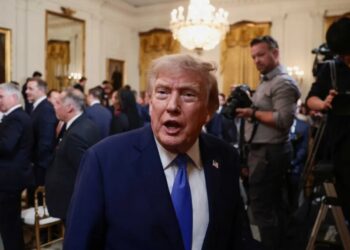
Mr. Trump clearly rejected that strategy on Wednesday when he reinforced his determination to keep the blockade on shipments from and to Iranian ports in place. “The blockade is genius, OK,” he told reporters during an event with the Artemis II astronauts. “The blockade has been 100 percent foolproof.”
The White House did not address the clear difference in strategy when asked about the effect of the blockade on the coming trip. The visit is supposed to focus on a trade deal and, to a lesser degree, security issues such as Beijing’s squeeze on Taiwan, China’s territorial claims in the South China Sea, rising Chinese cyberactivity against the United States and its growing nuclear program.
But in a statement, Anna Kelly, a White House spokeswoman, said that “President Trump has a positive relationship with President Xi, and he looks forward to visiting China later this year. Thanks to the successful blockade of Iranian ports and crippling impacts of Operation Epic Fury, the United States maintains maximum leverage over the Iranian regime as negotiations continue”
She added, “The president has been clear that Iran can never possess a nuclear weapon, and he always keeps all options on the table.”
Mr. Trump has repeatedly expressed frustration that neither the bombing that the United States and Israel conducted for 38 days, nor the economic strangulation that he is attempting by having the Navy intercept ships leaving or bound for Iranian ports, is achieving the desired effect.
“Now they have to cry uncle,” Mr. Trump said. “That’s all they have to do, just say: ‘We give up. We give up.’”
Mr. Trump has used variants of his “cry uncle” test over the past month, despite warnings from his own intelligence agencies and outside experts that the White House has consulted that nothing in Iran’s history or the nature of its constantly competing power centers suggests the country would offer what Mr. Trump had earlier called “unconditional surrender.” It was more likely, they have said, that Tehran would double down in its resistance.
In fact, even as Mr. Trump has swung from praise of Iran’s new leaders as more “reasonable” than their predecessors, to threats to resume bombing, to the blockade, the Iranian strategy appears to have remained steady. It has imposed a blockade of its own, in the Persian Gulf, that has prevented Arab states from risking sailing their tankers through the straits.
The president on Wednesday publicly rejected Iran’s latest proposal to reopen the strait and end the war. Iran offered to delay negotiations over the nuclear issues until later, but Mr. Trump told aides this week that he was not satisfied with that option, believing that the blockade is the most effective leverage the United States holds if the ultimate goal is to get Iran to ship its 11 tons of enriched uranium out of the country and to halt all nuclear activity for a number of years.
“Suffice it to say that the nuclear question is the reason why we’re in this in the first place,” Secretary of State Marco Rubio said on Fox News this week. “If Iran was just a radical country run by radical people, it would still be a problem, but they are revolutionary.”
(The United States has demanded 20 years in negotiations, and the Iranians’ last public position was three to five years. More recently, Mr. Trump has said 20 years is “not enough.”)
Some aides thought Mr. Trump should take the Iranian offer to reopen the Strait, believing Iran’s positions have hardened and seeing little evidence that the country’s leaders will make further concessions.
Mr. Trump has insisted that is unacceptable.
“There will never be a deal unless they agree that there will be no nuclear weapons,” he said on Wednesday. In fact, the Iranians have already agreed never to produce a nuclear weapon — they even made that commitment in writing when they ratified the Nuclear Nonproliferation Treaty and again as part of the 2015 nuclear accord with the Obama administration. But what they will not agree to, so far, is ending what they call a “right” to enrich uranium for peaceful purposes under the treaty.
Inside the White House, officials have prepared a range of options for the future of the conflict, including maintaining the blockade for months and resuming military activity inside Iran. But Mr. Trump has looming constraints on his ability to restart the war. The 60-day window to use force without congressional authorization expires this week, and some Republicans have already signaled they will not support an extension.
Members of Mr. Trump’s party, and some of his own aides, are growing anxious about the political impact of the war, especially as gas prices remain inflated. Republicans were already facing political headwinds going into November’s midterm elections, and a prolonged military conflict could exacerbate those.
In the next two weeks, China’s role in the conflict may prove crucial.
Among Asian nations it has by far the largest reserves of oil, so shortages are not an issue yet. But with oil suddenly above $110 a barrel, some of the highest prices since the opening of the war, the economic effect on the Chinese economy will be huge, most likely far higher than Mr. Trump’s tariffs.
China is Iran’s largest customer by far, and administration officials are betting that pressure from Beijing could force the Iranians into concessions.
Chinese officials played a critical role in persuading Iran to accept the first two-week cease-fire this month after Mr. Trump threatened to wipe Iranian civilization off the map. They asked their Iranian counterparts to show more flexibility in the negotiations over the strait and warned that the cease-fire might be Tehran’s only opportunity to prevent calamity, according to Iranians officials.
Now that negotiations seem to be at an impasse again, a number of officials and analysts say China may have an opportunity to steer toward a lasting peace — or at least a pathway toward reopening the critical waterway. In addition to the commercial relationship between the two countries, there is limited military cooperation. American intelligence agencies have assessed that China may have sent a shipment of shoulder-fired missiles to Iran for the war, though Mr. Trump said two weeks ago that he communicated with Mr. Xi to cut off further help.
At least in public, Mr. Trump has played down China’s assistance to Iran.
“I was a little surprised because I have a very good relationship and I thought I had an understanding with President Xi,” he told CNBC this month of the suspected Chinese shipment to Iran. “But that’s all right. That’s the way war goes.”
David E. Sanger covers the Trump administration and a range of national security issues. He has been a Times journalist for more than four decades and has written four books on foreign policy and national security challenges.
The post How Trump’s Iran Blockade Is Complicating a High-Stakes Trip to China appeared first on New York Times.