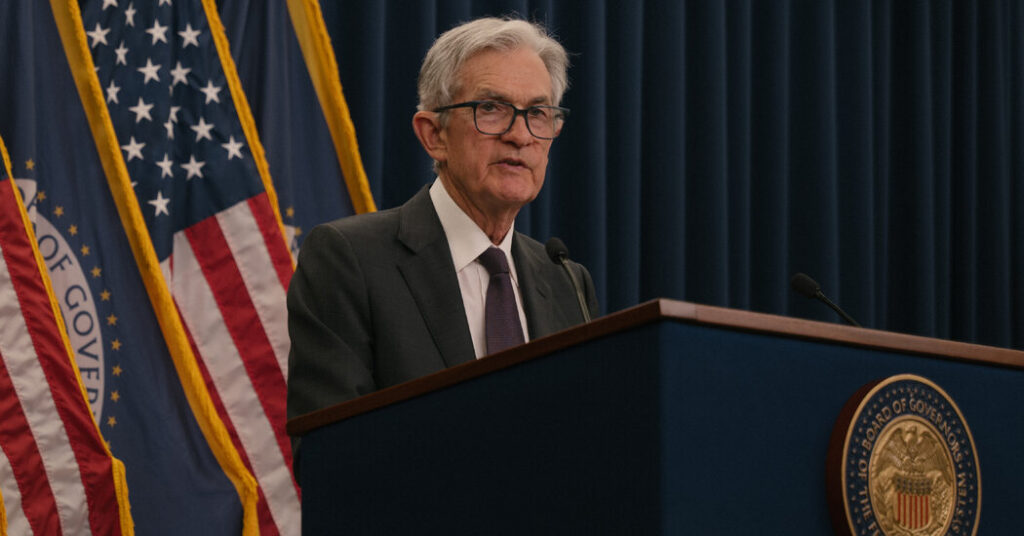
The Federal Reserve is preparing to hold interest rates steady on Wednesday for its third straight meeting this year — and likely the final one for Jerome H. Powell as chair.
Since policymakers last gathered in March, the war in Iran has continued to drag on, compounding the potential economic damage. Inflation has already risen sharply, reflecting an ongoing surge in energy prices. The labor market has stabilized somewhat, but Americans are feeling increasingly downbeat about the outlook for growth.
The combination of higher inflation and slower growth is particularly challenging for the Fed, and has prompted policymakers to endorse holding interest rates steady in a range of 3.5 percent to 3.75 percent for an extended period.
On Wednesday, the Fed will release a new policy statement alongside its rate decision at 2 p.m. in Washington. Mr. Powell, whose term ends May 15, will hold what is likely to be his final news conference as chair at 2:30 p.m. Pressure is now on the Senate to confirm President Trump’s pick to replace him, Kevin M. Warsh, in time. Mr. Warsh is expected to take the first step toward winning confirmation on Wednesday, just hours ahead of the Fed meeting.
Here is what to watch for:
Impact of the War
When officials last gathered in March, the United States was less than three weeks into its war with Iran. The closure of the Strait of Hormuz, a crucial shipping lane for global energy markets, had begun to gum up supply chains and lift energy prices, but the full extent of the economic impact was impossible to know.
Mr. Powell, at the time, leaned into the uncertainty of the moment, saying repeatedly that officials had “no conviction” in their forecasts when it was still so unclear how long the war would last and, in turn, how long energy prices would stay elevated.
“The thing I really want to emphasize is that nobody knows,” he told reporters.
Six weeks later, officials are facing the possibility of a much more protracted war, which risks keeping energy prices elevated.
The longer that price pressures linger, the more likely they broaden to other areas, like the services sector, and begin to push up inflation in a more sustained way. There is also a concern that at some point consumers will be forced to pull back on other spending in order to cover higher energy-related expenses, which would undermine a key pillar that is propping up the economy.
Mr. Powell will likely be under pressure to provide more specificity around the Fed’s views on the economic outlook, and how it is thinking through scenarios related to an prolonged conflict.
Rate Increases on the Table?
Until the war with Iran, the primary debate at the Fed centered around when — not whether — officials would restart rate cuts.
But the emergence of another inflation shock has begun to change the nature of the Fed’s internal discussions.
No official yet sees a rate increase as the most probable outcome this year, as Mr. Powell made clear during March’s news conference.
“We are balancing these two goals in a situation where the risks to the labor market are to the downside — which would call for lower rates — and the risks to inflation are to the upside — which would call for higher rates, or not cutting, anyway,” he said at the time.
Minutes from that meeting, however, showed an increasing number of officials supporting the idea of keeping rate increases on the table, or at the very least communicating that there were roughly equal odds that the next move could be up rather than down.
Mr. Powell will no doubt face questions about where officials now stand on the matter. Economists will also be looking out for changes to language in the Fed’s policy statement, which currently indicates the conditions under which the central bank would consider the “extent and timing of additional adjustments” to rates. An amendment to that line would send a strong signal that the Fed’s thinking around its next steps has shifted.
When Will Powell Leave?
If all goes according to plan and the Senate confirms Mr. Warsh by May 15, Mr. Powell’s tenure as Fed chair will end. But his time at the central bank may not be over. Technically, he can stay on as a governor until January 2028.
Mr. Powell’s decision hinges first and foremost on the outcome of a criminal investigation by the Justice Department into cost overruns for renovations at the central bank’s headquarters in Washington and whether he lied to Congress about them.
The investigation prompted a rare public rebuke from Mr. Powell, who said it was nothing more than a coercive tool to get the Fed to comply with the president’s demands for lower rates. Mr. Powell also made clear he would not leave the Fed until the investigation was “well and truly over, with transparency and finality.” Ultimately, he said he would base his decision on what is “best for the institution and for the people we serve.”
The investigation, which was stymied by a federal judge, also angered Senate Republicans, including Thom Tillis of North Carolina, who vowed to block any of Mr. Trump’s Fed nominees until Mr. Powell’s legal threats ended.
On Friday, the Justice Department announced it would drop the investigation and refer the matter to the Fed’s internal watchdog.
The Justice Department’s move was sufficient for Mr. Tillis to lift his block and allow Mr. Warsh’s nomination to proceed. Lawmakers are set to hold a vote on Wednesday morning to advance the nomination to the full Senate.
But it is unclear whether the Justice Department’s de-escalation will give Mr. Powell enough closure to leave. Jeanine Pirro, the U.S. attorney for the District of Columbia, said she would “not hesitate” to reopen the investigation again if needed.
Mr. Tillis also suggested the Justice Department might still appeal the federal judge’s ruling that quashed the subpoenas against the Fed. He said such a move would be not about pursuing Mr. Powell but about defending the power of prosecutors to issue subpoenas. An appeal would only further encourage Mr. Powell to stay.
Colby Smith covers the Federal Reserve and the U.S. economy for The Times.
The post What to Watch at the Federal Reserve’s April Meeting appeared first on New York Times.