In 2018, President Trump pulled out of the Iranian nuclear accord, promising that he would then negotiate a better deal. He couldn’t and didn’t.
Instead, Iran built up its nuclear program.
Then in February of this year, Trump again badly misjudged his leverage, starting a war with Iran that he apparently believed would be brief and successful, “a minor excursion” that would lead Iranian leaders to “cry uncle.”
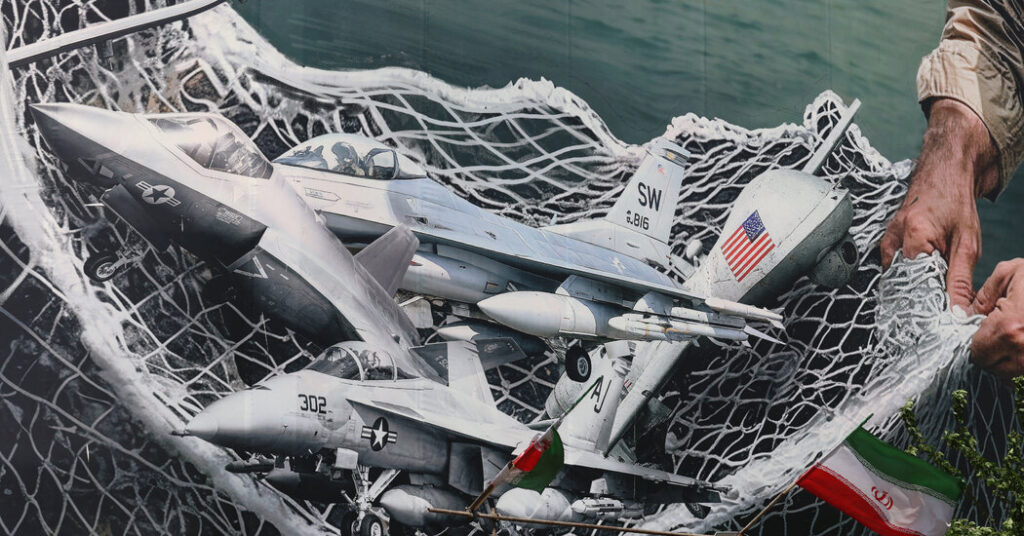
Instead, Iran seized the Strait of Hormuz.
Now Trump appears to be miscalculating yet again, believing that his blockade and economic pressure on Iran will succeed where his bombings failed. Trump canceled a round of nuclear talks on Saturday and seems to think that “the United States holds the cards,” as the White House put it.
The war will “come to an end very soon,” Trump told Fox News on Sunday. He added that Iran is running out of room to store its oil, which he seemed to believe would happen around Wednesday. After that, he said, “it just explodes.”
All this was news to petroleum experts.
It is true that Iran seems to be feeling pressure and reportedly is filling tankers and exploring exports by rail line to evade the blockade. Likewise, shutting off wells can cause damage to oil fields, as well as starve Iran of income. But there’s a wide range of views about how serious Iran’s storage challenge is. Some analysts believe the problems are overstated and that Iran still has weeks or even months before it reaches a crisis.
“No credible experts believe that Iran’s oil sector is about to collapse,” Esfandyar Batmanghelidj, an Iran watcher who is chief executive of a London-based research organization, told me. “Trump’s commitment to the blockade and his repeated statements that Iran is on the verge of collapse suggest that someone outside of government is feeding him unrealistic and politically motivated assessments of the situation in an attempt to undermine diplomacy.”
Danny Citrinowicz, formerly a longtime Iran analyst for Israel’s military intelligence agency, told me: “Contrary to the administration’s belief, especially the president’s, that a naval blockade would bring Iran to its knees, Tehran is unlikely to yield on its core strategic demands. Even under severe economic pressure, the regime is more likely to dig in, extending the deadlock, while the global economic fallout from disrupted maritime routes and potential strait closures steadily escalates.”
I fear that’s right. Trump has a record of extraordinary over-optimism about the Iran war. “We’ve already won,” he said on March 7. Two days later, he asserted that the war would be over “very soon.” On March 11, he announced, “We’ve won.” On March 20, he said the United States was considering “winding down.” Six days later, he said Iran was “begging to make a deal.” By April 16, the war “should be ending pretty soon.” The next day, he added that peace talks were going so well that “most of the points are already negotiated and agreed to.” And so on and so on.
What does this mean?
“The Americans clearly have no strategy,” Chancellor Friedrich Merz of Germany said Monday. Speaking of the United States, he added, “An entire nation is being humiliated.”
The basic problem seems to be that each side believes it has the other over a barrel. And each side sees something real: The other is hurting. My take is that each side would like an offramp but believes that time is on its own side and that the other will have to give in soon.
That’s a classic problem with authoritarian personalities, whether in Tehran or Washington: They surround themselves with flatterers who tell them that everything is going swimmingly. My own bet is that Iran may be able to suffer longer, partly because Iran’s dictators don’t face midterms. But it’s also true that like Trump, Iranian leaders seem cocky and overconfident and have repeatedly miscalculated.
They overreached in 1979 when they embraced the student seizure of the United States Embassy and held American hostages for 444 days, a foolish move that led to sanctions and isolation. They made things worse for themselves again when they continued to fight the Iran-Iraq war for six pointless years even after they recovered their territory, at enormous human and economic cost. And then their role in terrorist attacks abroad as well as repression at home compounded their isolation and backwardness.
This Iranian tendency to overreach may have increased now that the war has given additional power to hard-liners in the Islamic Revolutionary Guards Corps.
So I worry we now have two overconfident administrations facing off, each wary of appearing weak at home, each believing that time is on its own side, each perceiving the other as something of a paper tiger. That’s not a promising recipe for negotiating a peace deal; indeed, The Wall Street Journal reports that Trump has told aides to prepare for an extended blockade. That could hit the global economy by causing prolonged worldwide shortages of oil and gas and rising prices for everything from medicines to fertilizer, helium to condoms.
Iran has suggested an initial deal to reopen the Strait of Hormuz, setting aside for later questions such as the nuclear program. The United States for now is dissatisfied with that offer. To its credit, Pakistan is working hard to help bring the sides closer to a deal, and Trump should send representatives to try to engage in serious negotiations even if only on reopening the strait. Iran might emerge with some kind of unpalatable arrangement that lets it profit from ships passing through its territorial waters while mines linger in the main part of the strait, but that would be better than keeping the blockade going for months.
If that initial deal can be worked out, Trump must ensure that he preserves what leverage he has — in the form of sanctions relief — to push for curbs on Iran’s nuclear program. That is not so urgent but it is paramount: Trump was not much overstating things when he said that “the only point that really mattered” was a new nuclear agreement.
The paradox is that Trump’s initial threats of war appeared to have prompted Iran to offer a quite favorable nuclear deal in February. But two months into the war, Iran and the United States each seems to feel it is in the stronger position. Faced with the prospect of making concessions to the other side, each may prefer to delay or escalate, with the world economy held hostage.
What could possibly go wrong?
The Times is committed to publishing a diversity of letters to the editor. We’d like to hear what you think about this or any of our articles. Here are some tips. And here’s our email: [email protected].
Follow the New York Times Opinion section on Facebook, Instagram, TikTok, Bluesky, WhatsApp and Threads.
The post Two Cocky Authoritarians Blocking Hormuz: What Could Go Wrong? appeared first on New York Times.