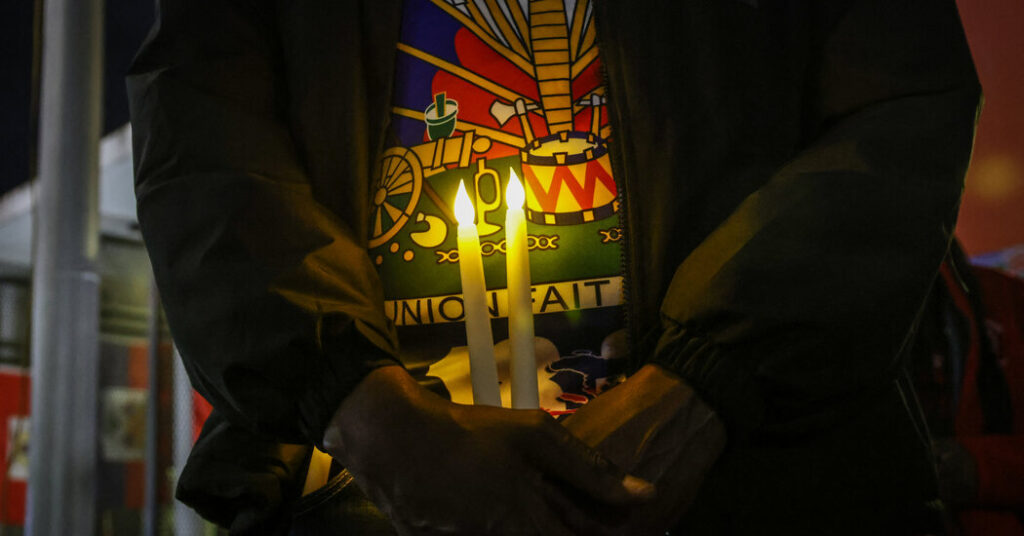
The Supreme Court on Wednesday appeared closely divided over whether the Trump administration could immediately end humanitarian protections that have allowed hundreds of thousands of Haitians and Syrians to live and work legally in the United States.
President Trump has moved to terminate a program, known as Temporary Protected Status, that has allowed migrants from more than a dozen troubled nations to settle temporarily in the United States. His inflammatory language about immigrants featured prominently in the court’s arguments.
The two cases before the justices involve more than 350,000 Haitians and about 6,000 Syrians whom the Trump administration has sought to expel from the United States, potentially forcing them to return to dangerous conditions in their home countries. The court’s ruling, expected in late June or early July, will also most likely have implications for immigrants from other countries whose protections the administration has sought to terminate, potentially affecting more than one million people.
The president’s plan to end T.P.S. protections is part of his broader effort to crack down on legal and illegal immigration by strictly limiting the resettlement of refugees, cutting illegal crossings of migrants seeking work and denying asylum claims from people crossing from Mexico into the United States.
In Wednesday’s case, the court’s three liberal justices posed tough questions to the administration, with Justices Sonia Sotomayor and Ketanji Brown Jackson suggesting that the decision to end the program was racially motivated. They cited the president’s false accusations during the 2024 campaign that Haitians in Springfield, Ohio, ate the pets of neighbors and his comments in December about Haitian immigrants being undesirable because they come from a “filthy, dirty, disgusting” country.
D. John Sauer, the solicitor general, said those statements were “unilluminating” and were references to poverty and crime rather than race. He denounced “judicial micromanagement” of the administration’s foreign policy.
Several conservative justices seemed to embrace the administration’s view that the text of the federal law that establishes the T.P.S. program makes clear that courts cannot second-guess the government’s decision to extend or to end the protections.
Justice Samuel A. Alito Jr. acknowledged that the administration’s analysis leading up to its decision was brief, but he said: “It is always going to be possible to pick procedural faults in — to raise procedural objections to what’s been done,” and he suggested that the law required courts to stay out of it.
After nearly two hours of arguments, it seemed that the court’s decision could come down to the votes of Chief Justice John G. Roberts Jr. and Justice Amy Coney Barrett, who are often in the majority and asked probing questions of both sides. But any victory for the migrants could be short-lived, merely requiring the administration to revisit its decision to terminate the program for the two countries but allowing it to withdraw the protections after a review.
The justices fast-tracked the cases, scheduling them for the final day of arguments in a court term that began in October that already included challenges to other major aspects of Mr. Trump’s agenda. In February, the court ruled against the legality of the president’s sweeping tariffs, and the justices will soon decide whether Mr. Trump can end the longstanding guarantee of birthright citizenship for the U.S.-born babies of illegal immigrants and certain foreign visitors.
At issue on Wednesday was a federal program created by Congress in 1990 with bipartisan support that now gives the homeland security secretary authority to grant temporary refuge to citizens of countries affected by armed conflict, natural disaster or other catastrophes, if they are already in the United States.
The law allows the secretary to periodically review such protections, terminating or extending them for certain countries. It lays out that the secretary must consult with federal agencies, review conditions in a country, and then make a decision based on those assessments.
Lawyers for the Haitians and Syrians, who filed lawsuits in Washington and New York, said that Kristi Noem, who until March 24 was the homeland security secretary, failed to take those steps. Instead, they accuse her of ending the programs without consultation and based instead on political considerations and orders from the president.
The class-action lawsuits were filed by T.P.S. holders, including engineers, students, doctors and caregivers, who want to continue to work and live in the United States because, their lawyers say, they could be killed if they were forced to return to Syria or Haiti.
Chief Justice Roberts asked the lawyer for the Syrians how the court should judge “how much political influence is too much” when evaluating whether the government had done a comprehensive analysis before deciding to remove the protections.
On the other hand, the chief justice expressed skepticism of a claim from the administration that its victory in the 2018 case testing Mr. Trump’s ban on travelers from certain predominantly Muslim countries compels a victory in the T.P.S. matter. He said that view would require a “significant expansion” of the findings from the earlier case.
Mr. Sauer, the solicitor general, repeatedly told the justices that the courts have no authority to review the secretary’s decision-making steps. He pointed to the text of the statute, which prohibits “judicial review of any determination” of the secretary “with respect to the designation, or termination or extension of a designation.”
Lower court judges, however, sided with the migrants, finding that the secretary’s decisions had been preordained and not based on meaningful analysis. The judges postponed the terminations, prompting the government’s lawyers to ask the Supreme Court to intervene.
In a separate case, the Supreme Court previously allowed the Trump administration to move forward with its plans to lift protections for more than 300,000 Venezuelans who had been living in the United States. The justices ruled twice in that case in emergency orders, providing technically temporary authorization to revoke the protected status while the case went through the courts.
But those orders did not include the justices’ legal reasoning, a common feature of the court’s so-called emergency or shadow docket, so it was unclear why the justices chose to handle the cases from Haiti and Syria differently by holding oral arguments and presumably issuing a more formal opinion in coming months.
Both sides agree that the law allows the administration to remove countries from the T.P.S. program. But immigrant rights advocates are asking the court to order the administration to restart its review process. Much of Wednesday’s discussion centered on how much consultation the homeland security secretary must undertake with other federal agencies to satisfy the law and whether courts even have the authority to entertain such questions.
Justice Barrett sounded skeptical that a do-over with more robust consultation would make much of a difference to the Haitians and Syrians.
“Is that going to get you very much?” she asked the attorney for the Syrians, Ahilan T. Arulanantham.
Why, she asked, would Congress permit the court to police what steps the administration takes before deciding to end the program — “kind of a box-checking exercise” — if the law does not allow the courts to review the ultimate decision?
In response, Mr. Arulanatham said, Congress and the “millions of people who live with T.P.S holders have some faith in government, and they believe that if there is consultation, the decisions will be better.”
In the Haiti matter, the lawyers said, the administration was also motivated by anti-black and anti-Haitian prejudice, in violation of constitutional prohibitions of discriminatory government actions. Geoffrey M. Pipoly, the lawyer for the Haitians, told the justices that the administration was discriminating against immigrants from nonwhite countries while allowing mostly white immigrants from another country, South Africa, to find refuge in the United States.
Mr. Sauer rebuffed the claim of racial discrimination, saying that the president’s quotes had been taken out of context.
Haitians first received protections in 2010 after a devastating earthquake. The program has been extended several times, including by the Biden administration after the assassination of the country’s last elected president in 2021. Since then, Haiti has grappled with gang violence, political instability and food shortages.
Mr. Trump tried to end protections for Haitians in 2018, but was blocked by lower courts and those efforts stalled before the case reached the Supreme Court.
As for the Syrian migrants, the government initially put protections in place in 2012, citing the “extraordinary and temporary conditions” in the country resulting from “a brutal crackdown” by the nation’s president at the time, Bashar al-Assad. Those temporary protections were repeatedly extended, including during the first Trump administration, based on armed conflict and the aftermath of the 2023 earthquake.
Reporting was contributed by Adam Liptak, Jazmine Ulloa, Miriam Jordan and Matt Schwartz.
Ann E. Marimow covers the Supreme Court for The Times from Washington.
The post Supreme Court Grapples With Trump’s Plan to Revoke Deportation Protections appeared first on New York Times.