On Saturday night, a gunman made an attempt on President Trump’s life.
This was the third such attempt in roughly two years. The first was in 2024 during a rally in Butler, Pa., where the president — then still a candidate — sustained some injuries. The next attempt took place the same year, this time at his Mar-a-Lago resort, where the would-be assassin was stopped before he could get close. And then we have this most recent incident at the White House Correspondents’ Association dinner in Washington.
To add to the catalog of recent political violence, there was the assassination of former Minnesota House Speaker Melissa Hortman and her husband last summer, as well as the killing of Turning Point USA’s Charlie Kirk at an event in Utah later that year.
Predictably, in the wake of Saturday’s attempt on Trump’s life, the president’s allies immediately jumped to blame his political opponents for the incident.
“The deranged lies and smears against the president, his family, his supporters have led crazy people to believe crazy things, and they are inspired to commit violence because of those words,” Karoline Leavitt, the White House press secretary, said on Monday.
Trump added his two cents as well in an interview with CBS News: “I do think that the hate speech of the Democrats much more so is very dangerous. I really think it’s very dangerous for the country.”
The Republican argument is simple. The more Democrats criticize Trump — the more they condemn him as a malign force in American politics — the more they put his life in danger.
But this argument does not stand up to scrutiny.
To start, even the most heated language coming from Democrats over the past few years falls well within the boundaries of ordinary political discourse in the United States. No elected Democratic leader has called for violence against Trump or his allies. All have condemned such violence when it has taken place. And you would be hard-pressed to find anything different among Democratic Party officials and liberal activists.
The same cannot be said about the political right, where figures like Steve Bannon muse about putting “heads on pikes” on “the two corners of the White House as a warning.” And it certainly cannot be said of the president.
Trump has been the most high-profile purveyor of violent language toward his political opponents since he stepped onto the national stage as a political contender in 2015.
Fantasies of violence against political enemies are, in fact, a defining feature of Trump’s political language.
During his first campaign for president, he pointed to the “Second Amendment people” when he wondered, aloud, whether anything could be done about a President Hillary Clinton. As the George Floyd protests consumed the country in the summer of 2020, Trump threatened violence against protesters. “These THUGS are dishonoring the memory of George Floyd, and I won’t let that happen… when the looting starts, the shooting starts.” He called for the death penalty against Mark Milley, former chairman of the Joint Chiefs of Staff, and once compared his political opposition to “vermin,” calling them the “real threat” to the nation. On the eve of his second victory in 2024, he floated the use of the military to handle “the enemy from within,” defined as “sick people, radical left lunatics.”
And then, of course, there is the Jan. 6 attack on the Capitol in 2021. “You’ll never take back our country with weakness,” he said to thousands of supporters at a rally outside the White House. “We fight. We fight like hell. And if you don’t fight like hell, you’re not going to have a country anymore.” All of this is just a small sample of the president’s embrace of violence in his language.
Conservatives once understood that societies are complex systems and that the reason to try to preserve certain norms and traditions was to avoid needless chaos and disruption as we change and progress. We cannot predict the full consequences of what we do and so we should choose carefully and deliberately as we navigate the world. We should be modest in our ambitions, aware of our own fallibility and mindful of the way things can go wrong.
Of course, inasmuch as this perspective actually shaped American conservatism, it was mostly to defend existing inequalities and hierarchies. Consider William F. Buckley Jr.’s defense of the Jim Crow South or Ronald Reagan’s jeremiads against Medicare. What looked like wisdom was usually just a rhetorical trope used to justify the power that some held over others. Still, there is something to be said for that spirit of humility, especially as it relates to our politics.
So it goes with Trump’s embrace of violent language. If his predecessors in the White House did not speak this way, it was not because they lacked a killer instinct or were never frustrated by criticism and mockery. Rather, they understood the weight and power of the office and the way that this language, if used, could spiral out of control into actual violence and disorder.
But in Trump we have a president who isn’t concerned with the impact of his language and the consequences of his words — who delights in wielding them as a weapon against others, with no regard for what it might do or who it might influence. He thought nothing, for example, of calling a group of Democratic lawmakers “traitors” who were “guilty of seditious behavior at the highest level” and who should be “arrested and put on trial” and even punished with “DEATH!” He thinks nothing of targeting individual critics with vitriolic social media posts or of threatening entire nations with total destruction.
Trump may not care about the power of his words. But those words still matter. They weigh on society. Ten years of violent language, 10 years of fanning the flames of discord and conflict, 10 years of calls to effect change through violence — all of these have had an effect.
It is not that Americans are new to political violence. It is one of the defining aspects of our national experience. But in the decades between the assassinations of the 1960s and the present, there had been a steady decline in incidents of such violence, broadly defined. Trump’s entry into American politics has corresponded with a reversal of that trend — with a growing sense among a number of people in society that the only way to make change is through the use of force.
Trump did not cause the attempts on his life. But it would be dishonest to deny that he is responsible for shaping the environment in which we live — for creating an atmosphere in which these kinds of events are more likely. And as the single most visible politician in the country, an atmosphere where political violence is more likely is one in which he may find himself a target, for whatever reason the particular person happens to have.
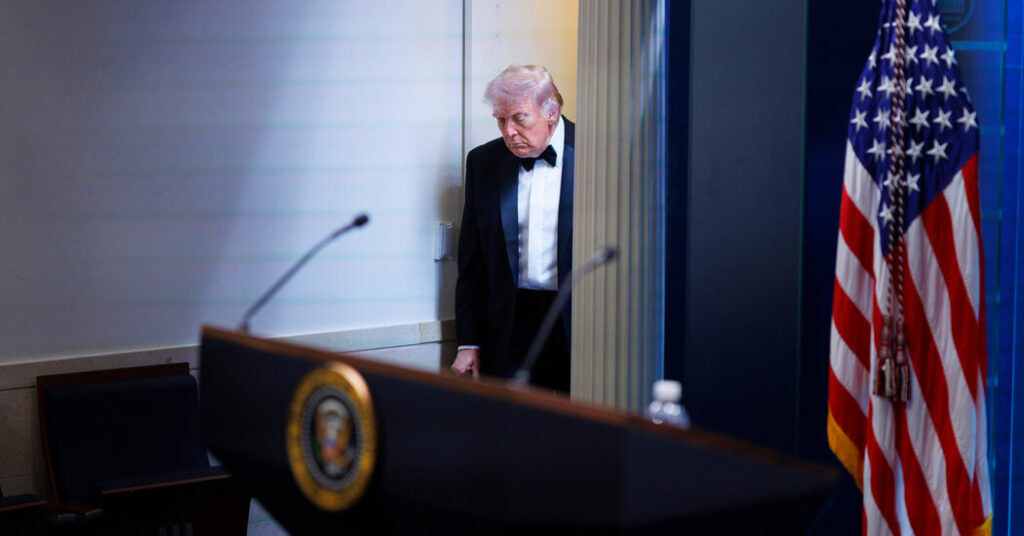
Trump’s response to this latest attempt on his life was to tell his audience of journalists that this was the reason he needed a ballroom — a space where he could safely hold court. And there is no doubt that, in addition to his megalomania, the ballroom reflects the president’s desire to make the White House a North American Versailles. But one should also consider the extent to which it reflects something else: a desire to isolate himself from the world.
This is a president who rarely travels beyond the confines of the White House compound or Mar-a-Lago. He rarely meets people where they are. Trump holds the occasional rally, but he does not move through the world the way most presidents have. More so than most who have held the office, he lives inside a bubble.
Some of this is vanity. Some of it is laziness. But some of it, I think, is fear. Trump is afraid of the world. Which in a way might mean he is afraid of the world he has helped build.
The Times is committed to publishing a diversity of letters to the editor. We’d like to hear what you think about this or any of our articles. Here are some tips. And here’s our email: [email protected].
Follow the New York Times Opinion section on Facebook, Instagram, TikTok, Bluesky, WhatsApp and Threads.
The post The Loneliness of Donald Trump appeared first on New York Times.