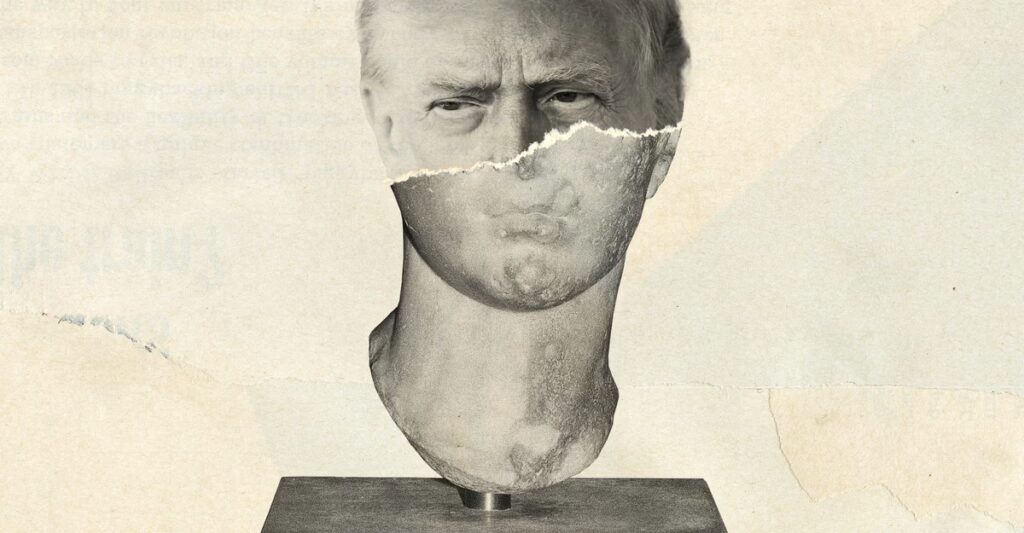
Had President Trump, we wondered, possibly been reading or at least thumbing through—just maybe—the works of … Georg Wilhelm Friedrich Hegel?
Impossible. And yet. Hegel’s theory of “world-historical individuals,” men who redirected the course of humanity, focused on three figures: Alexander the Great, Julius Caesar, and Napoleon Bonaparte. Hegel described them as unlikely “heroes of an Epoch” for upending established orders that had previously seemed fixed. They were “practical, political men” who were each condemned in their age for smashing norms and for other conduct “obnoxious to moral reprehension”—as Trump has been accused of, centuries later.
And though Trump has long compared himself to America’s two greatest presidents, we were recently told by two people who are in a position to know such things—a senior administration official and a longtime Trump confidant—that the president had, in private conversations, begun thinking about himself less as a peer of George Washington and Abraham Lincoln, and more as an addition to Hegel’s immortal trifecta.
“He’s been talking recently about how he is the most powerful person to ever live,” the confidant told us. “He wants to be remembered as the one who did things that other people couldn’t do, because of his sheer power and force of will.”
The tendency to self-aggrandize is as fundamental a feature of Trump as his sculpted hair and overlong red ties. But it has become even more important in setting his priorities and steering his actions as he hurtles through his final term in office. He no longer has to worry about the judgment of voters and can instead focus on what he’s decided really matters: ascending to become one of history’s so-called great men and leaving an enduring—and, in many cases, physical—imprint. The result, at least so far, has cost many lives and billions of dollars, damaged the world economy, strained already fragile alliances, and cratered the president’s standing with the public. But those around him cast his new focus as a liberation. “He is unburdened by political concerns and is able to do what is truly right rather than what is in his best political interests,” the administration official told us. “Hence the decision to strike Iran.”
What the American people think—and what near-term consequences they may face—has mattered less to Trump than his own designs to remake the world by bombing seven countries, toppling two world leaders in as many months, threatening to seize Greenland, and undermining the NATO alliance. Earlier this month, Trump described the conflagration with Iran in existential terms, writing on social media, “A whole civilization will die tonight, never to be brought back again.” Even when he later agreed to a two-week cease-fire—which has since been extended—Trump portrayed his Middle East adventurism as “one of the most important moments in the long and complex history of the World.” At home, he has focused his time and attention on unending tributes to his reign—building projects that recall ancient Rome, decorative gilding that evokes imperial France, banners with his visage draped across government buildings, and a gold coin set to be minted with his image for the nation’s 250th birthday. “He is conscious, proud, and hopeful that some of the things that he does are resetting long-standing orders of things,” a second senior official told us. “Not in a Socrates sort of way, just: The stuff I’m doing is very different, and it will reset things to some level, and that includes not just this country but the world.”
[Read: ‘I run the country and the world’]
When we asked several White House officials whether Trump had discovered and embraced Hegel’s writings, they dismissed the hypothesis almost laughingly. The president does not have a reputation as a reader. He did recently learn about the powerful triumvirate in a brief passage that someone handed him, the senior official told us, although that person couldn’t recall if it was a poem or an essay or something else. The second senior official suggested that Trump might be recalling a speech he heard at a golf-club event last year, where a speaker placed Trump in the frame of historical figures such as Alexander the Great and Genghis Khan. White House officials and allies have debated other reasons for the president’s turn toward history, and some have dismissed it as typical Trumpian braggadocio—the greatest, the biggest, the best. They all spoke with us on the condition of anonymity to candidly detail their private conversations with the president.
Then, on Saturday night, following an assassination attempt at the annual White House Correspondents’ Association Dinner, Trump turned briefly introspective, offering yet another glimpse of how he views his place in the scope of history. Speaking to reporters shortly after the alleged gunman had been apprehended, Trump said that he had “studied assassinations,” mentioned Lincoln, and argued that “the people that make the biggest impact—they’re the ones that they go after.” “They don’t go after the ones that don’t do much,” he continued, before musing that only “big names” face these threats to their life, and concluding: “I hate to say I’m honored by that, but I’ve done a lot.”
Trump’s heightened tendency to view himself as a world-historical figure—capable of brash, misunderstood greatness—has transformed his second term, and not necessarily in a good way. Republicans are in a panic about the political costs of the attack on Iran, which has increased prices and interest rates ahead of an election that will hinge on affordability. Democrats, meanwhile, delight in Trump’s focus on building a ballroom and a memorial arch, which swing-voter focus groups regularly identify as a misplaced priority. And inside the administration, the excitement of his first year has given way to a more defensive mentality, as some of the president’s most committed supporters splinter away and the political operation struggles to maintain the 2024 coalition.
But for Trump, the costs have been outweighed by what he views as the opportunity before him, a chance to transform the world in a manner that few historical figures have ever even approached. A second Trump confidant summarized bluntly: “He’s clearly in his ‘I don’t give a fuck’ mood.”
Ever since moving back into the Oval Office, Trump has been adding accents to the room, cluttering the space with golden urns, military flags, rows of presidential portraits, and a 19th-century copy of the Declaration of Independence. The crowns of the doors have been gilded, as have the seal and stars on the ceiling. Like clip art in blank spots on the wall, he has affixed ornamental molding, coated in gold leaf. When we entered the Oval Office for an interview last April, one of the first questions he asked us was of decor: “Do I do a chandelier?” he inquired. “Beautiful crystal chandelier, top of the line.” (Ultimately, he opted against it because the logistics were not ideal; one option included hanging it directly through the bald eagle’s beak on the presidential seal.)
The doors, however, remained glaringly unadorned until Trump had an idea: He took his personally designed presidential challenge coin—such tokens are generally a palm-size souvenir that’s popular in military and law-enforcement circles—and glued it to the center of the Oval Office door, at about eye level. “Everyone was impressed by how good it looked,” a White House official told us. In the weeks that followed, Trump made his way through the West Wing, seeking out new places to affix his coins (golden and featuring the presidential seal). One by one, the president decorated the office doors of each of his deputies. His aides are convinced that he will eventually cover all of the doors.
Trump, a developer by trade, has always loved these sorts of details—to a point of distraction. Building and branding are “in his DNA; it’s who he is,” David Urban, a Trump ally, told us. And now, as president, Trump feels that he’s deploying those skills for the common good. “He believes in his mind that he’s making all of these things better, and you know what? At the end of the day, he is making all of these things better.” The president’s friends and advisers have told us story upon story of his obsession with the smallest minutiae, of his dedication to his monuments of self—the time he got down on all fours to help explain exactly how he wanted new tiling at Mar-a-Lago arranged; the time he glanced out of a window at one of his golf courses and then stopped a meeting, just cold stopped it, so he could amble out to instruct the gardeners.
His passion for his personal projects has begun bleeding into daily work as president. One month into the Iran war, for instance—as gas prices averaged near $4, mortgage rates were climbing, and inflation fears were eroding stock values—Trump came to the press cabin in the back of Air Force One to argue that the bombing campaign was working. Or, at least, that’s what the reporters covering his trip home from Mar-a-Lago thought he was there to do. Then he suddenly switched from talking about the war to boasting about his plans for “hand-carved” Corinthian columns as part of his $400 million White House ballroom. The president presented six mounted, photo-realistic renderings of the project that he explained at length, like this was a miles-high slide show. He went on about the drone-resistant roof, the bulletproof windows, the multiple porches, and the basement military facility, before pausing near the end to explain his priorities.
“I’m so busy that I don’t have time to do this—I’m fighting wars and other things,” Trump told the assembled press. “But this is very important because this is gonna be with us for a long time.”
A foreign leader visiting Washington today would find a city under reconstruction, with tower cranes over the White House, a spectacle that recalls Roman Emperor Augustus’s claim that “I found Rome a city of bricks and left it a city of marbles.” There’s the planned remodeling (and recent renaming) of the Kennedy Center, the affixing of his name to the United States Institute of Peace, the attempted seizure of D.C.-municipal golf courses that Trump plans to renovate, the paving over of Jackie Kennedy’s Rose Garden into a Mar-a-Lago-style patio, and the tearing down of the East Wing to make way for the massive ballroom. (That destruction prompted the largest outcry, perhaps because the symbolism was visual, physical, visceral—a wrecking ball laying waste to a cherished pillar of democracy.) The proposed “Arc de Trump,” a 250-foot structure modeled after Paris’s Arc de Triomphe, would be taller than any similar structure in world history, and more than twice the height of the Lincoln Memorial, across the river from where it would stand. “The GREATEST and MOST BEAUTIFUL Triumphal Arch, anywhere in the World,” Trump declared three days after announcing the cease-fire with Iran.
Even the yearlong celebration of the nation’s semiquincentennial has become as much about feting Trump as observing the nation’s 250th birthday. Trump will mark his 80th birthday in June with a demonstration by modern-day gladiators—a UFC Freedom 250 fight on the White House South Lawn. The fighters will weigh in at the Lincoln Memorial. Later, they will emerge from the Oval Office to battle before a waiting Trump, the event complete with fireworks and a light show—a grandiose and very Trumpian tribute to himself.
Trump doesn’t like to use the term legacy, advisers and allies told us, and some have wondered whether he really cares about his legacy at all. “The only legacy President Trump is concerned with is making America greater than ever before,” the White House spokesperson Olivia Wales told us. As Trump searched for a running mate in 2024, the second Trump confidant recounted that they had tried to implore him to pick someone who could help continue his political movement. Trump retorted: “What the hell do I care? I’ll be dead.”
“I don’t think he’s sitting around musing about what people will think 100 or 200 years from now,” one of the senior officials told us.
But there is no dispute that something has changed in his second term—a freeing of his ambition, and a newfound sense of power. “My own morality. My own mind. It’s the only thing that can stop me,” Trump told The New York Times after a successful operation in Venezuela to capture its leader, Nicolás Maduro. His top advisers now talk about him as the person with “the highest tolerance for risk in the world, and the best instinct for self-preservation,” according to one of them. That has left everyone around him attempting to proceed as if this is a normal presidency—or, at least, a normal Trump presidency—but the president is different now, firmly in his second term with personal electoral victory no longer a driving force. The guardrails from the first term are gone, and Trump has all but abandoned the pretense of much caring about the Republican Party that he holds in an emperor-like grip.
[Read: It’s not just Iran. Trump is flailing on multiple fronts.]
Top White House officials, political advisers, and Cabinet members gathered in mid-February at the Capitol Hill Club to lay out a midterm-election strategy that would focus on delivering a consistent message that’s focused on the economy and cost of living, regardless of what Trump says or does. The group met again a month later, at Washington’s Waldorf Astoria, which was previously the Trump International Hotel. The February plan had run headlong into the expensive war, so the message became blunter: There was no longer room for error.
Sarah Longwell, a former Republican and an anti-MAGA political strategist who regularly conducts focus groups with Biden-Trump swing voters, told us that Trump keeps acting in politically irrational ways. “So every time he’s focused on the ballroom, every time he’s focused on the Kennedy Center, voters are like, ‘But you’re not focused on Americans. You’re not focused on me. You’re not focused on the economy,’” she told us. “Most people are like, ‘I don’t care about the ballroom. Just be focused on the economy. That was the whole point of you.’”
One Trump ally told us that the president is not particularly worried whether he loses the House, and that he cares only slightly about holding the Senate. The reason: A Democratic Senate means “a six-month impeachment trial versus three hours,” this person explained. But Trump has survived two impeachments, and he arguably returned more powerful. His focus now is on doing something more enduring with his influence. Trump worries about being perceived as a lame-duck president, several people told us, including this ally. He has—at least on one occassion—acknowledged his own mortality. Jimmy Carter died in late 2024, during the presidential transition, and when he lay in state in the Capitol Rotunda, Trump watched the proceedings for hours from Mar-a-Lago, transfixed by the coverage, a person close to the White House told us. One day, Trump mused, he would be inside a flag-draped coffin like that. (In a story about Trump’s health, New York magazine also reported a version of these comments.)
The same ally told us that Trump now cares more about his successor, believing that a Republican president loyal to him will help ensure that his actions are not immediately reversed. After losing in 2020, he had four years out of power to watch President Biden try to return the nation to a pre-Trump status quo ante, and he now understands what lasting change requires. But even that is complicated. “There is a little bit of tension there, because I think there’s a part of him who might also want to say, ‘I’m the only one who can hold this coalition together,’” the first Trump confidant told us. (Trump has publicly mused about running again in 2028—a clear joke to troll his opponents, advisers insist—though other people in Trump’s orbit, such as the MAGA influencer and former adviser Steve Bannon, are more seriously pushing the idea.)
[Read: Doomsday-prepping for Trump’s third term]
In short, the president’s incentive structure has changed. “The hallmark of his entire life has been: Solve the problem that’s in front of my face, and I bet I’ll be able to solve the next problem when I get to it, but I’m not going to worry about it right now. And it leads to this inherently short-term thinking,” this confidant said. Now that Trump is no longer running for president, this person explained, “he’s not thinking about What do my polling numbers say right now? or What are they for in the midterms I’m not running in, or for 2028 when I don’t care?”
Still, Trump’s team remains cautiously optimistic that it can refocus him on the coming midterms, which could act, perhaps, as the last guardrail to curb his influences in a term that, so far, has mainly been dictated by such whims. “He knows he is essentially on the ballot in the midterms,” one of the senior White House officials told us, as if by saying it aloud they could will it into reality. But after those elections, this person mused, “God knows what the next two years will look like.”
Hegel—whether or not Trump has actually read a word of his dense tracts—may offer some hints. Julius Caesar, Alexander the Great, and Napoleon Bonaparte, Hegel argued, operated with “an unconscious impulse that occasioned the accomplishment of that for which the time was ripe.” They were not exactly intellectuals, he wrote, and they did not live particularly happy lives. Napoleon was exiled in his 40s to St. Helena; Alexander died at 32; and Caesar, after declaring himself dictator of Rome, was assassinated at 55 by nobles. As Hegel concluded: “So mighty a form must trample down many an innocent flower—crush to pieces many an object in its path.” The German philosopher could just as well have been writing about Trump, some 200 years before the American president dubbed himself a great man of history and began trampling so many modern-day flowers.
The post Napoleon, Caesar, Alexander the Great—And Trump appeared first on The Atlantic.