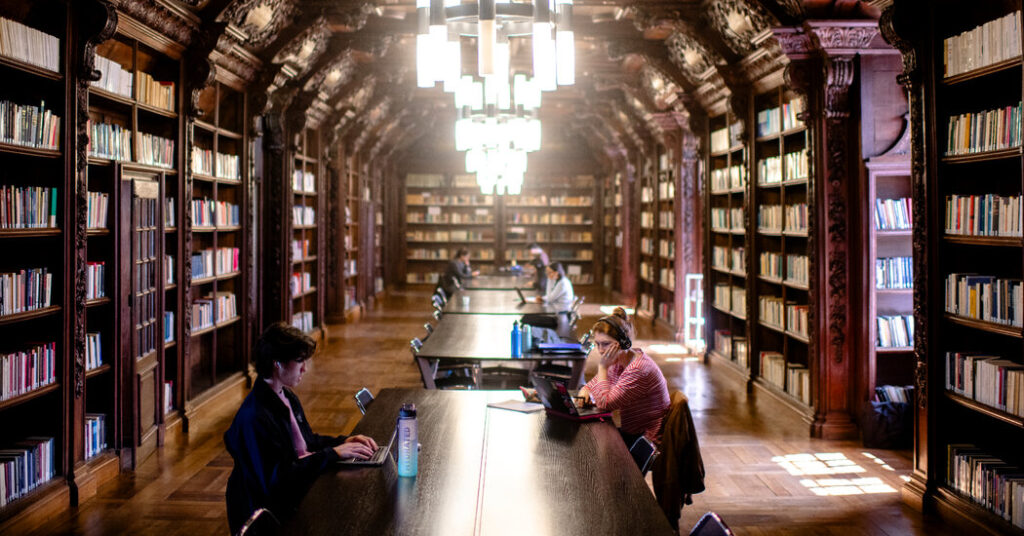
Amélie Sadlo had her heart set on college in the United States. She’d gone to summer school at Brown University and found its Ivy League campus in Providence, R.I., a world away from her bucolic hometown in the Austrian Alps. “I had this idealized vision of it in my head,” said Ms. Sadlo, now 18.
Then came the election of President Trump in 2024. A cousin of Ms. Sadlo’s who is studying in the United States ran into trouble with his visa. There was a deadly shooting on Brown’s campus. Suddenly the Ivy League no longer beckoned. “My mom told me she would not pay for it,” Ms. Sadlo said, adding, “Now I kind of see it.”
Instead, she chose Sciences Po, an elite French university that trains diplomats, journalists and politicians. It has long attracted students from around the world but in the last year has become a kind of sanctuary — both for foreign students anxious about going to the United States during the Trump presidency and for American students seeking respite from the upheaval of the Trump era.
Applications from the United States to Sciences Po’s bachelor’s program surged 52 percent this academic year, while the number of Sciences Po students applying to study for a year in the United States has plunged by 50 percent. For the first time ever, America is not the first choice for its undergraduates, who must study abroad during their third year, said Jeremy Perelman, the university’s vice president for international affairs.
This sudden shift has posed an acute challenge to Sciences Po, which tries to balance the students enrolling from overseas with those who leave for a year. It has asked American universities to reduce the number of students they send to its seven campuses around France to avoid overcrowding. Other international schools in Europe, like the London School of Economics, have also experienced spikes in applications from the United States.
There are multiple reasons for America’s loss of popularity, from gun violence to high costs. (At 5,740 euros, or roughly $6,700, Science Po’s average annual tuition for Europeans is barely a tenth of that in the Ivy League.) But students and administrators say the biggest culprit is uncertainty, stoked by reports of students who were denied visas or, in a few highly publicized cases, were pulled off the street and jailed by the immigration authorities.
“You need to rent an apartment, open a bank account, just know where you’re going to travel three weeks down the road,” said Luis Vassy, the director of Sciences Po. “People don’t like the uncertainty.”
A former diplomat who served in Washington, Mr. Vassy is careful not to blame Mr. Trump. But he said European universities were benefiting from the turmoil that had convulsed American campuses over issues like immigration and White House lawsuits against Harvard, the University of Pennsylvania and other institutions.
“It might be one of the areas where Europe in general, and France in particular, has an asset, which is to guarantee the freedom of thought,” Mr. Vassy said.
And yet Sciences Po has had its own tensions over free speech. About 100 students occupied an auditorium on its Paris campus on April 14 to protest draft legislation being debated in the French Parliament, which its backers say is aimed at curbing antisemitism but which protesters say would stifle criticism of Israel.
The university evacuated classes and called in the police to disperse the crowd. Seventy-six people were cited for “trespassing on school grounds” and fined 400 euros ($468). More than 140 faculty members signed a letter of protest, saying the administration had not tried to engage the students before breaking up a peaceful gathering.
“This environment threatens our ability to teach effectively and tarnishes the reputation of our institution,” the letter said.
Mr. Vassy rejected those claims, noting that Sciences Po played host to 2,000 events a year, many of them on divisive political issues. “Freedom of speech is fully guaranteed on campus,” he said, but added, “We have always said freedom of speech doesn’t extend to freedom to blockade the institution.”
There are fewer signs of discord at the Sciences Po campus in Reims, a stately city 80 miles east of Paris known for its cathedral and Champagne makers. Students there last week were finishing classes and cramming for exams — and expressing concerns about studying in the United States.
Maïwen Bilas, 18, a French second-year student raised in Guadeloupe, a French territory in the Caribbean, said she had planned to apply to Columbia for a master’s degree. But she is reconsidering after hearing stories of immigration officers demanding the smartphones of people entering the United States to scrutinize their social media accounts.
As a Black woman, Ms. Bilas said, she also worried about whether she would face racism, particularly in the wake of erroneous claims made during the 2024 presidential campaign by Mr. Trump and Vice President JD Vance about Haitian immigrants and the impact they have on American cities where they settle.
“I have Haitian friends who have family in the U.S.,” Ms. Bilas said. “I felt the frustration and the fear that they had to face.”
For Inès Cherifi, an 18-year-old from Morocco, the reluctance to go to the United States is not about where she comes from. America has been popular in Morocco since 2020, when the Trump administration recognized the country’s sovereignty over the disputed Western Sahara in return for Morocco’s normalizing relations with Israel.
But Ms. Cherifi noted that she had been vocal about the Palestinian cause in Gaza while on campus in France, which could complicate getting a U.S. visa. “I’m very much prepared just to never go,” she said.
U.S. students who study at Sciences Po said they believed that Mr. Trump’s re-election had negatively affected their classmates’ attitudes about Americans. Sofia Antonioli, 19, who is from Bethesda, Md., said that French students now used the word “American” as a pejorative, as in “Oh, that’s so American.”
“It has started to become more of a judgment,” she said.
Celeste Wang, 20, from Belmont, Calif., said: “A lot of people use it as a proxy for saying they disagree with some of the ways you live your life. Even silly things like me carrying a water bottle around school has become a ha-ha.”
Preanka Narenthiren, a 19-year-old from Toronto, agreed. “I think that everyone from every other country feels some sort of moral superiority, especially about American politics,” she said. “As a Canadian, I’m guilty of this.”
Not everybody is deterred. Nikola Kralev, 20, said he was leaning toward accepting an offer to study at Columbia. “I mean, coming from Bulgaria,” he said, “I feel that America’s not that bad, when you consider history.”
But even among the realists, the American beacon has dimmed. Gergo Tóth-Göde, 19, a second-year student from Hungary, recalled being rejected by Princeton. Now, he said, it doesn’t seem like such a lost opportunity. For his third year abroad, he is applying to programs in China, Vietnam and Singapore, arguing that the future is in Asia.
Mr. Tóth-Göde said he was not troubled by the populist tactics of Mr. Trump. After all, he said, his own country just shook off a populist prime minister, Viktor Orban. “This is a hot take,” he said: Populism is “a phase.” The trouble is rather that the political upheaval in the United States has made it an unreliable place to study.
He said he had no illusions about China, a surveillance state where academic freedom is sharply constrained. “But in China, I know what to expect,” Mr. Tóth-Göde said. “I know what the rules are. In the United States, it’s completely ambiguous. I might be taken away for voicing an opinion. In China, at least, I can control that.”
Ana Castelain contributed reporting.
Mark Landler is the Paris bureau chief of The Times, covering France, as well as American foreign policy in Europe and the Middle East. He has been a journalist for more than three decades.
The post In France, American Universities Lose Their Allure in the Trump Era appeared first on New York Times.