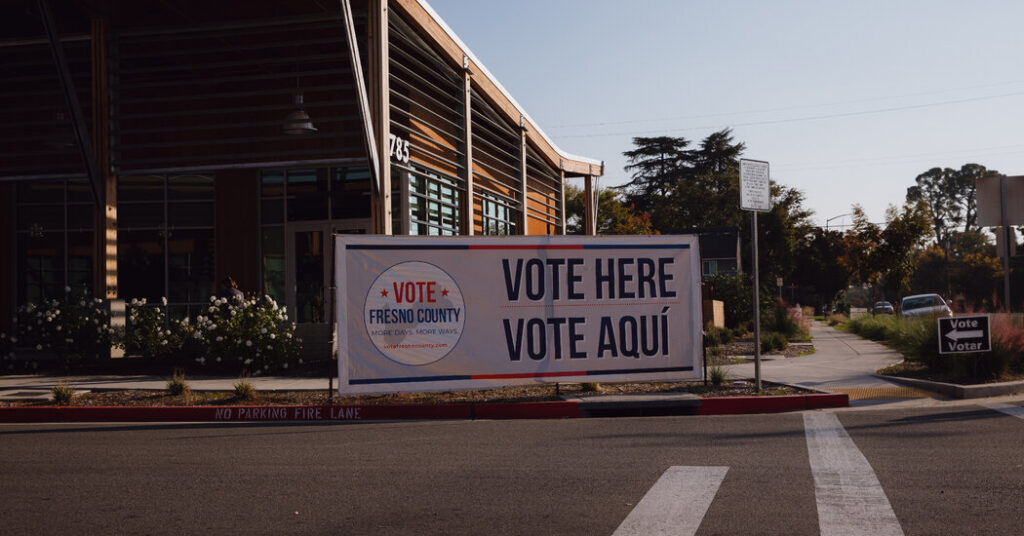
While the Supreme Court’s decision on the Voting Rights Act is expected to lead to significant changes in how Black voters are represented in the South, it could also affect how Latino and Asian Americans are represented in parts of the country where they comprise a large share of the electorate.
In California, the Voting Rights Act has been instrumental in building power for Latino voters. It was used to draw Latino-majority districts that have elected numerous Latino leaders since the 1970s, bringing Latinos into government systems that had previously been closed to them, from the federal level on down. Today, Latino politicians hold nearly one-third of the seats in California’s State Legislature and make up more than a quarter of its congressional delegation.
Texas, Illinois, New York and Arizona have also used the Voting Rights Act to draw Latino-majority districts, said Thomas A. Saenz, president of the Mexican American Legal Defense and Educational Fund.
“It has really been a game changer for Latino representation,” he said.
In California, the weakening of the Voting Rights Act is unlikely to drastically change representation for Latinos, Mr. Saenz said. Latinos make up such a large share of the state’s population, 41 percent, that Latino-majority districts will still exist in California, even without race-conscious gerrymandering.
Today, Latino voters are the majority in 16 of the state’s 52 congressional districts, and 27 of 120 state legislative districts. In another eight congressional districts, they make up at least 30 percent of the population, making them large enough to influence an election, according to an analysis by the Public Policy Institute of California.
“I think the impact of Callais is likely to be pretty muted in California,” Mr. Saenz said, referring to the case the Supreme Court decided on Wednesday, Louisiana v. Callais.
The story could be different for Asian Americans, which make up 17 percent of California’s population, said John C. Yang, president of Asian Americans Advancing Justice, a civil rights organization.
The population has only recently become large enough to be able to use the Voting Rights Act to draw majority-Asian American districts. Today, one of California’s 120 state legislative districts is drawn to empower Asian American voters. And the group is considered influential in six of the state’s 52 congressional districts.
The Supreme Court’s decision could weaken Asian Americans’ political power just as their population growth was beginning to give them more clout.
“We are getting to a point of critical mass where we can elect a representative more of our choice, more from our community,” Mr. Yang said. “And yet that right is being taken away from us.”
One of the most significant ways the court’s decision could affect California politics is at the local level, said Richard L. Hasen, a law professor at the University of California, Los Angeles.
California has a state law based on the federal Voting Rights Act that has required many cities and school boards to elect representatives by neighborhood districts, instead of across the entire jurisdiction. In many communities, the state law has led to nonwhite voters electing diverse representatives to local government because campaigning in a neighborhood is less expensive than running across an entire city.
The court’s decision could open the door for lawsuits, challenging districts in places that were forced to draw them by the California Voting Rights Act, Mr. Hasen said. He said he expected that challenges could come first in Palmdale and Santa Monica, Southern California cities that were forced by litigation in recent years to change the way their leaders are elected.
“It’s impossible to overstate the significance of this decision,” Mr. Hasen said. “It’s an earthquake in American politics.”
Laurel Rosenhall is a Sacramento-based reporter covering California politics and government for The Times.
The post How the Voting Rights Act Reshaped California Politics appeared first on New York Times.