Federal regulators on Tuesday ordered a review of all station licenses owned by ABC, an extraordinary move to pressure a major television network whose programming has frequently angered President Trump.
The agency overseeing the review, the Federal Communications Commission, said in a filing that the review was related to an investigation into ABC’s diversity and inclusion policies. But it came in the middle of a fight this week between Mr. Trump and the network’s late night host, Jimmy Kimmel, that prompted the president to demand that ABC fire Mr. Kimmel.
The F.C.C. action represented an escalation by the Trump administration and the president to punish major media outlets for their coverage. Mr. Trump has personally sued several news organizations, including The New York Times, and the Pentagon has tried to sharply restrict news media access.
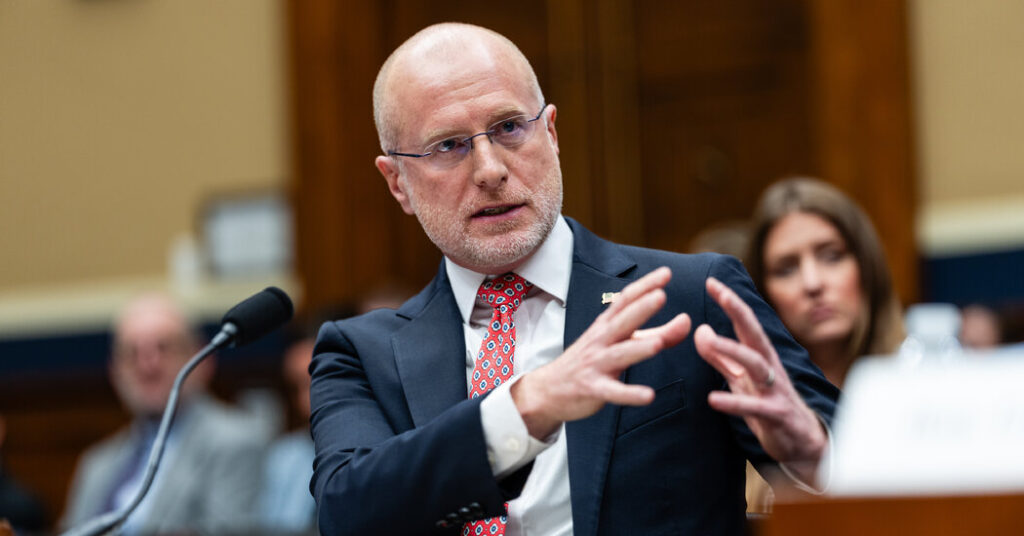
Mr. Trump’s F.C.C. chairman, Brendan Carr, has repeatedly threatened to take action against broadcasters, including to take away their valuable station licenses. His agency’s action on Tuesday was the first direct step toward potentially doing so.
It is extremely difficult for the government to take away stations’ rights to broadcast; it must be able to make a convincing case that the stations had shown a pattern of violating rules and regulations. Even if the F.C.C. ultimately decides to block the renewal of ABC’s station licenses, the network will have ample recourse in the courts. And it would be able to continue to broadcast as the fight played out.
The federal government has never before ordered such a sweeping review of a major television network’s licenses, which allow the companies to broadcast in local markets. All told, ABC owns eight of the more than 200 local stations that carry its programming across the country, in vital markets including New York, Los Angeles and Philadelphia.
Still, the move all but guarantees months if not years of legal wrangling that would lock the network in an expensive, running war with the federal government.
ABC’s parent company, The Walt Disney Company, said in a statement that it had long complied with F.C.C. rules and that it was “confident that record demonstrates our continued qualifications as licensees under the Communications Act and the First Amendment and are prepared to show that through the appropriate legal channels.”
“Our focus remains, as always, on serving viewers in the local communities where our stations operate,” the company said.
Media lawyers and free speech advocates have decried the action.
“This is about as extreme an action as I’ve ever seen the F.C.C. take against a broadcaster for frivolous reasons,” said Gigi Sohn, a senior staff member at the agency during the Obama administration. “It’s a message to every other network, ‘Watch yourself, you might be next.’”
Jameel Jaffer, executive director at the Knight First Amendment Institute at Columbia University, said in a statement on Tuesday that if Mr. Trump “gets his way, we’ll have only government-aligned media organizations that broadcast only government-approved news and commentary.”
“It would be difficult to imagine an outcome more corrosive to democracy or more offensive to the First Amendment,” Mr. Jaffer added.
Under normal F.C.C. protocol, ABC would not have to apply to renew any of its station licenses — which run on eight-year terms — until 2028, as Mr. Trump would be coming to the end of his presidency. (And some of its licenses do not come up for renewal until 2030 and 2031.)
But a little-used provision of the law allows the F.C.C. to force stations to apply for renewal of their licenses at any time, opening the door to an early refusal to renew.
Mr. Carr walked through a theoretical version of the process in a podcast released on Tuesday, shortly before his agency filed for the review. “You can accelerate when a license comes due and say, ‘Hey, we have significant concerns about how you’re conducting your operations,’” he said on “The Katie Miller Podcast.” “‘We want to review your license now, and decide if you’re in the public interest.’”
The process provides Disney with 30 days to file its application to renew its license. If the F.C.C. decides to deny the application and revoke the licenses, Disney will have a chance to plead its case at a hearing.
The agency has some leeway to decide the venue for the hearing, according to a person with knowledge of the F.C.C.’s thinking. It could conceivably take place before the F.C.C.’s commissioners: two Republicans, Mr. Carr and Olivia Trusty, and one Democrat, Anna Gomez, who spoke out against the license review on Tuesday. Agency actions require a simple majority vote.
But Andrew Jay Schwartzman, a longtime public interest lawyer involved in media regulation issues, said typically at the F.C.C. — and this instance is far from typical — the issue would go before the agency’s administrative law judge.
Mr. Schwartzman added that he regarded the case as “all bluster,” emphasizing how hard it is for the government to pull station licenses.
License revocation, which has been rare, requires the government to establish that a license holder has exhibited patterns of serious violations. Even in previous cases where stations faced allegations of political favoritism, they were mixed in with suspicions of fraud and lying to regulators. More generally, the law forbids the F.C.C. to use its regulatory power to censor.
“Even if this weren’t frivolous to begin with,” Mr. Schwartzman said, “the legal standard for denying a license renewal is almost insurmountable.”
In its filing on Tuesday, the F.C.C. indicated the decision to call for the early license reviews stemmed from an investigation, started in early 2025, into whether Disney violated F.C.C. rules, “including the agency’s prohibition on unlawful discrimination.” It had come after an executive order banning what the administration referred to as “illegal and immoral” D.E.I. programs in the federal government.
The F.C.C. has also started an investigation into the ABC show “The View,’’ over equal-time rules that apply to appearances by political candidates.
But there was no mistaking the timing of Tuesday’s action, plans for which were reported earlier by Semafor.
It came one day after President Trump and the first lady, Melania Trump, both called for the firing of Jimmy Kimmel over a joke he delivered in his monologue on his ABC late night show last week.
On “Jimmy Kimmel Live!” last Thursday, Mr. Kimmel imagined he was the M.C. of the White House correspondents’ dinner, and, pretending to address Mrs. Trump, said that she had the “glow” of an “expectant widow.”
That gala was ultimately canceled on Saturday after a 31-year-old man carrying deadly weapons breached security just outside the hotel ballroom. He has since been charged with trying to assassinate President Trump.
Mrs. Trump criticized Mr. Kimmel’s comments on Monday morning, saying that he “shouldn’t have the opportunity to enter our homes each evening to spread hate.” Hours later, Mr. Trump said on social media that the ABC host “should be immediately fired.”
Mr. Kimmel did not apologize during his monologue on Monday night. “It was a very light roast joke about the fact that he’s almost 80 and she’s younger than I am,” Mr. Kimmel said on his show. “It was not by any stretch of the definition a call to assassination, and they know that.”
Last year, ABC temporarily suspended “Jimmy Kimmel Live!” after Mr. Carr suggested he would take action against ABC because of a monologue joke that Mr. Kimmel made about the man accused of assassinating Charlie Kirk. ABC’s suspension quickly morphed into a flashpoint about free speech, and after a significant backlash, the network reinstated the late night show six days after it was pulled off the air.
The move once again casts Mr. Carr as Mr. Trump’s top “media pit bull,” as the Hollywood Reporter has called him, a role he clearly relishes.
But he has also drawn accusations that he is weaponizing telecom laws in doing the president’s bidding, occasionally even from Trump-allied Republicans.
In September, Senator Ted Cruz, Republican of Texas, described Mr. Carr’s threats to revoke Disney licenses for Mr. Kimmel’s Kirk monologue as “dangerous as hell,’’ likening Mr. Carr to a “mafioso.”
In November, a former Republican F.C.C. chairman under President Ronald Reagan, Mark Fowler, and other former agency leaders petitioned Mr. Carr to eliminate a decades-old “news distortion policy” that Mr. Carr has occasionally cited in criticizing broadcasters. The former leaders said it had become a “tool that chills speech, invites abuse and undermines First Amendment protections.”
Mr. Carr denied their petition. But, on Tuesday, they filed a request to the U.S. Court of Appeals for the District of Columbia to order Mr. Carr to bring it to a vote.
Cecilia Kang contributed reporting.
Jim Rutenberg is a writer at large for The Times and The New York Times Magazine and writes most often about media and politics.
The post F.C.C. Orders a Review of ABC’s Broadcast Licenses appeared first on New York Times.