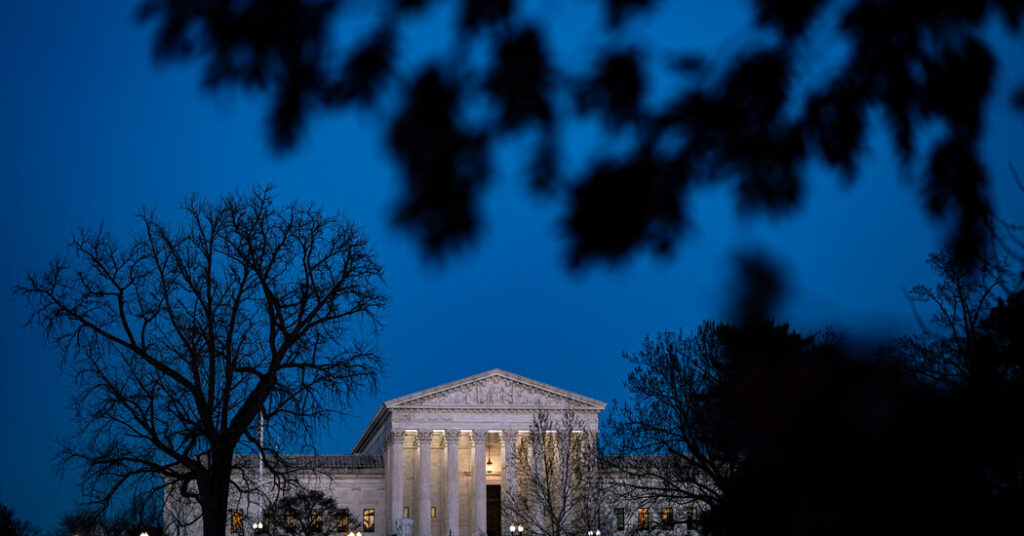
The Supreme Court has twice before addressed the Temporary Protected Status program that is the subject of Wednesday’s argument, in brief orders on what critics call the court’s shadow docket. Wednesday’s argument may shed light on the legal force of such terse rulings.
In May, the justices let the Trump administration temporarily lift protections for some 300,000 immigrants from Venezuela, blocking a lower court’s ruling. The Supreme Court’s order gave no reasons, which is not usual when the court acts on emergency applications. But the court’s failure to explain itself on such a consequential matter was the subject of criticism.
The court’s use of unexplained orders in fast-tracked cases arising from major presidential initiatives has its roots in a 2016 ruling that halted President Barack Obama’s Clean Power Plan, his attempt to address climate change through executive action. The court’s order in that case, like the one in May giving the Trump administration a green light to deport Venezuelan migrants, contained no reasoning at all.
The case on the T.P.S. program returned to Judge Edward M. Chen of the Federal District Court in San Francisco, who in September again ruled in favor of the immigrants after receiving additional evidence. He said he was not bound by the Supreme Court’s order in May, noting that it “did not provide any specific rationale for its decision.”
The Supreme Court then paused Judge Chen’s second ruling, too. The court’s second order, which was quite terse, said the unexplained first one was binding. “Although the posture of the case has changed, the parties’ legal arguments and relative harms generally have not,” said the brief unsigned opinion of a majority of the justices. “The same result that we reached in May is appropriate here.”
In asking the Supreme Court to let the administration lift protections for Syrian and Haitian migrants, Solicitor General D. John Sauer relied on the two earlier orders concerning Venezuelans. Among the questions Mr. Sauer asked the justices to resolve was “what to make of this court’s interim orders.”
In a supporting brief, more than 175 former judges wrote that emergency orders without real reasoning should have no legal weight.
“Whatever the force of the orders this court issues in cases on the emergency docket that explain the basis for the court’s decision,” the brief said, “its unexplained emergency decisions are not binding, or even especially informative, when lower courts exercise their judicial power in a different case involving different facts and circumstances.”
That was in keeping with remarks by Justice Samuel A. Alito Jr. in 2021, when he said the court’s emergency orders did not create precedents.
On Monday, the court issued a one-sentence decision in a redistricting case. It said it had ruled “for the reasons set forth” in an earlier emergency order in the case, which provided five paragraphs of reasoning for what was ostensibly an interim measure temporarily halting a 160-page decision from a divided three-judge panel of a lower court.
Adam Liptak is the chief legal affairs correspondent of The Times and the host of The Docket, a newsletter on legal developments. A graduate of Yale Law School, he practiced law for 14 years before joining The Times in 2002.
The post Arguments May Shed Light on the Court’s ‘Shadow Docket’ appeared first on New York Times.