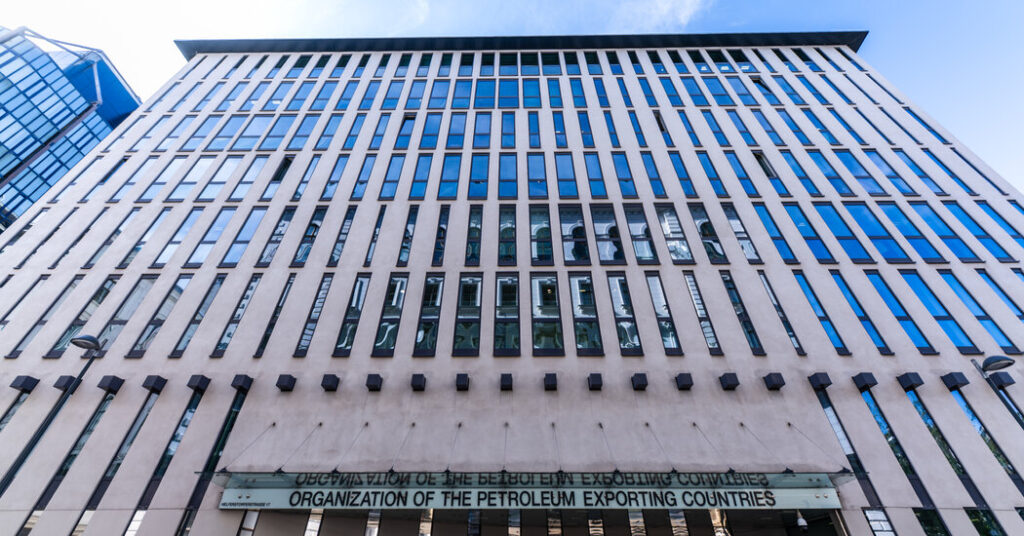
The OPEC oil cartel has long sought to control the price of oil by effectively controlling a big chunk of the world’s supply of crude. But its influence has been waning for years.
On Tuesday, it took another big hit when the United Arab Emirates said it would leave OPEC at the end of the week. OPEC countries supplied more than a quarter of the world’s oil before the U.S.-Israeli war with Iran began on Feb. 28; losing the Emirates would leave it around a little more than 20 percent.
Before the cartel was founded nearly 70 years ago, the world’s oil markets looked very different. Here’s how OPEC came to be, and how it has evolved.
What is OPEC?
The Organization of the Petroleum Exporting Countries was created in 1960 as a way to control oil prices and stabilize global markets. It currently has 12 members, including the Emirates, and Saudi Arabia is its de facto leader.
The other members are Algeria, the Republic of Congo, Equatorial Guinea, Gabon, Iran, Iraq, Kuwait, Libya, Nigeria and Venezuela. Together, the nations set production quotas, and can intervene during shocks by increasing or pulling back oil production.
This month, in response to the war’s impact on global supplies and energy infrastructure, members of OPEC said they would raise oil production quotas by 206,000 barrels a day in May. But the move is not likely to do much overall, as the Strait of Hormuz, a vital oil shipping route off Iran’s southern coast, remains effectively closed.
By mid-March, Persian Gulf countries had taken an estimated 10 million barrels of daily oil production offline, or about 10 percent of global supplies, the International Energy Agency said.
Why was it founded?
Before OPEC, another cartel effectively controlled global oil prices. The group, known as the Seven Sisters, included the predecessors of companies such as BP, Chevron, Exxon Mobil and Shell. Together, they controlled a huge amount of the world’s petroleum reserves.
“The oil-producing countries of the world were getting kind of a raw deal from the oil companies that were running the global oil system,” said Jeff Colgan, the director of the Climate Solutions Lab at Brown University’s Watson School.
In September 1960, Iran, Iraq, Kuwait, Saudi Arabia and Venezuela created OPEC. “For the first decade, they did a bunch of activity, but not a lot of economic impact,” Mr. Colgan said.
That would change.
OPEC’s shifting power.
The 1970s were by some measures the height of OPEC’s influence. In October 1973, several cartel members in the Middle East imposed an oil embargo on the United States and other countries that supported Israel in the Arab-Israeli war that year, also known as the Yom Kippur War. Oil prices skyrocketed, leading to a global energy shock.
“They were very, very effective at raising the gross price of oil and capturing a lot more of their revenues from oil,” Mr. Colgan said. “But on the other hand, what they soon discovered in the ’70s was that they couldn’t actually control the price of oil anything like the Seven Sisters.”
The 1973 embargoed oil accounted for about 7 percent of global consumption, and targeted only a handful of nations.
And, Mr. Colgan said, OPEC’s leaders have not always been able to make the group’s members abide by established quotas.
“They have leverage at particular moments; they don’t have leverage all the time,” he said. “Mainly they have leverage when the market gets tight — there’s a lot of demand chasing not a lot of supply, which includes moments like right now.”
During the coronavirus pandemic, oil prices dropped sharply, with U.S. crude briefly dipping into negative territory. OPEC and other oil-producing nations restrained production enough that the global prices recovered.
Members and expansion.
OPEC has had several organizational shake-ups. The five founding members were later joined by Qatar, which left in 2019 after what appeared to be frustration with Saudi Arabia’s dominance of the group. Several other countries — Angola, Ecuador and Indonesia — have also left or suspended their memberships. Other countries have withdrawn and then reactivated their memberships.
In 2016, the U.S. shale boom increased global oil supplies, leading to a steep drop in prices. OPEC, seeking firmer footing in the industry, began to work with other oil-producing nations to raise petroleum prices and revenues and stabilize government budgets.
That agreement, with Russia and other countries, led to a coordinated push to cut oil output and was the foundation for what has become known as OPEC Plus, an alliance of oil-producing countries that have agreed to coordinate on production levels.
“One of the things we look at historically is what percentage of global oil supply does OPEC represent,” said Pavel Molchanov, an industry analyst at Raymond James, an investment bank. “If we look at the 1970s, that was the peak of OPEC market power because in the 1970s, OPEC accounted for more than half of global oil supply.” That amount has dropped as production has increased elsewhere.
What’s next.
The closing of the Strait of Hormuz is a unique moment in the energy market, when changes in supplies have little impact on prices because one-fifth of the world’s oil is effectively choked off. And even with the Emirates’ withdrawal from OPEC, the group will still produce a large amount of the world’s oil.
“Right now is not the right time to be prognosticating on OPEC’s long-term influence,” Mr. Molchanov said. “We need to get the Strait of Hormuz reopened first, and then think about the long-term impact of everything that’s happened.”
Emmett Lindner is a business reporter for The Times.
The post What Is OPEC, and How Does It Operate? appeared first on New York Times.