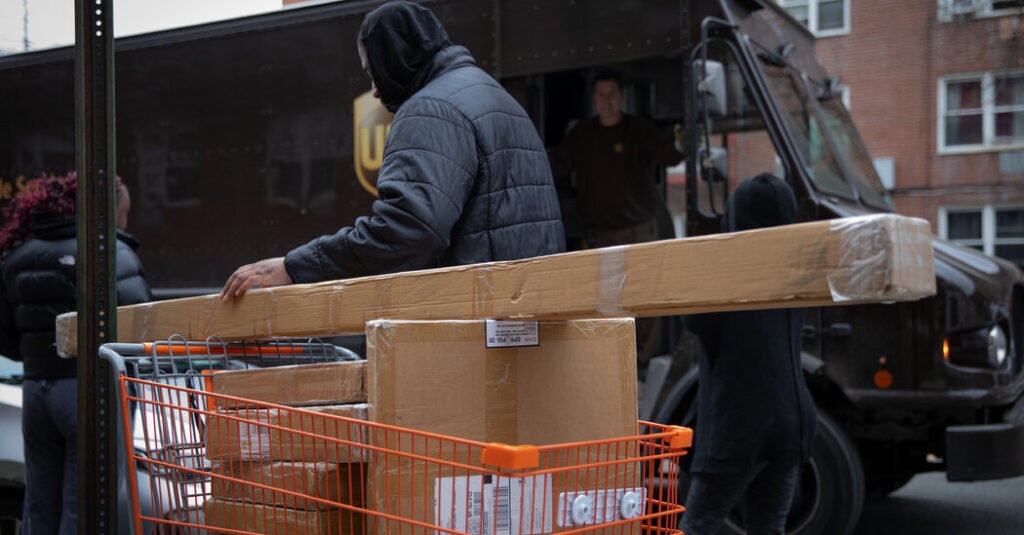
People young and old trek up to seven blocks to gather on a tree-dotted sidewalk on Staten Island, rain or shine. They line up, some still wearing pajamas, ID in hand. Someone is always standing in line somewhere in New York City, but this time, the people are not waiting to buy new sneakers or to try food that has gone viral.
They are waiting to pick up packages.
A driver from the United Parcel Service parks in front of 240 Park Hill Avenue, the designated drop-off location, every weekday morning. Residents of two apartment complexes on the borough’s North Shore arrive with bags and shopping carts to pick up their medicine, diapers, clothes, furniture and whatever else can fit on the company’s signature brown trucks.
Amazon comes to their door. FedEx enters their buildings. And the U.S. Postal Service still delivers.
But for decades, UPS drivers have stayed out of two complexes — Park Hill and Fox Hill — that now house about 1,400 apartments. The practice forces residents to predict when deliveries will arrive or risk not getting their packages that day. Sometimes the window is from 10:30 a.m. to 11:15 a.m.; sometimes it’s through noon.
In 2006, UPS said it made deliveries that way in an effort to protect drivers after five violent assaults by residents between 1985 and 1996. The rule, which had started about a decade before, appeared to initially cover more locations on the island but was amended in other places as residents complained, a city councilman stepped in and the company said adequate security measures, like cameras, were put in place, according to a report by City Limits.
The 120th Precinct, which covers the area, has seen overall violence drop dramatically since the 1990s, according to Police Department data.
Meanwhile, New York City has become the center of the e-commerce boom. UPS, a publicly traded company, has in recent years handled about 25 percent of all packages that are shipped daily across the United States.
A lawsuit claiming that the way UPS delivers packages to the two apartment complexes is illegal and discriminatory has been working its way through the Federal District Court in Brooklyn for more than a year.
UPS has said that it does not serve everyone in the same way. But Andrew Wilson, a partner with one of the firms that brought the suit, said his team has not been able to find details on any other communities served this particular way.
“We’re hopeful that the case brings about change,” said Mr. Wilson, with Emery Celli Brinckerhoff Abady Ward & Maazel.
Mitch Polikoff, head of media relations at UPS, did not answer questions about how long the practice had been in place, why it was instituted or whether it was in use anywhere else. He said he could not comment on the specifics of the lawsuit.
In a statement in 2024, before the lawsuit, Mr. Polikoff said, “Our top priority is the safety of our people, and we continually evaluate delivery methods to provide top-notch service while ensuring the well-being of our employees.”
To Fatima Camara, who has lived in the Park Hill complex for about 15 years, the policy feels unfair. In early April, she came to the pickup location with her injured right arm in a brace but was told her package was not there yet and to return another day.
“It’s not right because for me, I’m in pain,” she said. “I have to come all the way here to come pick it up.”
The policy isn’t officially written or communicated, residents say.
When a new resident moves in and sees a delivery notice from UPS but no package, they begin their search. Confused, they ask their neighbors, building management and the local UPS offices. They’re told to find the truck outside of 240 Park Hill.
On a warm morning in August 2024, nearly two dozen people stood on the sidewalk at the drop-off location.
Among them was Antoinette Moore, who had moved to the neighborhood about two years before. She said she had stopped in the middle of her job braiding hair to pick up a package. She had missed the delivery window for three days, she said, until she found a client willing to wait with her. Ms. Moore pointed to a woman nearby with a bright pink bonnet tied around her half-braided hair.
“I would love if I didn’t have to leave work,” she said.
But for people who grew up in the neighborhood, known for being the birthplace of the Wu-Tang Clan, the line is the only way of life they know.
Some longtime residents, who saw the violence their neighborhood weathered in past decades and is still experiencing, don’t fault carriers for not wanting to enter the buildings for their safety. Getting the packages directly from the truck at least guaranteed they wouldn’t be stolen from the lobbies, some residents said.
Keenen Hill, who has lived at Park Hill for about 30 years, and now works as a super in the complex, said he’s never heard any complaints. The driver has been the same for about the past eight years and has become like “an extended family member,” said Mr. Hill, who lived through the bout of violence cited by UPS.
“Everybody knows him,” Mr. Hill, 53, said. “It’s never been a problem.”
The driver directed questions to UPS.
Others have begun to question if the practice is unfair, even discriminatory.
Sharon McLennon Wier, executive director of the Center for Independence of the Disabled, New York, said the policy goes beyond an inconvenience and is “extreme.” It highlights a “huge disparity based on class and race and disability status,” she said.
The area has became home to a growing African immigrant community over the past few decades. The pickup location is now by the corner of Little Liberia Way and Park Hill Avenue.
“If it was a white neighborhood, and someone had a disability in that white neighborhood, their package is going to come straight to their apartment,” Ms. McLennon Wier said.
Gordon Flowers has lived in the Fox Hill complex since about 2011, but it wasn’t until an injury that made it hard for him to walk four years later that he learned about the UPS practice. Needing a walker to get around, Mr. Flowers said he became more dependent on deliveries to get medications and other necessities.
Several years ago, he began circulating a petition in the hopes of pressuring the company to reverse its policy, but a hot summer hampered his efforts and he got only about 175 signatures. He contacted local lawmakers, rights advocacy groups and UPS to no avail, he said.
At his wits’ end, Mr. Flowers reached out to lawyers.
“We want to be treated like everybody else,” Mr. Flowers said, adding: “We’re paying money, but we’re not getting the full service and I think that’s unfair.”
In October 2024, Mr. Flowers became the main plaintiff in the lawsuit filed in Brooklyn, which claims that UPS’s practice discriminates against residents of the buildings, 99 percent of whom the suit says are not white. The company delivers to other similarly sized apartment buildings in northeastern Staten Island with higher proportions of white residents, according to the filing, violating state and city laws.
The lawsuit seeks compensation and that UPS provide the same services that it gives to other multifamily buildings on the island.
In 2006, a UPS spokesman, Norman Black, denied that the practice was related to race or “a neighborhood not looking nice.” Precautions “tailored to a specific situation and building” were not limited to the Staten Island neighborhoods or New York City, he told City Limits.
In December, Progressive Management, the property management subsidiary of the Arker Companies, took over Park Hill. Simon Bacchus, a director, said it started a “comprehensive, $165 million rehabilitation of the property.”
“Improving security and the overall sense of safety for residents and visitors is a central priority,” he said. The company looks “forward to engaging with UPS as these improvements take shape.”
For now, some older residents have figured out workarounds.
When Victoria DiPaola in her 60s has a package, she doesn’t wait in line — she has her brother do it. Her brother, who lives in Park Hill, also stands in line for their mother.
“I get a headache with this,” Ms. DiPaola said. “I really do.”
Hurubie Meko is a Times reporter covering criminal justice in New York, with a focus on the Manhattan district attorney’s office and state courts.
The post UPS Won’t Bring Packages to Their Doors. Some Are Fed Up. appeared first on New York Times.