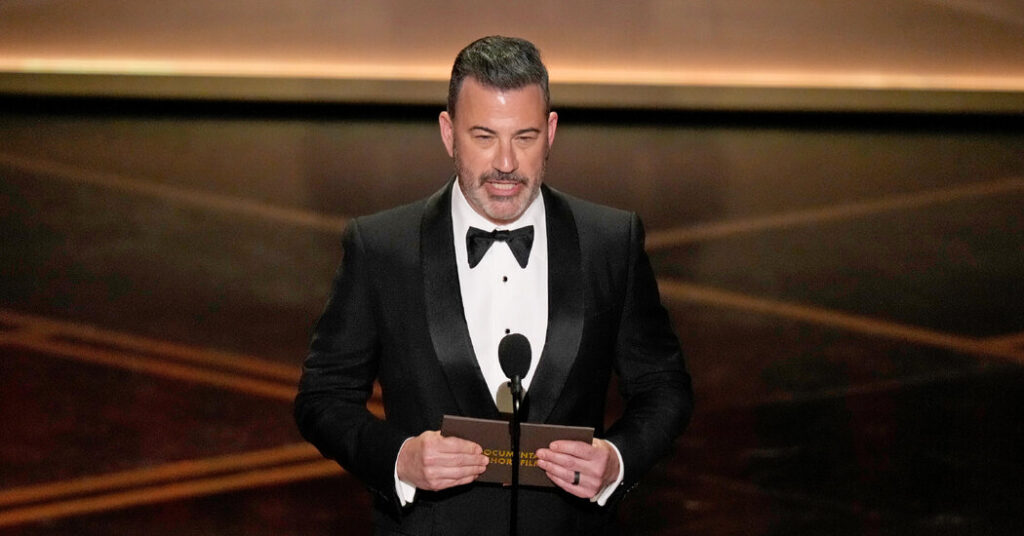
The talk show host Jimmy Kimmel defended himself on Monday night after President Trump called for the ABC network to fire him over a joke that the president said was “really shocking.” Mr. Kimmel also offered an endorsement of freedom of speech.
A back-and-forth on civil liberties between a late-night funnyman and the leader of the free world? How did we get here? Also, haven’t we already been here?
Here’s what to know.
What did Kimmel say about the president?
On “Jimmy Kimmel Live” on Thursday night, Mr. Kimmel held a mock roast of the president. Alongside jokes about Jeffrey Epstein and flatulence, he quipped at the first lady, Melania Trump, “Mrs. Trump, you have a glow like an expectant widow.”
Of the many jokes he delivered that evening, it ended up resonating for an unexpected reason.
When did Kimmel say this?
Mr. Kimmel’s routine was broadcast on Thursday night.
Then, on Saturday, the president attended the White House Correspondents Dinner in Washington where he was to deliver an address. After he was seated, an armed man breached security, and shots rang out as Secret Service agents scrambled. The suspect, Cole Tomas Allen, was charged in federal court on Monday with attempting to assassinate the president.
The timing of the joke about Melania Trump became awkward in hindsight.
What was the Trumps’ response?
Mrs. Trump called out Mr. Kimmel’s joke on Monday, writing in a social media message that the host’s “hateful and violent rhetoric is intended to divide our country. His monologue about my family isn’t comedy — his words are corrosive and deepens the political sickness within America.”
The president followed, calling the joke a “despicable call to violence.” “Jimmy Kimmel should be immediately fired by Disney and ABC,” he said.
The White House press secretary, Karoline Leavitt, added, “This kind of rhetoric about the president, the first lady, and his supporters is completely deranged.”
And Kimmel didn’t back down?
He said on his show on Monday that the gag “obviously was a joke about their age difference.”
“It was not by any stretch of the definition a call to assassination — and they know that,” he said.
“But I understand that the first lady had a stressful experience over the weekend,” he added. “And probably every weekend is pretty stressful in that house.”
He added, to applause from his studio audience: “Donald Trump is allowed to say whatever he wants to say. As are you, as am I, as are all of us because under the First Amendment, we have a right as Americans to free speech.”
Isn’t there history here?
Mr. Kimmel’s show was pulled off the air by ABC in September after Mr. Kimmel suggested that the man accused of assassinating Charlie Kirk was tied to the MAGA movement.
The decision to yank the show was praised by Mr. Trump.
The suspension was initially described by ABC as indefinite, but the show was back on the air in a week.
On his return, Mr. Kimmel acknowledged that his remarks were “ill timed,” but also said “a government threat to silence a comedian the president doesn’t like is anti-American.”
Is there something more significant at stake?
The chairman of the Federal Communications Commission, Brendan Carr, criticized Mr. Kimmel after the Kirk remarks and suggested his federal agency might take action against ABC.
Television stations have licenses to use the airwaves awarded by the F.C.C. The commission has the power to revoke those licenses, but it has rarely done so. The F.C.C. also has regulatory powers over the sales or mergers of TV stations or networks.
After an ABC reporter asked a question about Mr. Epstein last year, Mr. Trump suggested that Mr. Carr should look into taking action against the network.
Whether his administration would actually go through with this threat to strike back at a comedian who tells just as many jokes about Matt Damon is another question.
Victor Mather, who has been a reporter and editor at The Times for 25 years, covers sports and breaking news.
The post Kimmel vs. Trump: What’s Going On Here? appeared first on New York Times.