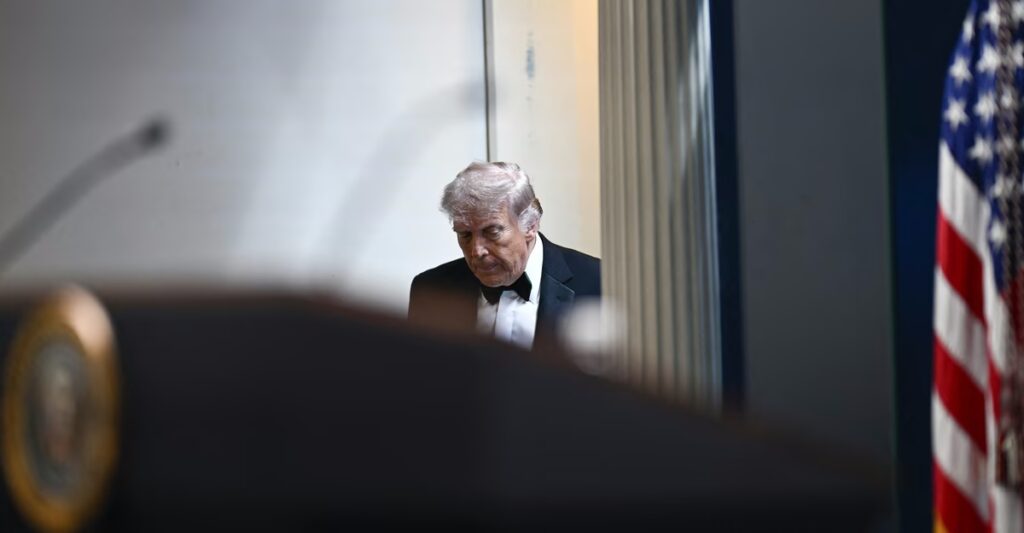
For a guy who had just been rushed out of a ballroom at the sound of gunfire, he seemed remarkably calm. For a president who regularly attacks the press, he seemed unusually gracious. For a fleeting period on Saturday night, Donald Trump appeared introspective, or at least as introspective as he’s capable of being in public.
“It’s always shocking when something like this happens,” he told reporters in the White House briefing room, standing in his tux and appearing to speak without notes. He briefly seemed to consider how familiar he was with threats to his life, and how the shock doesn’t fade: “Happened to me a little bit. And that never changes.”
At least three times within the past two years, Trump has been perilously close to a gunman trying to harm him and has escaped death. When a bullet grazed his ear at a July 2024 campaign rally in Butler, Pennsylvania, he described it as a religious experience in which divine intervention saved him for a higher calling. “I’m not supposed to be here tonight,” Trump said at the Republican National Convention shortly after the shooting. “I’ll tell you, I stand before you in this arena only by the grace of Almighty God.”
Such talk of the Almighty does not come easily to Trump, who has never been particularly religious, and on Saturday night, he turned to an equally unfamiliar topic: unity. This is a president who had frequently and harshly criticized many of the reporters in front of him, and had sued many of the news organizations that employ them. He had long boycotted the White House Correspondents’ Association Dinner, calling members of the media the “enemy of the people” and the dinner “a very big, boring bust.” But on Saturday night, he struck a different tone.
“This was an event dedicated to freedom of speech that was supposed to bring together members of both parties with members of the press,” he said. “And in a certain way, it did—because the fact that they just unified, I saw a room that was just totally unified.”
He added: “It was in one way, very beautiful, a very beautiful thing to see.”
Trump marveled at how the cavernous ballroom he had been looking out on two hours prior was a collection of divergent viewpoints. He called for those gathered “to resolve our differences,” suggesting that perhaps the labels “Republicans, Democrats, independents, conservatives, liberals, and progressives” could become less divisive. But he soon began to slip back into character with a grandiose boast: “Everybody in that room, big crowd, record-setting crowd—there was a record-setting group of people.”
Trump had privately remarked that he was impressed at how journalists continued to do their job after the incident, quickly turning from dinner participants to news gatherers, a person close to the president told us, speaking on the condition of anonymity to share the private details. Trump had fun on Saturday night, despite the dark turn, reveling in the black-tie, celebrity-filled party and delighting in answering questions from reporters that for once weren’t confrontational. He had watched some of the coverage before walking into the briefing room, this person told us, and continued to the next day, marveling in particular at footage of tuxedoed photographers snapping pictures and reporters in formal attire craning to get iPhone shots.
Our colleagues were part of that scramble. We have both been in dozens of sessions in the White House briefing room, which is named after James Brady, the White House press secretary who was severely injured in a 1981 assassination attempt of Ronald Reagan at the Washington Hilton, the same hotel that hosted Saturday night’s dinner. But none felt like this. Reporters were checking on one another, adrenaline pumping after experiencing a major news moment.
[Read: A shooting at the White House Correspondents’ Dinner]
Trump gave the first question of the night to Weijia Jiang, a CBS News correspondent and the president of the WHCA, who had been sitting next to him onstage and then crawled to safety behind him. He announced that he wanted to reschedule the dinner within the next 30 days and to make it even bigger and better, as if it were his event to plan. (He and his allies have also suggested that future dinners should be held in the massive but controversial new ballroom that he’s building at the White House.)
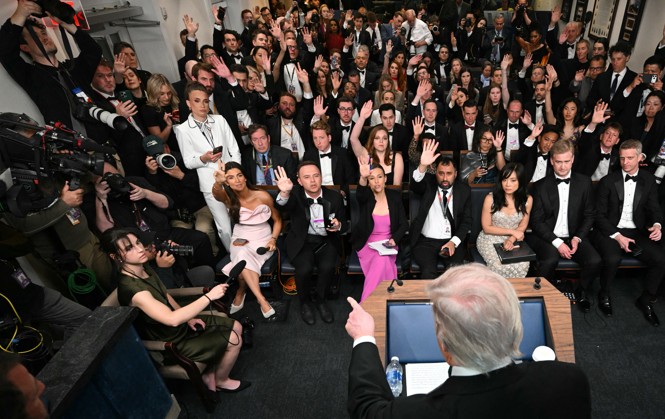
“I just want to say you did a fantastic job,” he said to Jiang from the podium. “What a beautiful evening, and we’re going to reschedule.”
The room of journalists burst into applause. Trump chuckled at the response and said: “After that, it’s very tough for her to ask a killer question, right?”
The warm feelings, predictably, didn’t last long. The next day, CBS News’s Norah O’Donnell visited the White House to interview the president for a segment that aired that night on 60 Minutes. It began with a recounting of the night before: Trump remarked on the Secret Service agents who had urged him to drop to the ground for his safety, on how well the first lady responded, and on the speed of the shooter. (“The NFL should sign him up. He was fast.”) “I wasn’t worried. I understand life,” he said, tiptoeing toward the philosophical. “We live in a crazy world.”
But then O’Donnell read from the text of a manifesto that the suspect allegedly wrote, stating that he was “no longer willing to permit a pedophile, rapist, and traitor to coat my hands with his crimes.” She asked the president to respond to that. Trump grew testy, saying he knew she would read that line. “You’re horrible people, horrible people,” he said. “I’m not a rapist. I didn’t rape anybody.”
But the line she read from the manifesto did not explicitly name Trump. Was it his assumption, she asked, that those lines were a reference to him? “Excuse me. I’m not a pedophile. You read that crap from some sick person?” he said. “I was totally exonerated. Your friends on the other side of the plate are the ones that were involved with, let’s say, Epstein or other things.”
The president told the journalist that she “should be ashamed of yourself, reading that.” O’Donnell pointed out that she was simply reading the words of the alleged gunman. “You’re a disgrace,” Trump said. “But go ahead. Let’s finish the interview.”
His temper, eventually, seemed to cool, and he appeared torn over whether to be angry at a media he’s long lambasted or appreciative that reporters had lived through the same experience. “I don’t know how long it will last—the relationship, the friendship, the spirit after a very bad event took place,” he mused.
In the hours after the security breach, Trump told reporters that he has been studying past assassinations, especially that of Abraham Lincoln, and it was clear that political violence has been on his mind. He has pushed to make government records on the assassinations of John F. Kennedy, Robert F. Kennedy, and Martin Luther King Jr. available to the public. He’s talked about William McKinley (“As you know, he was assassinated”), Charlie Kirk (“assassinated in the prime of his life for boldly speaking the truth”), and Shinzo Abe (“unfortunately assassinated”).
“These assassins, they seem to be high-IQ people, but they’re crazy,” Trump said yesterday of those who are accused of trying to kill him. The suspect in Saturday night’s attempt, Cole Allen, wrote in his manifesto, published by the New York Post, that his top targets were administration officials, ranked highest to lowest.
After the shooting in Butler, Trump would at times talk about the danger of the presidency. He returned to that idea on Saturday night, remarking that he’s always thought of race-car drivers and bull riders as being in particularly risky professions. But statistics show that the presidency is even more so, he said, carrying a 5.8 percent chance of being killed and an 8 percent chance of being shot at. “I can’t imagine that there’s any profession more dangerous,” he added.
About two months after the Butler shooting, a man with a gun was spotted by Secret Service agents outside Trump’s golf course in West Palm Beach, Florida, while Trump was golfing. Agents fired at him, he fled, and he has since been sentenced to life in prison. There have also been threats of assassination from Iran, which became one element of Trump’s decision to order a joint U.S.-Israel operation that killed Ayatollah Ali Khamenei. (“I got him before he got me,” Trump later said. “I got him first.”)
[Read: How Trump lives with the threat of Iranian assassination]
Though Saturday night was terrifying, the gunman never got close to the president or other officials. Some in his orbit were happy to take the moment to talk about something other than the war with Iran or the struggling economy. Those close to him told us they were reminded of Butler, when a heroic Trump was celebrated for being unbowed by the specter of violence. Trump seemed upbeat, one person who briefly spoke with him yesterday told us, believing that the incident was, in a way, further proof that he was a consequential president.
Asked on Saturday if violence was simply the cost of modern-day politics, the president responded that he thought that was true. But he added that he tries to push such thoughts out of his mind, adding that he has “a pretty normal life, considering,” and doesn’t want threats to affect his mental state the way they could for others: “To be honest with you, I’m not a basket case.”
Trump had wanted the dinner to resume Saturday night, and he suggested that he was planning to alter his jokes to capture the shifting mood of the room, and perhaps beyond. “I was going to get up and make an entirely different speech,” he said in an interview with Fox News’s Jacqui Heinrich yesterday morning. “I was going to really rip it last night. I was talking about everybody. And then they said, Well, my speech is going to be much different. It’ll be a speech of love. But I didn’t get a chance to do that. Probably I was better off if I didn’t. I don’t know.”
The post The Briefly Introspective President appeared first on The Atlantic.