On the first Saturday morning in April I sat on my sofa in Brooklyn, drinking coffee, and watched the B1 bridge outside Tehran partly collapse on my phone. Iranian engineers had spent years building it. It was meant to connect Tehran to Karaj, a city where I have relatives and that I visited as a child. The bridge had yet to open to the public. An American bomb cut it in half while families nearby were celebrating Sizdah Bedar, the Persian holiday known as Nature Day. Reports say that at least eight people were killed. An engineer at the site told a French reporter that the bridge had been like a child to him.
Below that video, Instagram showed me an ad for a Dr. Dennis Gross anti-aging face mask. Below that, an old college classmate arranging tulips on her kitchen island. Below that, a nurse at a hospital in Tehran carrying newborns through the debris. Below that, a video of nachos and lobster rolls and everything else someone ordered at Yankee Stadium on opening day.
I kept scrolling. I do not remember making a decision to keep scrolling. I don’t think I made one. My thumb just moved, the way it always moves, down and down, and the war and the face mask and the tulips and the nachos slid past in a single unbroken current, each one dissolving into the next before I could fix my attention on any of them. This was my Instagram feed. Yours would have shown you something else entirely. For me, the food video lasted 30 seconds. The bridge, 11. I obliged.
I called my mother later that morning. The person she asks about most is my cousin in Tehran. On the Persian New Year, on March 20, my cousin and I managed to FaceTime for three minutes before the signal cut out. He told me I looked sharp in my suit. We told each other what we always do. That we love each other, that we miss each other, that we hope to see each other soon. Then the screen went black.
There is a word in Persian, “ghorbat,” that describes the particular ache of exile. It is not homesickness, exactly. It is more structural than that, more permanent. It is the condition of being separated from a place by a distance that you understand, somewhere deep in your body, you may never close.
My parents have lived inside that word for more than 40 years. Their parents died in America, still calling Iran home. Ghorbat runs through Persian poetry the way longing runs through blues music, not as a subject that appears now and then but as the key in which everything is written. Centuries of invasion and exile carved the word into the language. The poetry evolved to hold the things displaced people could not take with them.
Something has changed about that word in the last decade, and it took this war for me to understand what. My family’s ghorbat was the house I was raised in. I had lived in it my whole life without calling it mourning. It was the low frequency of my days, so constant I mistook it for silence. Then the bombs started falling. To live inside ghorbat once meant you could not see what was happening back home. You mourned from a distance that at least had the mercy of being total. I do not have that mercy. I can watch a neighborhood in Isfahan get flattened in real time, in high definition, on a device I carry with me, from a coffee shop on Franklin Avenue in Brooklyn.
But there is another Iran in my memory. It’s the sound of my grandmothers laughing in rooms I will never sit in again. Through the phone in my pocket, I am closer to the country’s destruction than any Iranian exile in history has ever been. And I have never felt further from it. Because the images come and they come and they come, and the device that delivers them also buries them, instantly, under the next image, which is a slow-motion video of monarch butterflies beginning their migration north, which is a sunset over the Hudson River, which is an ad for running shoes. The closeness is an illusion.
What is real is the velocity. And the machine that drives it, which knows what I like but not what matters to me, draws no line between a bridge falling and a face mask ad. The velocity makes everything, the bridge and the face mask and the dead, weigh the same. Which is to say: nothing.
Then came the cease-fire. I watched my feed absorb that, too. Many Americans will not remember a single image from this war. They will not remember forgetting it. The forgetting will be the memory.
There is no modern vocabulary for what the scroll does to grief. The closest I have found is an entry in the diary of Leo Tolstoy, written late in his life. Tolstoy describes cleaning his study one day. He reaches the sofa and cannot remember whether he has already dusted it. The motion was so habitual, so emptied of conscious thought, that it passed through him without leaving any trace. If the act was performed unconsciously, he writes, then it was the same as if it had never been performed at all. And he goes further: If an entire life were lived this way, without awareness, it would be as if that life had never been lived.
More than 20 years ago, Susan Sontag argued that the problem with war on television was never that viewers stopped caring. It was that the medium was organized to keep attention moving, to make every image replaceable by the next. She was describing a screen that sat on a table in a living room. Everyone who tuned in saw the same images of the same war.
Mine fits in my pocket. The war it delivers is personal, shaped by an algorithm that tracks my grief as engagement. Sontag believed that a photograph could still stop time, that a single image could freeze a moment long enough to become memory. Vietnam’s napalm girl. Sept. 11’s falling man. There is no such image from this war. Not because the images don’t exist. They do, by the thousands. But the feed that delivered them to me did not deliver them to you. We are not watching the same war. There can be no napalm girl when there is no nightly news most everybody watches together. The images flash by too fast to scar, buried under the next video, the next photo, the next thing your thumb finds before your mind catches up.
Last month, in a Fox News segment filmed on a Florida beach, college students on spring break were asked what issues in America were most important to them. One said, “What bikini I’m going to wear next.” Others could not name the ayatollah. Several did not know the United States was at war.
I was served this clip on my Instagram feed, reposted by an account I follow. But watching it as an Iranian-American whose family is scattered across a country my own government is at war with, I did not feel outrage at those students. I felt recognition. The algorithm that fed me a collapsing bridge fed them which bikini to wear. We scrolled through Gaza. We scrolled through Ukraine. But in those wars, Americans were spectators. In this one, we dropped the bombs.
The images arrived the same way. Same phones. Same speed. One produced marches and sit-ins. The other has produced nothing. I watched Americans fill the streets over the Gaza war and I understood: To many, a sense of morality was clear. Iran doesn’t offer that. For more than 45 years, the regime has been the story. Americans learned Iran the way they learned most countries they would later bomb, in shorthand.
On the scroll, the ayatollah and my cousin look like the same person. That confusion is older than the algorithm, but the scroll perfected it. The scroll cannot tell a complicated story, only move you past it. Gaza let Americans feel righteous. Iran asks them to feel responsible. The difference was never in the images. It is in what Americans are willing to see in themselves.
Tolstoy assumed that awareness would change behavior. You would dust the sofa with intention, or not dust it at all. But the feed has proved something different: You can know that the scroll is erasing the war from your consciousness in real time and keep scrolling anyway. I watched what happened in Isfahan and understood that those were real buildings and real people and that my country is responsible for their destruction. And then I kept scrolling. Because stopping, truly stopping, would mean sitting with a grief and a complicity so enormous that the body resists it the way it resists pain, by going numb, by looking away, by swiping to the next thing.
I pick up my phone a hundred times a day. Last night I picked it up and, for once, put it back down. It sat there, dark, quiet, the size of my hand. The bridge. The nachos. The dead. The tulips. The war. I left it all on the table. It was the most conscious act I had performed in weeks.
Nick Mafi is the author of “Calatrava Art” and is working on his first novel.
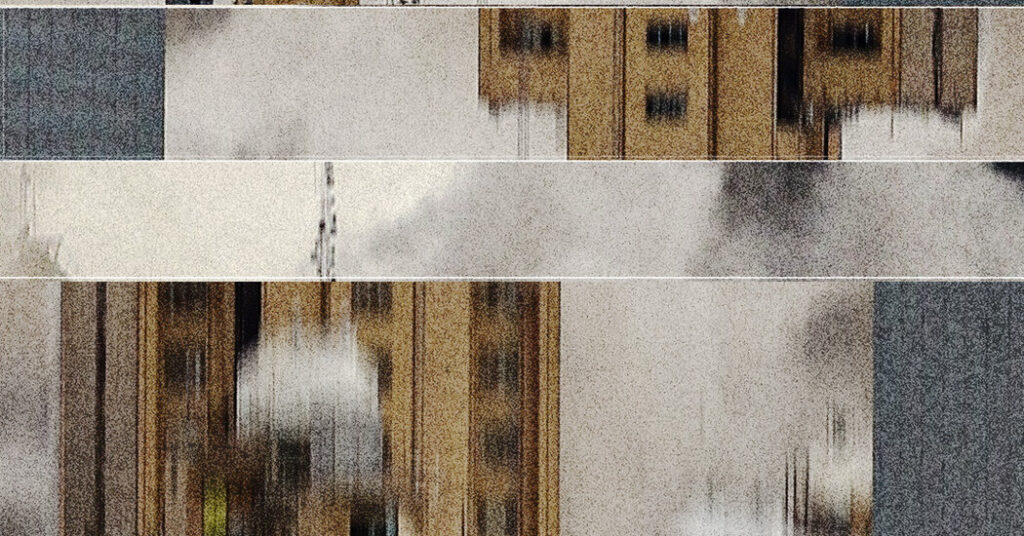
Source photograph via Getty Images.
The Times is committed to publishing a diversity of letters to the editor. We’d like to hear what you think about this or any of our articles. Here are some tips. And here’s our email: [email protected].
Follow the New York Times Opinion section on Facebook, Instagram, TikTok, Bluesky, WhatsApp and Threads.
The post War and Nachos on My Social Media Feed appeared first on New York Times.