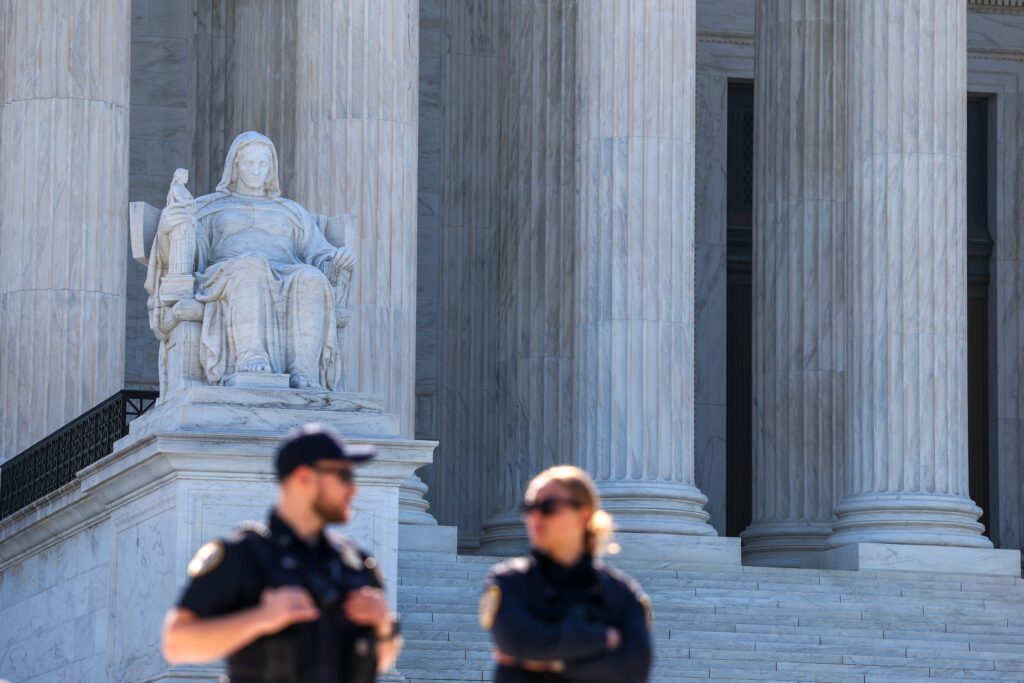
The Supreme Court on Monday grappled with the constitutionality of law enforcement’s use of Google location history data to track down a suspect, in a case that could further define the Constitution’s protections for digital privacy.
Some of the justices seemed inclined to uphold what are known as geofence warrants, a new tool that police use to narrow down suspects based on location data collected by companies such as Google. Although some justices seemed to agree that a warrant is necessary to obtain that data, they wrestled with how such warrants square with the Constitution, drafted long before the advent of technology that could pinpoint an individual’s location.
Chief Justice John G. Roberts Jr. said one of the central concerns about the warrants is that they could enable the government to catalogue everyone who was at particular location — such as a place of worship or political organization — at a particular time.
“What are the restraints that would prevent that from becoming a problem?” Roberts asked.
Attorneys for the Trump administration argue that the warrants — which seek to locate everyone who was within a specific geographic area at a particular time — can help investigators crack difficult cases without infringing on Americans’ constitutional rights.
Critics say the warrants are too broad, letting police see into the lives of people not suspected of crimes. The high court is considering whether a geofence warrant violated a bank robbery defendant’s constitutional right to be protected from unreasonable government searches and seizures.
An attorney for armed robbery defendant Okello Chatrie, who was swept up in a geofence warrant, faced evident skepticism from many of the justices. They questioned whether Google users, such as Chatrie, could have a “reasonable expectation of privacy” after they themselves turned on their device’s location history function.
“If you don’t want them to peer into your window … you can close the shades,” Roberts said.
But Justice Sonia Sotomayor noted that it can be difficult to turn off location history. She noted that Google’s privacy policies allow the company to respond to law enforcement requests for photos, email and documents, as well as location history.
“If this is consent, that means the government can seek those documents for any reason, not just the commission of a crime, or no reason, correct?” Sotomayor said. “So that means the government, a police officer randomly who decides, ‘I don’t like that person; let me just go look at their life to see if I can find a crime,’ that would be okay?”
Adam Unikowsky, Chatrie’s lawyer, said that without a finding that such data is protected by the Constitution, police could do so.
The case is the latest skirmish over how to balance cutting-edge data collection with Americans’ right to privacy. In 2018, the Supreme Court ruled 5-4 that police need a warrant — which requires a sign-off by a judge — to obtain cell site location data from phone companies. The majority, led by Roberts, found that “time-stamped data provides an intimate window into a person’s life, revealing not only his particular movements, but through them his ‘familial, political, professional, religious, and sexual associations.’”
Now, the court is looking at a different kind of location data — Google’s location history — which is far more precise and comprehensive, acting like a “digital diary of a person’s travels,” as Google, which opposes the broad nature of many of the geofence warrants, put it in court filings.
Users must activate the feature for it to work, and they have the ability to review and delete it as they wish, according to the company. Google said that since last year, it no longer stores location history on its servers and cannot respond to geofence warrants.
But it was still collecting and storing the data in 2019 when a robbery took place at a credit union in Richmond. Chatrie, who had his location history turned on at the time of the robbery, pleaded guilty after police tracked him down with a geofence warrant.
The warrant, signed by a local judge, asked the company to provide an anonymized map of every Google user within 150 meters of the bank and within a half-hour of the robbery, according to court filings. That search returned information on 19 users and their movements.
But Google had reservations when detectives asked for the identities of those 19 users, and the company told the detectives to narrow the list. They did so by specifying the target’s movements an additional 30 minutes before and after the initial time frame.
The search turned up three suspects. Google then “unmasked” those users, providing their names and account information. One of them was Chatrie, whose movements appeared to match those of the robber. Detectives then obtained another warrant to search Chatrie’s home, finding a handgun, two robbery demand notes and nearly $100,000 in cash, according to court records. Some of the cash was wrapped in bands signed by a teller from the robbed credit union.
Although Chatrie pleaded guilty, he reserved his right to challenge evidence obtained through the geofence warrant. A federal judge in Virginia found that the warrant violated Chatrie’s Fourth Amendment rights but ruled that detectives were acting in good faith, so the data could not be excluded as evidence.
A panel of the U.S. Court of Appeals for the 4th Circuit affirmed the decision, as did the full appeals court.
Central to the case is whether Chatrie had a “reasonable expectation of privacy.” Because he had his Google location history turned on during the robbery, the government argues that he in effect volunteered a record of his movements and had no reasonable expectation of privacy, meaning a warrant was not even necessary.
Attorneys for Chatrie argue that his location history is his property, which Google was storing for his personal use. When police obtained it, it was as if they had rummaged through his house, the attorneys argue.
Although Google has taken no position on Chatrie’s case specifically, the company urged the court in an amicus brief to find that law enforcement officers must obtain warrants for an individual’s location history data. They should not be sweeping warrants like the one in Chatrie’s case, which capture the location data of people not involved in crimes, Google argued.
“A contrary rule would leave the intimate details of millions of Americans’ daily lives — data that will exist in many forms as technology rapidly develops — exposed to warrantless surveillance,” the company wrote.
The post Supreme Court weighs whether police can demand Google location data appeared first on Washington Post.