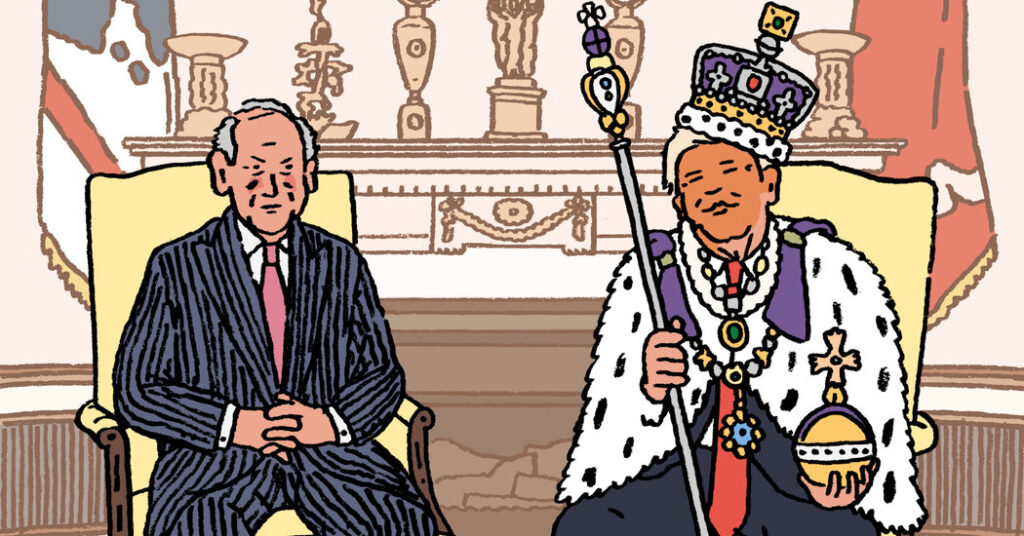
King Charles III of Britain touched down for a state visit on Monday at a moment when relations with the United States are particularly fragile. But despite President Trump being so unpopular in Britain that around half of Britons thought the visit should be canceled, it’s going ahead — with increased security, after the shooting on Saturday night at the White House correspondents’ dinner.
Winston Churchill’s belief, first expressed in 1946, in a “special relationship” between the two countries feels like a broken dream. Is there any reason to believe it might be revived this week?
The king and the president have precious little in common. They are both in their late 70s — Charles is 77 and Mr. Trump is 79; both hold the title head of state; both inherited a lot of money.
Otherwise, they are opposites. The king is soft-spoken, artistically inclined and given to bouts of self-doubt. He wouldn’t be seen dead in a baseball cap. The president is brash, loud and boastful. Charles likes to peck away at a small portion of organic vegetables and fish; Mr. Trump prefers a Big Mac and fries.
Their outlooks, too, couldn’t be more different. Charles has long worried about climate change. At the COP28 climate summit in 2023, he said that humans are carrying out “a vast, frightening experiment” on the planet, and that unless the balance is restored, “our survivability will be imperiled.” Mr. Trump told the U.N. last year that “windmills are pathetic,” and called the idea of a climate footprint a “hoax.” Charles was an author of a book called “Harmony: A New Way of Looking at Our World.” Three years earlier, Mr. Trump wrote one called “Think Big and Kick Ass: In Business and in Life.”
Charles is inclined to worry. In a broadcast marking the 100th anniversary of his mother’s birth this month, he said, “Much about the times we now live in, I suspect, may have troubled her deeply, but I take heart from her belief that goodness will always prevail, and that a brighter dawn is never far from the horizon.” Mr. Trump is confident that force will prevail, even if it means he has to bomb other countries “back to the Stone Ages.”
These men are by no means natural soul mates. Nevertheless, there are signs that a British monarch can still hold some sway in the White House. In an interview with the right-leaning network GBNews in November, Mr. Trump said that when he was a child his mother would tell him to be quiet whenever Queen Elizabeth II was on television. “My mother was a great fan of the queen,” he said. “Any time the queen was on, she said, ‘Excuse me, don’t talk. We have to listen to the queen.’ ” He has described these moments as formative, and said they left him with a lifelong respect for the royal family.
Mr. Trump has praised Elizabeth II’s son — only last week he told the BBC that Charles is both “a fantastic man” and “a great man.” And after Mr. Trump criticized the British armed forces at Davos in January — for, against all evidence, “having stayed a little back, a little off the front line” in Afghanistan — Charles, who is the head of the British armed forces, was widely reported to have sent a correction to the White House. Around the same time, in a rare course correction, the president released a statement praising “the great and very brave soldiers of the United Kingdom.”
Whether from nerves or self-aggrandizement, even confident, successful people presented to royalty often spout an unstoppable stream of gibberish. Terry Wogan, a veteran broadcaster, called it “the Royal Effect.” Elizabeth II once asked President Nixon’s ambassador to Britain, Walter Annenberg, where he and his wife were living. His verbose reply, recorded on camera, was: “We’re in the Embassy residence, subject, of course, to some of the discomfiture as a result of the needs for elements of refurbishing and rehabilitation.” The queen maintained a fixed smile throughout. It was all part of her training.
No doubt Charles will employ the same technique while Mr. Trump inevitably rambles on. He is a good listener. Virtually all his working life has been spent asking people polite questions — “Have you come far?” “Have you been waiting long?” “What exactly do you do?” — and smiling and nodding empathetically at their replies.
Of course, the trick of the royal family is to make everyone feel special, however brief their acquaintance. Some presidents realize that this is a necessary illusion. Mr. Trump told The Daily Mail, a British tabloid, in 2024 that he’d heard he was the queen’s favorite president. Susan Page, the Washington bureau chief for USA Today, interviewed senior officials in the palace and the British government for her book “The Queen and Her Presidents.” She wrote that she asked them about Mr. Trump’s claim that he was the queen’s favorite and “they responded with startled laughter.” The British monarchy has not managed to survive for more than a thousand years without a ruthless sense of self-preservation.
In “The Godfather, Part II,” Michael Corleone tells his treacherous brother Fredo that he no longer means anything to him. “You’re not a brother, you’re not a friend,” he says. “I don’t want to know you or what you do. I don’t want to see you at the hotels, I don’t want you near my house. When you see our mother, I want to know a day in advance, so I won’t be there. You understand?” Michael issues strict instructions to his aides that nothing should happen to his brother while his mother is alive.
It’s a story that might ring a bell. Just a few years after the queen’s death, Charles stripped his brother, Andrew Mountbatten-Windsor, of his title and evicted him from his home. The image handed down to posterity will be of Mr. Mountbatten-Windsor slumped in the back of a police car, desperately trying not to be seen.
This week Charles will be smiling benignly and nodding politely, but it’s worth remembering that beneath that good humor and politesse there is a layer of steel. Courtesy can be tactical as well as virtuous.
Craig Brown is the author, most recently, of “Q: A Voyage Around the Queen.”
The Times is committed to publishing a diversity of letters to the editor. We’d like to hear what you think about this or any of our articles. Here are some tips. And here’s our email: [email protected].
Follow the New York Times Opinion section on Facebook, Instagram, TikTok, Bluesky, WhatsApp and Threads.
The post The President and the King appeared first on New York Times.