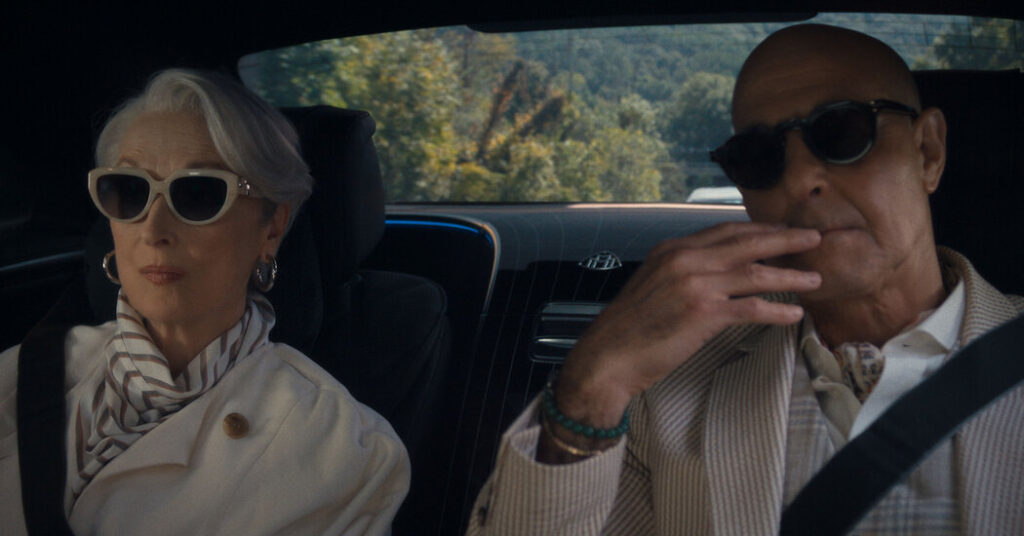
When 20th Century Studios released a trailer for “The Devil Wears Prada 2” it quickly racked up millions of views. It is impossible to say, however, how many of those views came from the same people rewatching the coming attraction, not because they could not wait to see the sequel, but because they could barely see the trailer.
“The heartbreaking story of a woman who can no longer afford lamps in her office,” read one viral post, showing Meryl Streep’s Miranda Priestly of yore alongside a screenshot from the new dimly-lit trailer. “So did we just forget how to light movies?” asked another, above bright images from the 2006 film beside shadowy, shrouded shots from the sequel. Noting that the sequel employs the same director and cinematographer as the original, one poster lamented “that isn’t a skill issue it’s a choice. So why DO new movies insist on looking like that. Absolutely lifeless.”
Ask anyone on Letterboxd and they’ll surely report that the average movie today lacks the “look” of the average movie from even just 25 years ago: Images are dark and blurry, special effects a C.G.I. sludge, the overall feeling artificial and flat. Even fans who can’t put their finger on what is happening or why seem to be in consensus that it’s happening.
In November, Tom van der Linden, the host of the YouTube channel Like Stories of Old, posted a wonky, nearly 30-minute explainer on “Why Movies Just Don’t Feel ‘Real’ Anymore.” Within a month, it became his most popular video ever. James and Anthony Deveney, independent filmmakers and hosts of “Raiders of the Lost Pod,” also devoted an episode to this issue. An excerpt they shared across social media — titled “Why New Movies Look Bad” — has the highest engagement of any clip they’ve ever made.
“I think over the last 10 years, it’s not even just cinephiles. It’s just everyday moviegoers. We all feel like movies have changed. They don’t look the same anymore,” said James Deveney. “You go back to the 2000s and anytime before that, even B-movies, C-movies, look good!”
These commentators suspect a few culprits: Bottom-line-focused executives for whom cinema is nothing more than “content”; standardization wrought by streamers; the inherent supremacy of shooting on film over now-dominant digital. “People are becoming hip to it, and it’s a big factor in why people aren’t going to the movies anymore,” said Deveney.
To van der Linden, there’s “a moral question” at play. “The reality of a movie is not something that exists on its own,” he said. “It’s solely determined by the viewer’s immersion in the movie. When that breaks, there is a disconnect that is kind of tragic.”
What’s With Those Blurry Backgrounds?
Ironically, several of the features in modern movies these film buffs decry are, according to the industry professionals, likely deployed to make movies shot on digital look more “cinematic.” Take a chief complaint: an overreliance on shallow depth-of-field shots, in which the foreground is in focus and the background is blurry, like Portrait Mode on an iPhone.
“I think there’s a sense [out there] of everything being in focus is video-y, and narrow depth of field is cinematic,” said the cinematographer Steve Yedlin (“Knives Out,” “Star Wars: The Last Jedi.”) He says there is a misconception that “softness” is what makes a movie look like a film.
Last year, Ed Lachman, a four-time Academy Award nominated-cinematographer (“Far From Heaven,” “Carol”) appeared on the cinematographer Roger Deakins’s podcast and attested that movies shot with a shallow depth of field make everything look like “mush.” Deakins — arguably the most influential cinematographer in movie history — didn’t disagree: “You’re often isolating the character in a kind of sea of mist.”
In our interview, Lachman clarified that a shallow depth of field “can be used sometimes, for effect.” Think of a character having a mental breakdown as the world around them falls away. “But overall doing that, it also loses how we actually see things. Even in our peripheral vision, we see deep focus.”
For van der Linden, the blurry-background conundrum is exacerbated by “fake-looking C.G.I. elements.” He pointed to 2025’s “Jurassic World Rebirth”: Compared to the technically-jankier but actually-superior “Jurassic Park” (1993), the latest installment’s backgrounds are constantly out of focus. The environments — even in scenes shot on location — are rendered “faker” through digital visual effects that undermine the world-building. “Subconsciously, I’m not registering that landscape as a real place, and that detracts from the reality of the movie as a whole,” he said.
Lachman agreed. “Something is lost with this over-manipulation of the image, so it loses its credibility — or I call, authenticity — of what you believe about the image.”
Nothing to See Here
But none of that matters if the audience can’t even see what’s happening onscreen. Whatever happened to the “lights” in lights, camera, action?
The advent of digital is partly to blame. Film cameras require more light. “People probably do stretch the ability to shoot in lower light with digital cameras,” said Vanessa Bendetti, vice president and head of motion picture at Kodak.
But she theorizes something else is going on. “I think there’s a lot of effort to try and make digital feel cinematic,” she said. Low lighting is part of that effort to create mood. “Because otherwise it can feel the same as a commercial or a soap opera,” she said, “or whatever else is being shot with a digital camera.”
While there is disagreement, even among the pros, as to whether film is innately superior to digital, everyone agrees that one tricky side effect of the pivot to digital is what it’s done to dailies and, by extent, the entire moviemaking process. Film dailies take about 24 hours to turn around; a director can watch a video tap on set (a device “taps” the camera — like tapping a phone — and is hooked up to an external monitor, showing what’s in the frame), said Bendetti, but “it’s not an exact representation at all of what the film will look like.”
With digital, dailies are available on a monitor — instantly. “Anybody who is part of the production can be sitting next to the monitor and have a lot of opinions about what they’re doing,” said Bendetti.
Yedlin thinks this too-many-cooks situation ultimately leads to a certain flattening. “People are playing it safe,” he said. “Bland safeness on set is going to be bland safeness in the end. Bland safety on set is not a way to make something strong in post.”
In Yedlin’s view, “When you really get down to the bare bones of it, it’s not even a technical issue. It’s the diplomacy issue.” By the time a movie is in postproduction, “Who is going to be the person who says, ‘Well, now I’m going to take this thing you’ve been staring at for months and make it look totally different’?”
Todd Vaziri, a visual effects artist and supervisor at Industrial Light & Magic who has contributed to movies like “Avatar” and “Mission Impossible — Ghost Protocol,” described another all-too-common scenario: “When the release date of a picture is set up before the screenplay, designs and ideas are fully in place: In a lot of cases, that’s the current environment. Our schedules have gotten way shorter, the shot counts have ballooned.”
For creative decisions, Vaziri said, “It’s so easy to say, ‘Let’s just put that off. Let’s wait until we’re done filming. We’ve got enough to deal with.”
‘The Netflix Look?’ Not Quite.
Among some movie lovers, the mediocre appearance of the average new release has a name: The Netflix Look. There is a pervasive sense that streamers — through negligence or fiat — are making everything look the same.
Yedlin insists this is not the case. He has worked with both Netflix (the two most recent “Knives Out” movies) and Peacock (“Poker Face,” notable for the 1970s film-like texture Yedlin achieved, despite shooting digitally) and says plainly, “Nobody is enforcing a bland look.”
There’s something less sinister at work, he says. “I’ve heard people say things like, ‘Netflix has their Netflix look,’ and I’m like: They’re not telling filmmakers to do a look!” said Yedlin. Instead, viewers are seeing “the look as perfectly as the flimsy container can do.”
“There’s a big setup problem” with people’s televisions, he says. There are two common viewing formats, SDR and HDR — standard and high dynamic range — which communicate to a player how an image can be shown. “If the player is playing HDR and the TV thinks it’s SDR, it’s going to be spectacularly flat and washed-out.” (Imagine building something in meters when the instructions were written in feet.)
But Bendetti, from Kodak, has an assessment aligned more closely with certain fan concerns. “The people who are making decisions about the way the movie should look are not always the filmmakers,” she said, adding: “Everyone is going to have an opinion about what is best for them for their return on their investment,” she says of the distributors, studios and financial backers. “It’s that way more than ever now.”
Is there hope? “I think there’s already sort of a countermovement,” said van der Linden, citing the success of his video. Fans yearn for a meaningful experience at the movies, and he believes “more filmmakers [are] interested in finding new ways to connect with people in a time when it feels like that connection is being lost.”
The post Are Movies Really Getting Darker? Let’s Shine Some Light on the Issue. appeared first on New York Times.