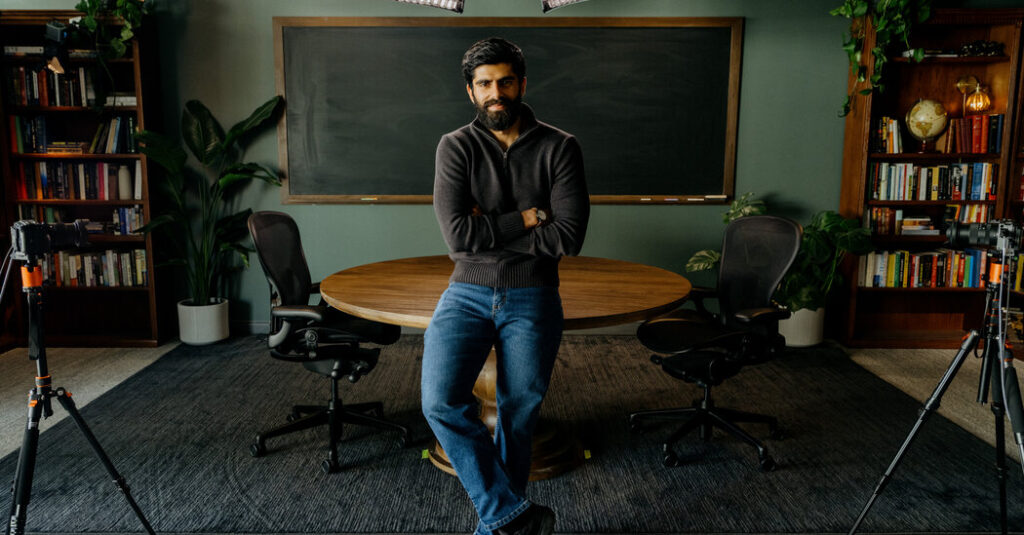
As Dwarkesh Patel entered a small sushi restaurant in San Francisco’s SoMa neighborhood on a recent Monday evening, a ripple of excitement passed among four young men sitting together near the door. Before Mr. Patel, a 25-year-old podcaster with a weightlifting-enhanced physique and a dense beard that friends call “majestic,” could approach the hostess, two of the men asked him for selfies. He obliged, then stepped outside to wait for a table. I asked whether this happened a lot. “I feel like it’s gotten especially intense in the last few months,” he said.
Though Mr. Patel is largely unknown to tech outsiders, the “Dwarkesh Podcast” averages two million listens per episode, and within the bubble of A.I. builders, backers and worriers, it is mandatory listening. The busiest chief executives (Satya Nadella, Mark Zuckerberg) and most influential A.I. researchers (Ilya Sutskever, Andrej Karpathy) sit with him for interviews that often exceed two hours. Tyler Cowen, the economist and public intellectual, describes Mr. Patel as “the No. 1 chronicler of the A.I. era; no one comes close to him in that way.”
Mr. Patel has achieved this distinction by immersing himself in the artificial intelligence community and speaking its language. An episode that included, without pausing for definitions, the terms “quadratic attention costs,” “KV vectors,” and “nines of reliability” went viral in A.I. circles. Mr. Patel told me his aim is to dig into the debates at the frontier of A.I. development. “And those things are just lost if you are, in the moment, trying to translate for other people.”
Mr. Patel’s affable aura of authority derives, too, if not from his plain-vanilla undergraduate computer science degree, then from his milieu of friends, roommates and group-chatmates who include researchers at A.I. labs, investors and A.I.-adjacent thinkers. It’s all quite cozy. Mr. Patel’s assistant is the brother of Anthropic chief executive Dario Amodei’s chief of staff, who is in turn the fiancée of Leopold Aschenbrenner, Mr. Patel’s friend and former podcast guest from whose multibillion-dollar A.I.-focused investment fund, Situational Awareness, Mr. Patel sublets office space. Sholto Douglas, a researcher at Anthropic who is one of Mr. Patel’s roommates and a repeat guest on his podcast, recently competed with Mr. Patel in a “chestmaxxing” showdown on a YouTube show called “Swole as a Service” (where standing shoulder presses meet A.I. chitchat). “People don’t think of him as a commentator on A.I.,” says Sasha de Marigny, chief communications officer at Anthropic. “He’s very much in the community, in the inner ring.”
His interviews shape elite opinion. Over the past year, Mr. Patel’s skepticism has risen about current A.I. models’ potential for “continual learning” — the ability for a machine intelligence to keep learning on its own, the way people do. Mr. Patel remains confident that A.I. will reach that inflection point, and that it will be hugely disruptive before then; he just believes that transformative A.I. may take up to a decade to arrive, instead of a year or two, because of various technical “bottlenecks.” About continual learning not happening as fast as expected, “obviously people were aware of it as a problem,” Mr. Douglas says, “but a lot of the A.I. labs started talking about it publicly after Dwarkesh raised its public prominence.”
Mr. Patel’s taste in guests, and approach to interviewing them, encapsulates a worldview — a mix of rationalist clarity, libertarian inclination, and a rosy outlook on the technological future — that is very much at home in parts of Silicon Valley. If you’re looking for wary considerations about the dystopian potential of A.I. or even ambivalence about its value, Mr. Patel’s podcast is not for you. But if you want to know how the people building the world we’re all about to live in think and talk among themselves, there’s no better place to eavesdrop.
Murmuring With Claude
A couple of blocks from the sushi spot, earlier that Monday, Mr. Patel sat at an open-plan corner desk on the fifth floor of a converted industrial building wearing loose jeans and a fitted maroon polo. He was scheduled to meet Jensen Huang, the chief executive of Nvidia, in three days, and habitually stroked his beard as he rewatched a recent state-of-the-company presentation by Mr. Huang at a gibberish-level 2.6x speed in preparation.
One of the reasons smart, rich, busy people like to appear on his podcast is that Mr. Patel goes sufficiently deep in the weeds to ask questions no one else would. He’ll spend up to two weeks preparing for an interview, using flash cards to help master the material, writing elaborate question trees to anticipate the branching paths a conversation might take, and hiring tutors for topics such as economics, hardware and physics. He spends much of his time reading and thinking and talking to L.L.M.s.
The next day, he’d have a working lunch with three friends, all with A.I.-insider credibility, who would help him game out the Huang interview (he has similar strategizing meals before many of his interviews). To help him understand different kinds of logic chips, another friend had designed a series of practice problems for him to work through.
Now, though, Mr. Patel kept coming back to a graph Mr. Huang had shown during his speech. “I’ve got this failure mode where I need to make sure I understand every single chain of the logic of a presentation,” Mr. Patel mused aloud. “What exactly is going on in this graph? I need to move on at some point, but … “ He stared at the screen some more. “So this video has like 35 million views,” he said. “I wonder how many people actually ask themselves, like, ‘why is the X axis laid out this way?’” — it seemed to him to conflate two different things — “Anyways.”
He closed his eyes, rested his head in one hand, and began speaking in a low voice about why he didn’t understand the graph. He was talking to Claude, the Anthropic chatbot (he uses different L.L.M.s for different purposes). He addressed it again: “Explain Jensen’s point here about latency versus throughput.”
Other than a break for lunch with a researcher from an A.I. lab, Mr. Patel spent most of his 11-hour workday at his desk. Periodically, he stood, put on headphones, and took a 10-minute walk outside while listening to indie and Indian music.
He toggled between prepping for the Huang interview and doing postproduction on an interview with Michael Nielsen, a pioneer of quantum computing, which would go up the next day. (Mr. Patel releases two to three full episodes each month.) While on its face, the episode wasn’t about A.I., it concerned the history of scientific progress, which Mr. Patel considered directly relevant to assessing claims about whether A.I. will accelerate scientific discovery. Even Mr. Patel’s nontechnical guests — interviews with the military historian Sarah Paine account for four of his 10 most popular episodes on YouTube — tie back, if not directly to A.I., then more broadly to the near-future.
Mr. Patel sped through the Nielsen video looking for low-energy or redundant moments to cut and occasionally typed comments in the margins of a transcript, which his Argentina-based editor could also read. If he doesn’t feel like an interview got to the crux of his curiosity, he’ll sometimes ask a guest to rerecord an episode, and other times not release an episode at all. “He asked Mark Zuckerberg to rerecord,” Mr. Aschenbrenner says. Did Mr. Zuckerberg agree? “Of course not.”
A Knack for Networking
Mr. Patel recorded the first episode of “The Lunar Society,” his original name for the podcast, from his dorm room at the University of Texas at Austin in 2020, during the early months of the Covid pandemic, when he was 19. He was taking online classes, bored, and thirsty for intellectual engagement. So he did what any normal college sophomore might do and cold-emailed Bryan Caplan, a member of George Mason University’s famously libertarian economics department. In the email, he described how three Caplan books had shifted his perspective on immigration, education and how many children to have. Mr. Caplan responded encouragingly, and after a further friendly exchange, Mr. Patel asked if he could interview him for a podcast. Mr. Caplan was impressed with the result. “He wasn’t just repeating 10 questions from everyone else. He had his own close-reading questions.”
Mr. Caplan and his sons happened to spend a couple of months that summer in Austin, staying at the home of Steve Kuhn, the billionaire ex-hedge fund manager. Mr. Patel had lunch with Mr. Caplan nearly every day, and joined him at Mr. Kuhn’s house for pickleball (Mr. Kuhn founded Major League Pickleball), intellectual salons and role-playing games, including the Mr. Caplan-written “Badger and Skinny Pete,” based on two “Breaking Bad” characters.
Mr. Patel’s parents, who emigrated from India when Dwarkesh was 8, and who’d hoped he would become a radiologist or, more recently, at least make professional use of his computer science degree, were uneasy with his nascent media efforts. But Mr. Patel’s precocity was a magnet for mentors and benefactors. Mr. Kuhn offered to invest in the podcast in return for equity. “Even at that age,” Mr. Kuhn says, “he in some ways commanded the room in ways not many people do.”
Early on, when all Mr. Patel had to show for himself was a couple of blog posts and one podcast episode featuring Mr. Caplan, Anil Varanasi, co-founder of Meter, a network-infrastructure company in San Francisco, reached out and asked how much Mr. Patel would need to keep doing what he was doing for six months. (Mr. Varanasi, a former student of Mr. Caplan’s, has made similar overtures to other promising young people.) Not much, said Mr. Patel, who was then living with his parents in Austin. Mr. Varanasi sent him $10,000. Mr. Caplan opened the door to other interviews, including Tyler Cowen and other George Mason economists. Mr. Cowen, through his Emergent Ventures program, himself later gave Mr. Patel a grant.
Besides the podcast, which at the time was largely focused on economics and history, Mr. Patel wrote blog posts that he now calls “insight porn.” “The Mystery of the Miracle Year,” which he published four months after graduating college, explored how Albert Einstein, among others, did most of his greatest work within a 12-month span. The post ended with an appeal to free “smart twentysomethings” from “rote menial work, prevent them from being overexposed to the current paradigm.” Viewing conventional wisdom and middle-class drudgery as impediments to innovation is the kind of self-validating thesis tech entrepreneurs love. Within two days of its posting, the Y Combinator co-founder Paul Graham and the venture capitalist Marc Andreessen would both tweet links to the essay. More consequentially, Mr. Patel became the 42nd person Jeff Bezos was following on Twitter. He tweeted about this in wonderment. “You’re thoughtful and thought-provoking,” Mr. Bezos replied. “Gratitude. Please keep it up!” In 48 hours, Mr. Patel’s Twitter followers went from 800 to 14,000. His mother wondered whether he could ask Mr. Bezos for a job.
He moved to San Francisco shortly after the November 2022 release of ChatGPT. Suddenly, A.I. was the story of the era, what everyone in Mr. Patel’s fast-growing network was either working on or talking about, and San Francisco was where it was all happening. Early the next year, he secured an interview with Ilya Sutskever, then chief scientist at OpenAI, which received half a million views on YouTube. He sent a studiously granular list of questions in advance. “The amount of research he does just to make the ask is kind of absurd,” says Tamara Winter, the commissioning editor at Stripe Press, a book imprint started by the eponymous financial technology company.
When Stripe Press was throwing a pop-up gathering in London in the fall of 2023, Mr. Patel, who happened to be in town, showed up. There were a few hundred attendees, and clusters of bright-eyed young people gathered around him. “It turned into an impromptu Dwarkesh meet-up,” Ms. Winter recalls. She later commissioned and published a book-length distillation of his podcast, written by Mr. Patel with Gavin Leech. “The Scaling Era: An Oral History of AI, 2019-2025” has sold, she says, “tens of thousands of copies.”
The Alternate Tech Media Universe
Mr. Patel is part of a cohort of tech-aligned media that the industry has incubated, or gravitated toward, as Silicon Valley’s relations with traditional media have soured in recent years. These range from the breezy and bro-y “TBPN,” a streaming chat show, to the sometimes sycophantic “Lex Fridman Podcast.” Speaking of Mr. Patel’s ability to book prominent guests, Ms. Winter says: “I think the cynical interpretation would be, ‘Well, he’s not going to ask difficult questions, because he’s not a journalist.’ I think that would be true if Dwarkesh was a very different kind of person.”
Mr. Patel doesn’t see himself as a journalist, and he will do things that news organizations’ ethics rules generally prohibit, such as signing onto an amicus brief on behalf of Anthropic in its recent lawsuit against the Department of Defense, and angel-investing in companies whose founders he has interviewed (he disclosed the stakes). He believes in a “glorious transhumanist future,” and his tone isn’t adversarial. But his admirers say that his technical fluency and extensive preparation enable him to follow up or push back on superficial answers that most interviewers would simply accept. The Jensen Huang episode became heated as Mr. Patel repeatedly challenged the world’s most valuable company’s chief executive on the national-security implications of selling chips to China. “If I do cover a topic,” Mr. Patel says. “I think my reputation would suffer a lot if I don’t ask tough questions or don’t do it in a deep way.”
Scott Alexander, an influential Rationalist — a tech-adjacent subculture of people dedicated to systematically improving how they reason and form beliefs — cowrote “A.I. 2027,” a detailed imagining of a rapid intelligence explosion. Mr. Alexander recalls being interviewed with one of his co-authors, Daniel Kokotajlo, an A.I. researcher, by Mr. Patel for eight hours (whittled, in the end, to three): “We wanted Dwarkesh because he’s most listened to in the A.I. community, and even being on his show is a sign that a smart person takes you seriously.”
“So many people ping him,” Mr. Aschenbrenner says, “and he’s very selective about it.” Mr. Patel isn’t immune to big names, but he is clearly most in his element having substantive conversations with experts who know something he doesn’t. Recent interviews with Mark Zuckerberg and Elon Musk drew some criticism even from fans, who felt the tech executives were at times making unsubstantiated claims or regurgitating talking points. “I don’t want to see a Dwarkesh podcast where he constantly fact-checks the guest and is antagonistic,” one commented on YouTube after the Zuckerberg interview, “but I also don’t want to see him basically used for PR purposes. It feels like a sacred norm of what makes the Dwarkesh podcast so great was violated.”
Speaking more generally about interviewing politicians or chief executives, Mr. Patel said, “It’s not optimal, because there’s not that much to learn, often, and a lot of reputation to lose, but I think there’s still a responsibility to do it.”
His Own Boss
On April 2, OpenAI announced it had acquired the “TBPN” podcast for an amount reported to be in the low hundreds of millions of dollars. Mr. Patel’s show makes most of its revenue from mid-roll advertising on YouTube by season-long sponsors who want to reach, say, researchers at the big A.I. labs who control tens or hundreds of millions of dollars in discretionary spending. But Mr. Patel suggested that getting acquired by a larger company wouldn’t be attractive to him. He declined to say how much money his show makes but noted, “I think people underrate how well they can do running their own business.”
Max Farrens, the show’s general manager, sketched out three ways the company could grow — expand to become a network of shows; turn into an A.I.-focused investment fund; or become a research company. Mr. Patel doesn’t seem excited by any of those ideas. “I like not having people to manage.” What he really likes is preparing for his interviews; he has said that he chooses guests based on how much he’ll enjoy spending two weeks getting ready to ask them questions. “It’s not really clear what the additional capital would allow me to do,” he says. “I’m the bottleneck.”
The post The Podcast Where You Can Eavesdrop on the A.I. Elite appeared first on New York Times.