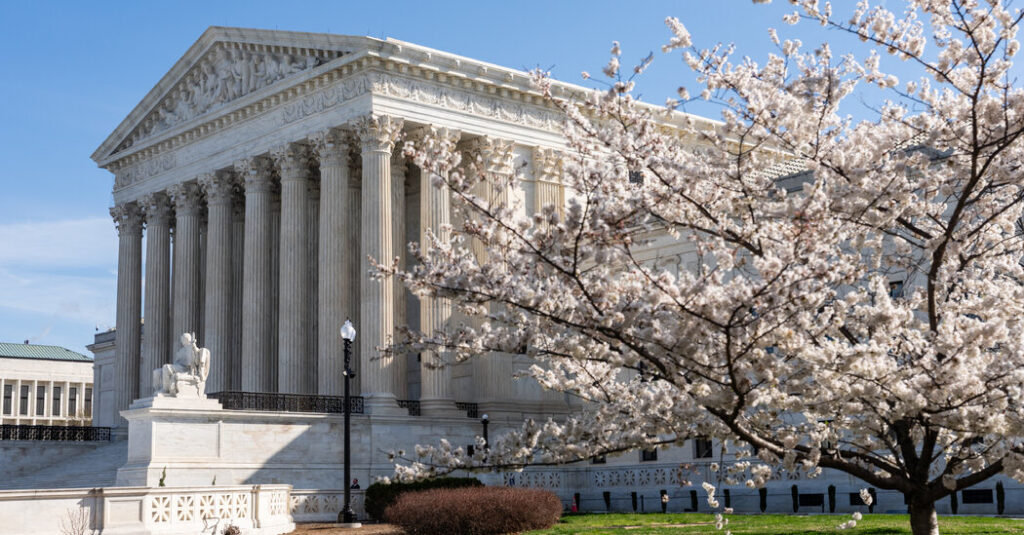
The Supreme Court is set to hear arguments on Monday in a case that could lead to the dismissal of tens of thousands of lawsuits against Bayer, the pharmaceutical and biotech giant, that claim the weedkiller Roundup caused non-Hodgkin lymphoma.
Developed by Monsanto in the 1970s, Roundup is one of the best-selling weedkillers in the world, but it has been dogged by controversy over its effects on human health. The company, which was acquired by the German conglomerate Bayer in 2018, has faced thousands of lawsuits, amounting to one of the largest waves of such litigation in U.S. history.
Evidence in lab animals, and more limited evidence in humans, has indicated a link between Roundup’s active ingredient, glyphosate, and cancer. The World Health Organization’s International Agency for Research on Cancer in 2015 classified glyphosate as “probably carcinogenic to humans.”
The Environmental Protection Agency considers the herbicide to be safe. The E.P.A. is responsible for pesticide labeling nationwide, and Bayer argues that the federal agency’s decision overrides state-level legal claims, effectively insulating it from lawsuits. The federal government faces an Oct. 1 deadline to re-examine the effects of glyphosate.
Monsanto, which was acquired by Bayer in 2018, had petitioned the court to review a lawsuit brought by John Durnell of St. Louis, Mo., a gardener who used Roundup for decades. Mr. Durnell received a diagnosis of non-Hodgkin lymphoma and sued the company in 2019, alleging that his illness was a result of exposure to the pesticide and that Monsanto had failed to warn of the cancer risks.
The Trump administration has formally backed Bayer in the case, reversing a position taken by the Biden administration. In February President Trump also issued an unusual executive order invoking the Defense Production Act to guarantee production of glyphosate-based herbicides, essentially elevating Roundup to a national security priority.
That came soon after Bayer made a move to end the bulk of its current litigation over Roundup, proposing a $7.25 billion class-action settlement. With a Supreme Court win, much of Bayer’s litigation woes over the weedkiller could be behind it.
The Justice Deptartment agrees with Bayer’s argument that federal law expressly and implicitly pre-empts any failure-to-warn claims under state law, because the E.P.A. has already evaluated the pesticide and determined that a cancer warning is not required. That means manufacturers cannot unilaterally alter federally approved labels without violating federal law, D. John Sauer, the U.S. solicitor general, said in his brief.
Environmental groups argue the E.P.A.’s review process is deficient and routinely fails to require cancer warnings to protect the public. They note that a federal court vacated a health-risk assessment and pesticide-registration review conducted by the E.P.A. in 2020, calling the agency’s evaluation of glyphosate’s cancer risk flawed.
“E.P.A.’s overall review is limited, leaving an important and robust role for states,” George A. Kimbrell, lead counsel for the Center for Food Safety, wrote in his brief.
Glyphosate is the most widely used herbicide in the United States, sprayed on “Roundup Ready” genetically modified crops including corn, soybeans, and cotton to control weeds. In the United States, about 280 million pounds of glyphosate are applied annually across nearly 300 million acres of farmland.
Farmers also often spray glyphosate on non-GMO crops such as oats, wheat, and lentils shortly before harvest, drying out the plants and making them easier to harvest. This leads to higher residues in finished products like oatmeal, bread and cereal.
Over the past year, Bill Anderson, the Bayer chief executive, has said the company could stop selling its Roundup weedkiller altogether because of the billions of dollars that it has paid out toward its Roundup litigation. The situation had become an “existential” threat to the company and farmers, he said in May.
That has raised concerns that American farmers could lose the dominant supplier of a weedkiller that has become the cornerstone of U.S. food production. Notably, Health Secretary Robert F. Kennedy Jr. — who as an environmental lawyer once helped win a $289 million jury award against Monsanto, now owned by Bayer — has stood by the administration’s support for glyphosate.
The food supply depended on it, he said in February, even as he said that herbicides and pesticides were “toxic by design” and “put Americans at risk.”
A growing body of scientific literature has linked glyphosate exposure to non-Hodgkin lymphoma and other cancers, as well other diseases. That research contradicts the findings of the E.P.A. as well as food regulators in Europe, which maintain that glyphosate is unlikely to be carcinogenic.
In December, a landmark study that found glyphosate was not a human health risk was retracted by the journal that published it in 2000, after revelations that Monsanto’s scientists had played a significant role in the research.
At a symposium on glyphosate in March, nearly 70 health experts called on regulators around the world, including the E.P.A., to address glyphosate’s harms to human health and its links to cancer and other chronic diseases. The experts said in a join statement that “glyphosate and glyphosate-based herbicides harm human health and can cause cancer,” and “the comprehensive evidence supports this conclusion, with the strongest epidemiological evidence linking exposure to increased risk of non-Hodgkin lymphoma, a cancer of the lymphatic system.”
The full findings of the group are set to be published later this year.
A victory for Bayer at the Supreme Court could establish that, because the E.P.A. has reviewed glyphosate and determined it does not require a cancer warning, individual states cannot allow lawsuits that claim the product is mislabeled because it lacks that warning. That could eliminate a substantial portion of Bayer’s liability, said Nora Freeman Engstrom, a professor of law at Stanford Law School. “It would close the books on substantial liability,” she said. “But not all.”
The administration’s actions have stunned and infuriated both environmentalists and the largely female, health-conscious “Make America Healthy Again” activist supporters of Mr. Kennedy, who had thrown their support behind Mr. Trump.
Kelly Ryerson, a MAHA campaigner, said the movement planned to hold a rally at the Supreme Court on Monday when the justices hear arguments on Bayer’s case. The rally would be called “The People vs. Poison,” she said in a notice to her followers. “We plan for it to be huge!”
Hiroko Tabuchi covers pollution and the environment for The Times. She has been a journalist for more than 20 years in Tokyo and New York.
The post Supreme Court to Hear Arguments in Landmark Roundup Weedkiller Case appeared first on New York Times.