This is an edited transcript of “The Ezra Klein Show.” You can listen to the episode wherever you get your podcasts.
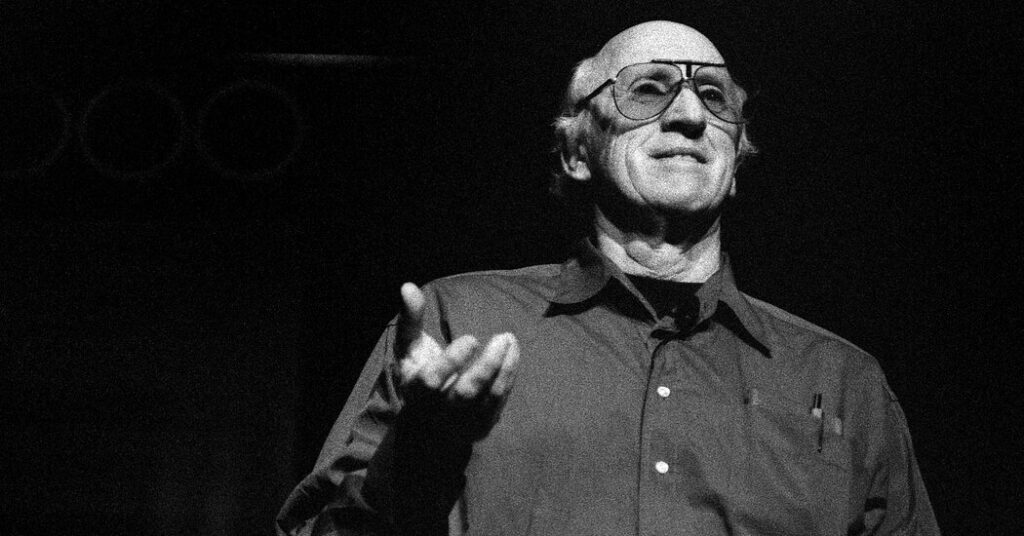
If you were looking for the most influential philosopher of the internet, the person who laid down the way Silicon Valley thought in its more idealistic era, the person you’d find is Stewart Brand.
Brand has had one of these amazing lives. He seemed to be present for almost everything that mattered there in 1960s culture — in the moment of the hippies, in a $20-a-month apartment in San Francisco with other beatniks. There at the mother of all demos — the one that created much of the structure for modern computing, that foresaw many of the places we’re ultimately going to go. There creating The Well, one of the earliest online communities. There with the Whole Earth Catalog, which Steve Jobs described as an early inspiration for what we now think of as the internet.
Archival clip of Steve Jobs: When I was young, there was an amazing publication called the Whole Earth Catalog, which was one of the bibles of my generation. It was created by a fellow named Stewart Brand, not far from here in Menlo Park, and he brought it to life with his poetic touch. This was in the late ’60s, before personal computers and desktop publishing. So it was all made with typewriters, scissors and Polaroid cameras. It was sort of like Google in paperback form, 35 years before Google came along. It was idealistic, overflowing with neat tools and great notions.
The list of all the places Brand was and all the things he influenced is very long — from the Clock of the Long Now to his long-running correspondence with Brian Eno. And along the way, Brand has been writing these very beautiful, unusual books. Not only the Whole Earth Catalog but “How Buildings Learn,” in 1994, which I love, and then, more recently, “Maintenance: Of Everything, Part One,” which explores something many of us would rather avoid: the constant and almost spiritually important work of fixing our cars, of doing home repairs, of caring for one another.
Brand makes maintenance sound philosophically potent, even beautiful. And one thing I think is interesting about this book at this moment, written by somebody with the weight of Brand, is that it points toward a different way of thinking about technology. It points toward a different ethos that Silicon Valley can maybe move toward — something a little bit more humble, something a little bit more rooted in the natural relationship we all have to one another and that we all have to aging and to loss.
So I wanted to have Brand on to talk to him about that and so much else that he’s seen and thought over the years.
Ezra Klein: Stewart Brand, welcome to the show.
Stewart Brand: Well, thank you, Ezra. Glad to be here.
I want to start a little bit back in your history. In the 1960s, you were part of a movement that got called the back-to-the-landers, communards ——
Hippies.
Hippies.
What was that? How would you describe the vision there for society?
For various reasons, a whole lot of people in college in the early ’60s and on through, into the early ’70s, thought they needed to reinvent civilization. The ’50s had been so successful, it became kind of bland. The beatnik poets who preceded us showed a revolutionary path of going wild and going deep.
So we figured out ways to go wild and go deep.
Many dropped out of college and decided that since civilization had to be reinvented — they had to do a gathering of their peers and basically go back to the countryside and farm and build their own buildings and have their own rules and start over.
They all failed. But the communes were highly educational.
We learned that free love isn’t free.
We learned that you can’t expect the women to do all of the really hard work, like pioneer women used to have to do — carrying the water and cooking the meals and taking care of the kids and doing everything else — while the guys were building domes and other interesting buildings.
Another thing that we discovered was that the countryside is actually kind of boring, especially if you don’t connect with your neighbors — which we did not, mostly.
So we fled back to the cities. Some of us figured out how to do too many drugs, and some of the rest of us noticed that and didn’t do that.
But it was a wonderfully fearless time. We undertook wild and crazy things. We had this aesthetic of having the most wonderful adventures you could with the least amount of money you could. You have to be creative under those circumstances.
So that was the hippies.
The Whole Earth Catalog was speaking, in a way, to the fact that these were college dropouts who didn’t know how anything worked. They had not been raised on a farm or a ranch.
How would you describe what the Whole Earth Catalog looked and felt like to somebody who has never seen one?
It was pretty big, actually. Bookstores complained about it. It’s about as big as a laptop now, basically folio-size.
And thicker than a laptop. I’ve seen them. It’s big.
Oh, yeah. By the time we get the so-called Next Whole Earth Catalog, it was several pounds of everything.
Steve Jobs, in his famous commencement speech, said it was like Google decades before Google came along.
The Whole Earth Catalog had all those books — on how to be a beekeeper, how to grow sheep, how to make candles. [Laughs.] We were actually candle dipping.
So that was what the Whole Earth Catalog was. It turned out what it really did is what YouTube does now — it conferred agency.
You mentioned that among the communards, some of them did too many drugs.
I’ve always wondered if this story about you is true: that the reason we have NASA’s picture of the whole Earth came from your doing psychedelics on a roof one day?
I was in San Francisco and kind of bored, and one of the things you did with boredom at that time was drop some acid and see what happens.
It was a minor dose — about 100 micrograms. I went up on the roof of the $20-a-month place where I lived in North Beach and ——
[Laughs.] Twenty dollars a month in North Beach?
Yeah.
Wow.
OK. That’s already hard to believe, but it was true.
Somehow it’s easier to believe that you got NASA to take a picture of the Earth than that anything in North Beach ever cost $20.
Well, it turns out it didn’t really get NASA to do that. We’d been in space for 10 years, at that point — us and the Soviet Union. The cameras had always been looking outward or at pieces of the Earth, but they could have been looking back to see the Earth as a whole.
I was pretty sure that would change everything. I wound up starting a campaign. There was a button that said, “Why haven’t we seen a photograph of the whole Earth yet?”
I know it got looked at by a lot of people at NASA, in Congress and so on. I got to know some of the astronauts, like Rusty Schweickart.
When they took photographs, it came just a year or two later, after my campaign.
Got it. So it was a little coincidental. You had the idea on the roof, but the roof is not what led to the picture.
I think that’s correct. But it led to understanding the picture, I think, for a lot of people.
That metaphor of the camera pointing outward, as opposed to inward — at what we don’t yet have as opposed to what we do have — actually feels like a nice metaphor for maintenance.
I hear this in the Whole Earth Catalog, too. In a way, it feels like a lot of your career and thinking has been building up to this topic, that the Whole Earth Catalog was also a manual for maintaining your life, for maintaining the things you had.
Let’s begin with the most basic question: What is maintenance?
It’s what keeps things going. I’m a biologist by training, so you find that everything alive spends a lot of its time basically maintaining being alive.
Even the extent of reaching outside itself — you’re not just eating. If you’re a beaver, you’re busy cutting down trees to maintain your dam, which is what protects your lodge.
Most plants spend a lot of time basically helping the soil around them do things that work well for the plant. The soil itself is alive.
We’re always maintaining our bodies. We maintain our vehicles and our houses and homes and cities that we live in. We’re catching on that civilization is something to maintain as a whole.
And even the planet — we’ve now stepped up to terraforming. We’ve been terraforming badly, and we need to terraform well. So the levels of maintenance are enormous, and the constancy of it is a given.
How did it come to occupy so much of your mind?
Because I’m a bad maintainer. I brushed my teeth when I felt like it, and, consequently, I lost quite a few.
Looking into the things that you’re not good at, especially intellectually, is one way to stay young, because you’ve got a beginner’s mind.
But I did grow up with a father who was a do-it-yourself kind of guy with a big bench in the basement. And I had a bench in the basement.
As you know, many of the software programmers began by building Heathkit radios and stuff. Well, that was me, too. I was building Heathkit radios.
You grew up in a time when the technologies we used were more intelligible. Something you track in the book is that some of them were designed to be that way.
One of the really interesting stories you tell, that I was hoping you could tell here, is about the Ford Model T versus the Rolls-Royce.
I had known about the Ford Model T. I didn’t realize that the Rolls-Royce was a contemporary. So tell me about the difference between those two cars.
Well, they both began in 1908. Ford was building a car that could manage American driving when it was mostly dirt roads. So it had to be pretty rough and ready and rugged and robust. He’d figured out interchangeable parts by then, so they could manufacture them cheaply.
Rolls-Royce went the other way, which was to have a car so perfectly tuned, with every part filed to exactly fit with all the other parts around it. It was really, really reliable. It would always run.
But with Rolls-Royce, you couldn’t do maintenance yourself because everything was so perfectly tuned and assembled that you would have to take it back to Rolls-Royce to do any work on it.
But if you got a Model T, it was basically just a platform for adding things that you wanted and doing the repair yourself.
There’s a dimension of the way you describe what that made possible in the Ford, which is that it became, as you say, a platform. It became a space of creativity. People sold all these kits to change the Model T.
It struck me, reading this — and you’re very intertwined in the history of Silicon Valley — that it had a lot of the feeling of early technology, which people could hack and alter and add to in all kinds of ways. Versus later technology, where you have to jailbreak an iPhone to do anything with it, where we now have A.I. systems and we don’t even really understand what’s happening inside of them.
There is this tension between the builder-hacker ethos that was so present in other technological eras, but also the earlier periods of the web and personal computers — versus where a lot of these systems and companies have gone.
You describe maintenance as an ethos, but it’s also a question of what we are capable of doing, both somewhat legally and technically, with our technologies — which makes it also a decision made by the companies.
How do you think about that?
Well, I’m just working on writing about the right to repair issues going on now. There’s a question of ownership.
Ownership, I think, is not just a question of having paid for and having legal possession of something. It’s actually possessing the knowledge of what it’s really about, how it functions, how to look for problems, how to diagnose problems when they come up, how to fix it.
Doing maintenance on something is basically how you really take ownership of it and enter it into not just your physical life but your mental and social life.
This will be another thing that the coming of A.I. is going to raise another level of discourse on, because one of the things software engineers are always trying to do, they hate doing: endless simple maintenance, taking care of dependencies and stuff like that. They call it toil. Good word.
They try to automate it to get ahead of it so that the system can be made capable of seeing when the problem is coming and immediately get itself to go around it. I’m sure that A.I. is going to bring many more levels of that. That’s the upside.
The downside is you spend more and more of your life arguing with robots. [Laughs.]
We have a theory of mind. You and I are talking; we each have a pretty good idea of what the other is doing mentally. With A.I., that’s not the case. And the intentions are all different.
So in a way, we’re dealing with all these new species who talk our language, but they come from a different frame in some deep respects.
I think that A.I.s are going to teach us more about being human. Because we’re going to see what not quite human is like and become more and more acquainted with the difference.
Let me pick up on the A.I. question. Something that you write about in “Maintenance: Of Everything” — and in this section, you’re quoting the philosopher Matthew Crawford — is that there is a necessity to the intelligibility of the things we use.
As I read that, I was thinking about a moment I had with one of your creations that relates to A.I., which is the Whole Earth Catalog — this remarkable, deep catalog of all these tools and ways to fix things, and ways to know about things and to create a whole life in a do-it-yourself way.
The first place I ever saw one physically was in the offices of OpenAI, when I visited them, probably in 2021 or 2022.
Really? That’s amazing. Huh.
I remember thinking that there was something almost ironic about this catalog that was so dedicated to making the world intelligible at this place where they were explaining to me that they didn’t understand the fundamental center of how their systems worked, and that they’re creating something where one of its most fundamental characteristics was unintelligibility.
As somebody who has been around Silicon Valley a long time, I wonder what you make of that — as somebody who cares about whether or not we understand things well enough to work on them. Now all the energy is in creating things we don’t understand, so we can offload more of our work onto these systems we don’t understand — in a way that I think is also going to change who we are and what we are as human beings.
A.I. is moving very fast and is solving a whole lot of problems. And, of course, it is creating a whole lot of new problems. They’re kind of alien intelligences, in a way.
One of the good things that happened with large language models is they are trained basically on human communication. So they are, in that sense, intelligible as human intelligence. How it actually functions in there, in terms of the extreme niceties of what’s going on, down to the bits and bites level, is not so intelligible.
But so far, we’re making them in real imitation of human communication and, to some extent, human thought. It’s going to move beyond human thought pretty quickly. And it’s certainly reaching out, in terms of data space, much wider than any human can, in a much shorter time.
That fact alone leaves us feeling like redwood trees trying to communicate with a hummingbird. They’re linked. They live together. The hummingbird maybe lives in the redwood tree, but the redwood tree isn’t capable of paying much attention to who’s in its branches or how fast they’re moving.
So we’re introducing new pace layers into the world we live in. It’s cellular. The brain moves really quickly, and these computers — because they don’t have to use chemicals the way our brain does — they go a lot faster.
We can engineer at these levels more than we can understand. Part of being a human society now is having a range of specialists who understand these things in depth, that can speak up and say: Well, here’s what we’re pretty sure is going on.
I’m going to be thinking about that redwoods and hummingbirds analogy for a little bit.
I guess my question is: What role does maintenance and the associated virtues and knowledge have in a world where technologically it’s requiring so much sophistication and specialization to understand things, and some of them, like A.I., even the people making the technology can’t understand?
A lot of the examples in the book, which I often found very moving, are sailboats and Model Ts. And even if somebody was precision calibrating every single bolt in the Rolls-Royce, somebody knew what those bolts did.
In that way, “Maintenance” struck me as almost countercultural — that it was arguing for virtues it feels our society is pulling further away from.
I try to take a position of never shaking my finger and saying: You should brush your teeth. You should change your oil. You should be a nanny to your behavior, you child! Wake up and be a grown-up and take care of things!
Most things work pretty damn well most of the time. So when they don’t, it comes as a surprise. Suddenly there’s a problem, and: Oh, dear! Oh, dear!
The people who do maintenance for a living obviously do not have that frame of mind. They are more like: Oh, yeah, it’s broken. Let’s see. This is this familiar thing. I could fix that right now. Oh, I don’t have the part for that. Well, I’ll go online and get the part.
Online access to information and parts is just astounding now — and that’s the great solution for people. They’ll have a problem with something they’ve owned for three or four years, and it came with a manual, but they misplaced that, for sure.
Well, it turns out, they go online, and here come some recommendations for some videos for exactly your problem and exactly your make and model and year of the device that you’re having trouble with.
Actually, there are four different versions of the issue you have and four different solutions to doing it — one notably better than the other. You follow that, and the thing is fixed.
You’re all-powerful. You’ve totally taken agency, and that particular device is now more legible to you. YouTube has replaced manuals. It has replaced the Whole Earth Catalog, in terms of conferring agency on anybody to learn anything or fix anything.
So it’s mostly a happy story, but you have to go online to get the aggregate wisdom of humanity on the case.
You’ve lived on a tugboat for 40 years.
Yes.
That must require a fair amount of maintenance.
Well, especially if the tugboat was built in 1912.
Wooden boats don’t usually last more than a century. Ours has because of a whole lot of maintenance.
Boats are so lovable. We call them she. They are all that stands between us and the wide, dark sea trying to kill us. They’re like a motorcycle in that respect — they’re kind of hazardous. Relying on them is an intimate process.
Maintaining a boat has an endearingness, a quality to it that is attractive. What is not attractive is the amount of it and the cost of it, and the specializedness of the work that has to be done.
It’s like living inside a beautiful violin, where all of the curves and all the nuances are very carefully crafted. Replacing parts crafted in that detail takes some doing. But it’s worth doing.
One thing I enjoyed about the book is the way that it recasts work that can be described or thought of as tedious as almost a spiritual practice. You write: “Treat the boring task as a ritual, alive with aesthetic nuance and a welcome respite from the clamor of thinking. Find your own contemplative practice.”
Tell me about that idea of maintenance as a contemplative practice.
Well, I can’t do meditation. I get bored. But people who do meditation sort of embrace the boredom and utilize it as a way to calm their mind and maybe center their mind on something that they don’t usually go to mentally.
For example, often, things for maintenance are done by the Japanese with a great deal of ceremony. Just changing the lights of a streetlamp, there are guys in uniform. They have a special routine they do with a ladder where they go up the pole and do a little formal thing at the beginning and another little formal thing at the end, and it turns a simple task into a somewhat more complex dance.
Moving together in time is one of the profound things that humans have been doing for a very long time, and having a uniform where you’re doing something, especially a service, we make kind of a big deal of it. So ritual is one way to make really, really repetitive maintenance less onerous.
The other dimension that struck me as interesting when I read the words “contemplative practice” is that there are a lot of ideas about thinking in the book. You quote quite a lot from “Zen and the Art of Motorcycle Maintenance,” which is a classic book.
I was also very struck, in the first chapter, by how you write about a sailboat race. You talk about a sailor thinking about how to fix a problem on his boat. And he forces himself to think for two days before acting, because he says: “I did not want to crystallize my thinking prematurely.” I really liked that line.
Tell me about maintenance and speed, maintenance and rhythm. It comes up often in the motorcycle part of the book, as well, about not moving too quickly.
Well, one of the problems with repair is that it’s a trauma for the system that you’re trying to fix, and it’s easy to get things wrong.
A couple of years ago, they were in the process of doing maintenance on the Notre Dame steeple, the tallest part. It was kind of rotted out. Because they were up there, doing work, they introduced flame in an area. It then took off and burned down the cathedral.
At Chernobyl, they were doing just routine maintenance and were careless, and it got out of hand.
So that’s his reason to be cautious and take thought, often for diagnosing the problem.
Bernard Moitessier had a steel boat that was pretty much waterproof, but he had a collision with a ship that bent the valve spit 20 to 25 degrees off. It meant that a storm might take down his whole rig because it was no longer symmetrical. So he knew what the problem was, but how could he fix it by himself at sea?
That was where he took the advice he had heard from other maintainers: Don’t just jump for the solution, because you might make the problem worse. Think through the solution. Disrupt the system minimally in the process of figuring out what needs to be fixed, fixing only that, and then back out carefully so the rest of the system doesn’t get disrupted.
It’s a highly intellectual process, doing diagnosis and repair.
There are dimensions of it that are highly intellectual, and as you said at the beginning, it’s what living things are doing all the time. One thought I had while reading the book was that maintenance is what we call care when it is applied to things as opposed to people.
For a lot of the book, I was thinking: Where do I do the most maintenance in my life? Aside from my own body, like brushing my teeth and showering, I have kids, and the act of parenting is ongoing maintenance, among many other things.
Yes.
There’s been a lot of work and thinking on care work in recent years, and I was curious about how those connections existed in your mind as you wrote the book.
How do you think about the relationship between maintenance and interpersonal care?
Well, it wound up that, basically, most of the book is Chapter 2, “Vehicles.” And the land vehicle that humans have used for 6,000 years is a horse, and the horse takes a lot of maintenance.
I’ll read something here from the book, if I may. There’s this philosopher named Albert Borgmann who wrote:
You cannot remain unmoved by the gentleness and conformation of a well-bred and well-trained horse — more than a thousand pounds of big-boned, well-muscled animal, slick of coat and sweet of smell, obedient and mannerly, and yet forever a menace with its innocent power and ineradicable inclination to seek refuge in flight, and always a burden with its need to be fed, wormed and shod, with its liability to cuts and infections, to laming and heaves. But when it greets you with a nicker, nuzzles your chest and regards you with a large and liquid eye, the question of where you want to be and what you want to do has been answered.
And I end with: “I wonder if that might come again someday — a vehicle that cares back.”
Tell me what you make of that.
Your children care back. That makes maintaining them completely different from maintaining your vehicles.
I think this is one of the things we may ask our A.I.s to do for us: Give us things that care back in some sense.
Now the question is: Are they faking it, or do they mean it? And maybe part of the design will be that they do mean it, that there is somebody there caring.
You’ve been around Silicon Valley a long time. We’ve mentioned the Whole Earth Catalog. You were involved in early versions of the World Wide Web — the personal computer.
And there was a lot of idealism in all of that. When you look around, which of your hopes feel as if they were borne out? And which of the hopes feel as if they ended up corrupted, or something that you look on with more skepticism now?
Well, it’s a classic case of David Deutsch’s line: You solve certain problems, and other problems emerge.
The problems that we thought were being solved were especially in terms of communication, and understanding that computers were communication devices. And isn’t it amazing that we all still use email, which was one of the first things invented for the microcomputers, as they were called then?
Lots of other stuff has been added on. The social systems have connected lots and lots of people in really profound ways. There are lots of the things available through the internet, from Wikipedia to the Internet Archive to iFixit to YouTube. In that sense, it has really surpassed the dreams that we had.
But then, of course, it introduced problems that we didn’t completely anticipate. The very first social media started to have flame wars. It started to have these people being rude to each other, because they were not in the same room, and nobody could punch anybody, but they could gang up on each other. Things like that started to become semi-pathological online.
It was kind of like when advertising was explored way back when, and it became more and more persuasive and interesting. And then, with AdSense on Google, as Nicholas Negroponte used to say, it wasn’t just advertising as noise — it was advertising as news. It was focused on your expressed interests.
And then that felt like an invasion of our privacy, that it knew what I was interested in. In some cases, that’s not welcome, but in other cases: Oh, yeah, I didn’t know about that thing. Thank you for letting me know.
Except nobody ever thanks it, but they do act on it. That’s what keeps these things going.
So yes, these problems keep coming up, and they keep getting solved partially, or other stuff comes along that replaces that whole domain, but it has problems. That’s the nature of life.
There’s something you said a second ago — that we act upon it. I have the feeling more and more when I am online — on social media, on YouTube, on TikTok — that I am being acted upon.
If you opened up the Whole Earth Catalog, you are the person turning the page. You are the actor deciding whether or not to have your eyes stop on a certain box and read into that box. The tagline of the Whole Earth Catalog that was so beautiful was: “We are as gods and might as well get good at it.”
Then the internet emerges, and you’re typing search terms into Google. You’re using your bookmarks, and you’re looking through your email.
And over time, things have become algorithmic, and you can feel the systems sort of moving around you and trying to figure out what you’re interested in. And then you linger on something, and it starts serving you a lot of it.
Obviously, people enjoy it on some level, or they wouldn’t use the systems. But I do wonder how they’re changing us.
So much of the message, it feels to me, of early computer thinking, early web thinking, was about the user and what they could do and how empowered they would be. Increasingly, it feels like we are being given many, many offers to be sometimes wonderfully disempowered. Particularly the way the systems use our attention now, it does feel like the volition has shifted.
I think you knew Marshall McLuhan back in the day.
I did.
A lot of his ideas about how different ways of structuring a medium changed the person using it feel very relevant here. I’m curious if you think that’s true or if that feels overstated to you?
Well, have you had Cory Doctorow on your show?
Yes, we had an episode with Tim Wu and Cory Doctorow that just came out recently.
Excellent. So he’s quite right. There’s a lot of what he calls “enshittification” that has happened to various entities, where basically, sponsored content comes more and more in front of the content that you’re asking for. And it’s on Amazon, it’s on Google, and so on, when you do a keyword search.
But now, with Google, I use their Gemini 3. And it’s not so much a search for a word string anymore. It’s a search for: Tell me about this subject, please. And it is great.
For example, in Part 2 of the book, there’s a whole section on the later history of John Deere, in which they went from one of America’s oldest companies, that was absolutely revered by its customers, to the poster child for right to repair, because its customers were so furious at it for forcing them to delay getting fixes to their machines.
The whole business of a farmer being able to fix everything turns upside down. They had to go through the corporation and the dealerships, and they just hated that.
So I asked Gemini 3: How can I find out what the argument was within John Deere, within the company? And it said: You’ll find it with their stockholders. And take a look at Reddit, where you will find people who either used to work there or still work there, telling the secrets of what’s going on behind the scenes.
So, thanks to A.I., I hadn’t really thought of those two ways to look inside the company. And it turned out that nobody was speaking up for the customers inside the company.
This gets to a question we were circling earlier. Right to repair, among other things, is a legislative idea. It would be, potentially, legislation that the government would pass, saying that companies have to do this.
One thing I was thinking about in the book is that it is treating maintenance often as a question of our knowledge about the things we are caring for.
But it is also a question of, first, whether the companies that make those things have made those things open to care — open to maintenance — whether you can get into the system, whether you can get into the innards. They do not want you getting inside an iPhone.
And second, because often, as you say with John Deere, the company would make more money by just having you replace these technologies on a structured timetable, whether or not society or government comes in and says: We actually are going to force you to make maintenance something people can do.
So as you’re thinking about right to repair and as you’ve been around technology for a long time, do you think it is something we should pass? Do you think that if we’re going to make maintenance a social value, it’s something that government has to insist that the companies permit?
Yes. And there are already some laws in place in places like Massachusetts and Colorado. It’s moving pretty quickly. And some companies are getting out in front of it.
I have a Tesla, and Tesla is somewhat ahead of this one. They sort of fought back for a little while and then realized: Screw it. We’ve got all this information about your vehicle, and we’ll share it with you.
And there are lots of companies, like Patagonia, that have whole videos teaching you how to repair their garments. And so it goes.
Some of this can get sorted out in the marketplace. But some companies have such a grip on their field, and John Deere is one of them, that they don’t feel they have to worry about competition. And if that’s the case, that’s where the government usually does need to step in.
So if somebody read this book and they wanted to make regular maintenance more a part of their life but didn’t quite know how or where — and didn’t feel like they have anything obvious to fix but see this as a virtuous skill, a discipline — where do you advise them to start?
How do you weave this into a life in which you’re not used to thinking about your possessions or even yourself in this way?
Have a child.
[Laughs.] That’s a big commitment to just learn about maintenance.
Yes. This is the “I and Thou” stuff that Martin Buber used to talk about — having a relationship with your stuff that feels like a relationship you have with a child or with a pet. Let it become shiny with use.
With tools, the rule is to get the best tools you can. If you use them all the time, get the best you can. Because then your respect for the tool plays out in the care that you give to it and in honoring the process of taking care of things and yourself and others.
Sometimes maintenance tasks are seen as of a caste-level difference. Who cleans the toilets? Who takes care of the dead things? And so many maintenance tasks are not only low status, they’re low paid. And that doesn’t need to be the case.
People don’t notice the really good maintainers from the so-so maintainers, because they’re not paying attention. Well, the really good maintainers are worth paying attention to — to the point that they do get recognized, they do get paid. And are honored, sort of in the way we honor librarians or libraries. These are actually the pillars of civilization.
The folk singer Pete Seeger said: You should consider that an essential art of civilization is maintenance.
When I was asking you what led to writing this book, you said that maintenance is something that you are not very good at or have not been good at traditionally. Since immersing yourself in it, in terms of its technical questions and its spiritual and personal questions, how has your relationship to maintenance changed?
What do you maintain that maybe you didn’t before? What have you found as ways to do it that were not true before this project?
[Chuckles.] I’m 87 years old. Guess what? By the time you’re in your 80s, just being old is a half-time job.
In maintenance theory, this is called the bathtub curve. Like with a building, when it’s brand-new, there are lots of problems. But then they start to even out, and you plug along and just stay ahead of the maintenance — and it’ll be OK. But then, when it gets pretty old, especially if it’s a wooden building, problems increase. So the bathtub is high maintenance in the beginning, it levels out, and then it’s high maintenance toward the end.
When you’re in your 80s, you’re toward the end.
Generically, or probably genetically, I’m somewhat of an optimist. That’s fatal for maintainers. Maintainers are realists, and they’re pessimists. They’re always looking for what could go wrong, and: How can I get ahead of that?
Or they hear something questionable. I might say: Oh, I don’t think that’s serious. A maintainer says: That sounds like it’s serious.
So there’s a whole attitude issue that one becomes aware of, and my shortcoming is that I’m an optimist.
I think that’s a good place to end. So always our final question: What are three books you’d recommend to the audience?
I recommended David Deutsch’s “The Beginning of Infinity.” It’s basically optimism at a cosmic level.
It’s full of the realization that there are always problems, and there are solutions. And that goes on infinitely. You’re always at the beginning of infinity when it comes to that.
I recommend a book by Simon Winchester. It’s called “The Perfectionist: How Precision Engineers Created the Modern World.”
I wound up revisiting, when I did a section on manuals, the great manuals of history. But the one I was looking at was Denis Diderot and Jean le Rond d’Alembert’s “Encyclopédie,” which had diagrams of how all the trades and crafts of the 18th century actually worked. But the French Revolution shot down all of the rational optimism that was in that book.
The Scottish Enlightenment thinkers were very impressed by it, and they all studied Diderot’s encyclopedia. And they came up with their own encyclopedia called the “Encyclopedia Britannica,” which went from strength to strength for 100 years. And basically, the Scottish Enlightenment was the source of our Constitution, which was an Enlightenment document, and of our Declaration of Independence.
And that’s what really needs to be maintained if we want to maintain civilization on the planet. It’s the engagement with science, with engineering, with open discourse, with replacement of political leaders without bloodshed — basically, dealing with problems in a way that we honor that they can be corrected and that there will be other problems, and of being comfortable with that and moving with that and being as intelligent as we can be in managing all that.
So those three books are what I recommend
Stewart Brand, thank you very much.
Thank you, Ezra.
You can listen to this conversation by following “The Ezra Klein Show” on the NYTimes app, Apple, Spotify, Amazon Music, YouTube, iHeartRadio or wherever you get your podcasts. View a list of book recommendations from our guests here.
This episode of “The Ezra Klein Show” was produced by Annie Galvin. Fact-checking by Kelsey Lannin. Our recording engineers are Aman Sahota and Johnny Simon. Our senior engineer is Jeff Geld. Our executive producer is Claire Gordon. The show’s production team also includes Marie Cascione, Michelle Harris, Rollin Hu, Kristin Lin, Emma Kehlbeck, Jack McCordick, Marina King and Jan Kobal. Original music by Pat McCusker. Audience strategy by Kristina Samulewski and Shannon Busta. The director of New York Times Opinion Audio is Annie-Rose Strasser. And special thanks to Fred Turner. Transcript editing by Sarah Murphy, Andrea Gutierrez and Marlaine Glicksman.
The Times is committed to publishing a diversity of letters to the editor. We’d like to hear what you think about this or any of our articles. Here are some tips. And here’s our email: [email protected].
Follow the New York Times Opinion section on Facebook, Instagram, TikTok, Bluesky, WhatsApp and Threads.
The post Stewart Brand, Silicon Valley’s Favorite Prophet, on Life’s Most Important Principle appeared first on New York Times.