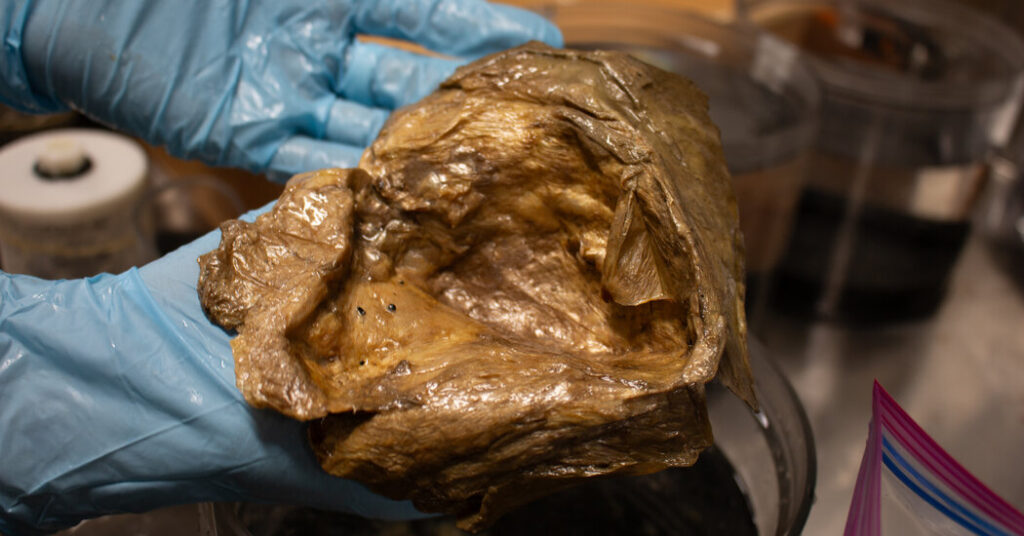
Explorers sent a robot two miles under the ocean near Alaska to look for odd creatures, and unexpectedly struck gold.
To be more specific, they found a golden blob, smooth and shiny with a perplexing hole in it, stuck to a rock on the seafloor.
Was it coral? A sea sponge? An alien?
No, the explorers concluded. After more than two years of investigation, the U.S. National Oceanic and Atmospheric Administration said this week that researchers had identified it as a part of a deep-sea anemone.
The “golden orb,” as many newspapers and science magazines called it after it was found in 2023, perplexed researchers and enthusiasts of the deep sea around the world.
It was spotted on a three-week voyage that summer along Alaska’s southern coast by NOAA Ocean Exploration, a federal program that delves into unfamiliar seas. From a ship at the water’s surface, a team used a remotely operated diving vehicle to gather more than 300 samples of deep-sea creatures.
On the seventh dive, the robot was exploring underwater mountains when the scientists saw the golden object on a rock, glistening alongside white sea sponges. The scientists drove the robot closer.
Then they decided to poke it. A remotely operated arm scratched the object’s surface, revealing that it was soft and flaky, video footage from the robot showed.
The scientists wanted to retrieve a sample, but the rock was too big to lift. Instead, they used the robot’s suction tube to gently slurp the golden material away.
The following week, scientists said that the object, about four inches in diameter, was still unidentified. It was unclear whether it was a new species or an unknown life stage of an existing one, Ocean Exploration said in a statement at the time.
“Isn’t the deep sea so delightfully strange?” Sam Candio, a NOAA scientist who was on the expedition, said in the statement. “While somewhat humbling to be stumped by this finding, it serves as a reminder of how little we know about our own planet.”
Over months, a team of scientists from NOAA, the Smithsonian Institution, the American Museum of Natural History and several universities analyzed the object.
In a report published on Tuesday, the scientists said that sequencing the object’s DNA had given them an answer: Relicanthus daphneae. An animal species, it is a type of anemone with long tentacles — generally purple, pinkish or red — found at the bottom of oceans around the world.
The species has not been observed much because it lives in such an inaccessible habitat, the scientists said. But looking at other anemones allowed the scientists to determine that the object was part of a base, usually obscured, on which the animal rests.
Pictures of other anemones showed they too sat on gold-colored blobs attached to rocks, the scientists said. They learned that the part, called a cuticle, could be left behind as the anemone moved.
“This is why we keep exploring,” Capt. William Mowitt, acting director of NOAA Ocean Exploration, said in a statement this week, “to unlock the secrets of the deep.”
John Yoon is a Times reporter based in Seoul who covers breaking and trending news.
The post Golden Blob, a Mystery From the Deep Sea, Is Identified appeared first on New York Times.