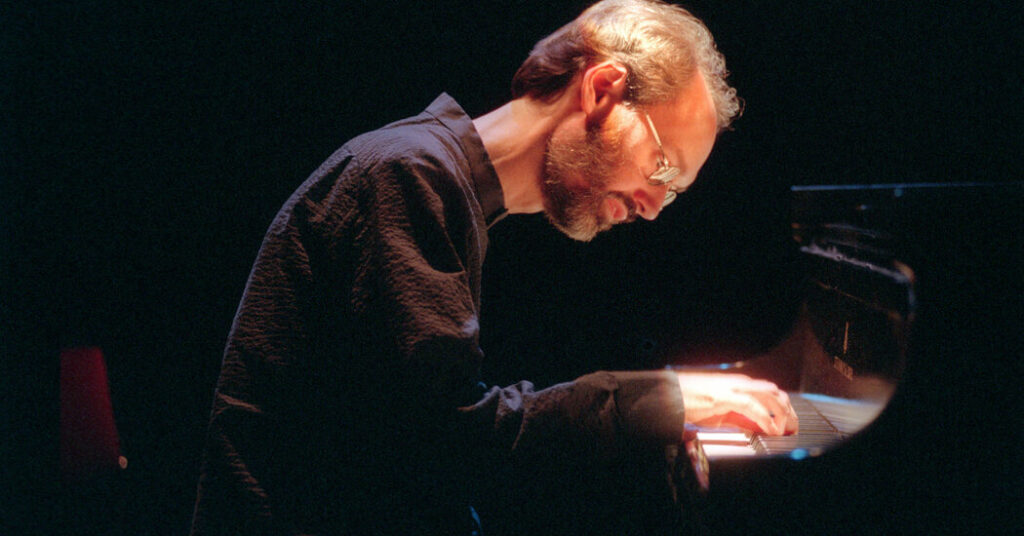
Michael Harrison, a composer and pianist whose richly resonant, spiritually inclined compositions and improvisations, many for pianos he radically redesigned, drew on his deep knowledge of Indian raga and nontraditional tuning systems, died on April 17 in Manhattan. He was 67.
His death, in a hospital, was announced by his family, which said the cause was complications of pancreatic cancer. He lived in Yonkers, N.Y.
Mr. Harrison was pursuing a degree in composition at the University of Oregon in the late 1970s when he started studying Indian music. After singing ragas each morning, he would find that his piano sounded out of tune to him.
Trying to understand what he was hearing, he read the entry on “just intonation” in the Harvard Dictionary of Music. Associated with the ancient Greek philosopher Pythagoras, just intonation is a mathematically pure tuning system in which intervals between notes are based on whole-number ratios.
As Western music evolved, it shifted to “tempered” tuning, which allowed musicians to move between keys more easily but which abandoned the purity of the Pythagorean ratios. In non-Western music like ragas, though, older modes of tuning persisted.
Mr. Harrison came to believe that just intonation was the correct path, one that corresponded to his emerging, spiritual conception of music.
“Just intonation is the optimal resonance,” he said last year in an oral history interview conducted by two of his students. “It’s finding those musical harmonies that create the most resonant fields. And we experience that not only through our ears musically, but through our whole nervous system, our psyche. It calms us down. It feels like an attunement — a deep attunement.”
An apprenticeship with the foundational Minimalist composer La Monte Young helped Mr. Harrison incorporate this method into his own compositional voice. From 1979 to 1987, Mr. Harrison served as the piano tuner for Mr. Young’s “The Well-Tuned Piano,” a multi-hour improvisation in just intonation.
As Mr. Harrison assisted with about 50 iterations of the work — sitting beside Mr. Young at his Bösendorfer grand, sometimes spending multiple days tweaking a single chord — the immersion in the idiosyncratic tuning reshaped his conceptions of harmony and time. He ultimately became the only other pianist whom Mr. Young ever permitted to play “The Well-Tuned Piano” (though only once, in a private performance).
Mr. Harrison soon conceived his own long-form composition, “From Ancient Worlds” (1992), for an instrument he created called the harmonic piano, which had a retooled pedal that could shift between two tuning configurations. He then turned to “Revelation,” first performed in 2001, a spellbinding and lyrical structured improvisation built from reverberant overtones.
In an email, the composer Terry Riley, another major Minimalist, described “Revelation” as Mr. Harrison’s “magnum opus.”
“Michael was one of the second generation of musicians building on Minimalism and raga to open up new possibilities to expand the possibilities of tonal music,” Mr. Riley wrote. “He was an extremely kind and generous man openly sharing his gifts and knowledge with fellow musicians.”
Describing performing in just intonation in a 2001 interview with the magazine NewMusicBox, Mr. Harrison said: “Many times I experience a euphoric state in which I get completely absorbed in the luminous tone clouds and tidal waves of resonance that carry me, and I feel like I’m immersed in sound. I feel like I’m discovering the lost realms of tone colors that evoke a deep and powerful emotional response.”
The New York Times included a recording of “Revelation” on its list of the best classical music albums of 2007.
Michael Kent Harrison was born on Oct. 24, 1958, in Bryn Mawr, Pa., to David Harrison, a mathematician, and Ann (Hill) Harrison, who oversaw the home.
When Michael was 6, his father took a position at the University of Oregon, and the family moved to Eugene. He began piano lessons not long after, though he quit after a negative experience with a strict teacher. As a preteen, he returned to improvising on the family’s Steinway upright, and his father taught him the rudiments of music theory.
Drawn to mountain climbing, he went on a transformational backpacking trip in Nepal at 15, while he was a student at Phillips Academy in Andover, Mass. He started exploring transcendental meditation and developed a lifelong fascination with the work of the Sufi mystic Hazrat Inayat Khan. (He liked to quote a remark by Khan: “The joy of life depends upon the perfect tune of mind and soul.”)
After taking a world music course at the University of Oregon, Mr. Harrison sought out the prominent singer Pandit Pran Nath, who had already taken Mr. Young and Mr. Riley as disciples. Mr. Harrison completed his undergraduate degree at the university in 1983 and received a master’s degree in composition from the Manhattan School of Music in 2015.
During his intensive work with Mr. Young and ongoing studies with Mr. Pran Nath, Mr. Harrison briefly courted mainstream success. He recorded “In Flight,” a jazzy, post-Minimalist piano improvisation, for a 1985 album released by Windham Hill, the popular New Age label, and the track was used in the trailer for the 1990 film “Awakenings,” based on the Oliver Sacks book.
But Mr. Harrison ultimately chose a more experimental path, supported by a day job as a piano broker. He also joined a piano restoration firm that was renamed Faust Harrison Pianos when he became a partner.
Other major works by him include “Just Ancient Loops” (2012), a joyously propulsive composition for the cellist Maya Beiser; “Just Constellations,” (2015), an uncanny exploration of harmonies from “The Well-Tuned Piano,” which was performed by the vocal ensemble Roomful of Teeth in a huge water tank in Colorado; and “Seven Sacred Names” (2021), a hypnotic meditation on Sufi mysticism.
Mr. Harrison is survived by his wife, Marina Harrison, and his sister, JoEllen Harrison.
After years of composing works in just intonation while continuing to study, perform and teach Indian music, in the 2010s Mr. Harrison began fusing the two approaches by adapting ragas for piano.
Last month, Cantaloupe Music released “Evening Light,” Mr. Harrison’s first album in a planned multi-record project of traditional and original ragas, intended to eventually span 24 hours. The work has also been presented in an installation, in collaboration with the filmmaker Bill Morrison.
Before he became too sick to continue working, Mr. Harrison was able to record the piano parts for additional albums in the series for future release. He was to have performed music from “Evening Light” at Bang on a Can’s Long Play festival in Brooklyn next month.
One of his raga students, the composer Elliot Cole, has helped supervise the “Evening Light” project.
“For him, the heart of music was not making a fixed composition,” Mr. Cole said of Mr. Harrison in an interview. “It was reinhabiting a space like a raga or a tuning, to rediscover and bring back to life over and over again what it has to offer, and squeeze out every last drop of it, while having a deep experience doing so.”
The post Michael Harrison, 67, Dies; Inventive Composer Who Played With Tuning appeared first on New York Times.