The scammers come in many varieties: The slick broker who “saves” a home from foreclosure, only to vanish with the title. The caregiver who exploits an older man’s trust to hijack his deed. The financial whiz who promises a mortgage renegotiation that ends in an eviction.
Every year, cases like these afflict homeowners across New York City. The schemes are examples of deed theft, a practice in which people fraudulently take ownership of others’ homes.
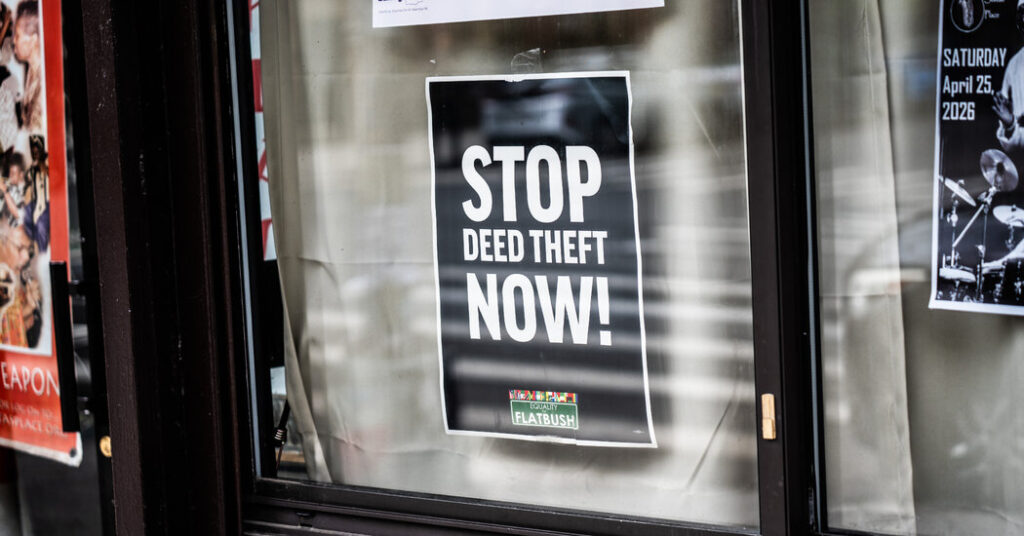
Just two days ago, a Brooklyn city councilman was among several people arrested at a protest against the crime.
Now, the city is creating an Office of Deed Theft Prevention that will investigate instances of deed theft and try to stamp them out.
Deed theft has been a particular problem in predominantly Black neighborhoods, where investors can capitalize on rising property values and gentrification.
Mr. Mamdani, who has focused much of his attention on helping the city’s renters, is moving to create the office as he seeks to improve his political standing with Black homeowners and their representatives.
Mr. Mamdani is appointing Peter White, a lawyer who most recently worked for Access Justice Brooklyn, a nonprofit group, to lead the new office. It will be part of the city’s Finance Department and will coordinate efforts between the housing department, the city’s commission on human rights and more.
While government officials have pursued deed theft cases in recent years, it remains a difficult problem to address. It is not always obvious to homeowners that they have been victims, and years could pass before any offense is reported.
It can also be tough to determine when behavior is criminal and when a homeowner may simply be making a bad decision involving getting rid of their home. And the legal ownership of a home may be murky, particularly if the property was inherited by several different heirs or is in the hands of a guardian or conservator.
The protest this week where the councilman, Chi Ossé, was arrested, did not center on an actual example of deed theft, according to the state attorney general’s office, but a property dispute between heirs and relatives of the property’s former co-owners.
Still, officials have worked to more effectively address the issue. In 2024, state officials passed a law, known as the Heirs Property Protection and Deed Theft Prevention Act, that firmly established deed theft as a crime. The law was written in part by Letitia James, the state attorney general.
One government estimate from 2023 found that there were at least 3,500 complaints of deed theft filed over the previous decade.
The Furman Center at New York University released an analysis last April that found that tens of thousands of New York City homeowners were vulnerable to deed theft, scams, under-market sales and other legal problems that could strip them of their equity.
Jeffery C. Mays contributed reporting.
Mihir Zaveri covers housing in the New York City region for The Times.
The post Mamdani Creates Office to Fight Deed Theft in New York City appeared first on New York Times.