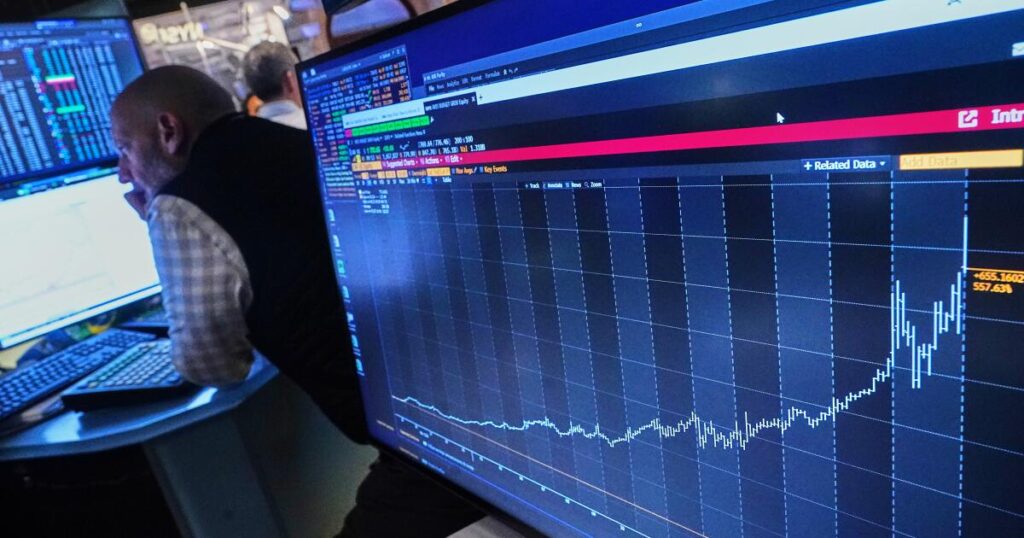
It seems so illogical. How can the U.S. stock market be setting records when gasoline prices are still expensive, U.S. households are feeling less confident about the economy and the war with Iran is still going?
But for Wall Street, everything eventually comes back to a different, basic question: How much money are companies making? And at the moment, they’re earning so much that investors are willing to pay higher prices than ever for a piece of ownership of U.S. companies.
It’s been a jarring ride for investors, many of whom may have felt the urge to dump their stock investments last month when the S&P 500 fell nearly 10% below its prior record. But as it has every time so far in its history, the index at the heart of many 401(k) accounts rewarded investors who remained patient by not only recovering all its losses but also forging to new heights. On Wednesday, the index closed at a record 7,137.90.
Here’s a look at what’s been behind the market’s surprising strength:
What sets a stock’s price
Stock prices flitter up and down every second for myriad reasons, many of which no one can explain. But at its heart, and over the long term, a stock’s price depends on two things: how much money a company is making and how much an investor is willing to pay for each $1 of that.
More fear
The latter part of that formula tends to swing up and down with interest rates and how much greed investors are feeling versus fear.
When fear prevailed in the early days of the war, stock prices dove. The worry was that a long-term surge for oil prices because of the war could send a debilitating wave of inflation crashing into the global economy.
Interest rates also rose, further undercutting stock prices, as investors worried the threat of high inflation would prevent the Federal Reserve and other central banks worldwide from cutting the short-term interest rates they control. While lower interest rates can give the economy a boost, they can also worsen inflation.
Less fear
Since late March, expectations have built that the United States and Iran will avoid a worst-case scenario for the global economy. It would be in both countries’ economic interests to do so, and for Iran’s leadership, an end to the war would also likely mean survival.
The ceasefire that the two sides agreed to earlier this month is still holding, though it’s tenuous.
The market’s shift away from abject fear has also shown itself in oil prices. The price for a barrel of Brent crude oil, the international standard, went from roughly $70 before the war to $119 when worries reached their heights. It has since pulled back and was bouncing around $100 on Wednesday.
Much of the focus has been on the Strait of Hormuz, which oil tankers use to exit the Persian Gulf. If Iran keeps the strait closed, and if the U.S. Navy continues to blockade Iranian ships, everyone will get hurt. Customers worldwide will not get oil, and Iran will not get revenue from selling its own crude.
“By denying Iran its oil-related revenue, traders may be thinking that the economic war may be more effective in getting concessions from Iran’s regime than was the kinetic war only, and that this will end the war sooner, rather than later,” according to Thierry Wizman, a strategist at Macquarie Group.
Traders on Wall Street are also betting again on a chance that the Fed could resume its cuts to interest rates later this year. They see a much lower probability than they did before the war, according to data from CME Group. But they’re no longer worried about the possibility of hikes to rates.
Profit strength
As fear has eased, investors have been able to turn their focus more to the first part of the equation making up stock prices: profits. And those have been coming in strong.
A little more than 15% of S&P 500 companies have already reported how much profit they made during the first three months of 2026, and the vast majority have topped analysts’ expectations. That includes everyone from Citigroup to J.B. Hunt Transport Services to UnitedHealth Group.
If the rest of the companies in the index just match analysts’ estimates, earnings for S&P 500 companies will end up being roughly 14% higher than a year earlier, according to FactSet.
Those results include a month of wartime, and while companies say they’re still wary about potential risks because of the fighting, they’re not showing many signs of it hurting their earnings.
Bank of America’s chief executive officer, Brian Moynihan, said last week that “we saw healthy client activity, including solid consumer spending and stable asset quality, indicating a resilient American economy.”
That’s even though many U.S. households are feeling nervous about more expensive gasoline and higher prices broadly due to tariffs, as shown in recent surveys.
Expectations for more
Analysts have actually raised their expectations for upcoming profits for S&P 500 companies since the war began. They’re forecasting growth for S&P 500 profits to accelerate to 20% in the second quarter, and companies aren’t giving them many reasons to reconsider.
Delta Air Lines said earlier this month that it’s seeing strong demand from people flying both for business and for vacations. PepsiCo last week stuck by its forecast for profit over 2026, which it initially gave before the Iran war began, and CEO Ramon Laguarta said he’s encouraged by how resilient its international business has been. GE Vernova on Wednesday said demand is soaring for power from AI data centers, and it raised its revenue forecast for the year.
All is still not clear
Of course, the U.S. stock market can easily return to falling. Wall Street’s mood could swing quickly back to fear if U.S.-Iran talks break down and the oil market looks to be facing shortages.
And if oil prices stay high for long enough, it would erode some of those profits for companies. Not only would it raise costs for businesses, it would also weaken the spending power for U.S. households and other customers.
Choe writes for the Associated Press.
The post How Wall Street is setting records despite the Iran war appeared first on Los Angeles Times.