This is an edition of the Books Briefing, our editors’ weekly guide to the best in books.
One of my favorite works on the history of ideas is an episode of the podcast 99% Invisible, titled “Whomst Among Us Let the Dogs Out.” For most of the show, an artist named Ben Sisto investigates the origins of Baha Men’s 2000 earworm, “Who Let the Dogs Out,” tracing the song back, across multiple versions, to a chant from a 1986 Texas high-school football game. Sisto’s ostensible goal is to figure out who deserves “credit” for a regrettably unforgettable musical hook; his results show, instead, that many ideas are less original, and more communal, than we might imagine. This larger truth also applies to, say, William Shakespeare’s Hamlet, as well as the subject of a recent essay by my colleague Olga Khazan—Mel Robbins’s blockbuster self-help book, The Let Them Theory.
First, here are six stories from The Atlantic’s Books section:
- Is cohabitation the feminist future?
- The questionable triumph of the ‘baling wire hippies’
- Eight of the most fascinating biographies to read
- Peter Hujar’s photos are all the rage. He’d be shocked.
- “Catch,” a poem by John Waters
- “Scars,” a short story by Sigrid Nunez
This week, Khazan looked into allegations from a woman named Cassie Phillips that Robbins had appropriated her idea. In 2022, Phillips went modestly viral on social media with a poem, nearly every line of which contained the phrase Let them. The central idea—the same one that Robbins expounds in her book—is that we cannot control the negative behavior of others, and should focus instead on ourselves. Phillips said she never sought to monetize the statement, which she had tattooed on her forearm, and she’s unsure whether she wants compensation from Robbins, although she opposes Robbins’s attempt to trademark the phrase.
Robbins, who first used the phrase publicly in 2023, said that she never saw Phillips’s poem, and that the idea came to her from a piece of advice her daughter had given her. Yet, as Khazan writes, “Robbins also acknowledges that many people and groups, including the Stoics and the Buddhists, have previously lauded the virtues of detachment. Indeed, between Seneca and Mel Robbins came ‘Let It Be,’ I’m OK—You’re OK, and ‘Shake It Off.’” Phillips, for her part, said she was inspired by the words of a Tyler Perry character, Madea.
I doubt that the source of the “let them” idea will be definitively litigated in a court of law. In 2017, I tried to make sense of another accusation of IP theft, in which a writer named Charles Green laid out a detailed claim that his unpublished manuscript served as the template for Chad Harbach’s literary baseball novel, The Art of Fielding. Green’s copyright-infringement suit was eventually dismissed; a judge examined both works and declared that they “are not substantially similar.” Green’s list of eerie parallels included two swimming-pool metaphors and a climactic injury in the bottom of the ninth inning with two outs and two strikes. These are, in fact, common tropes of fiction going at least as far back as Bernard Malamud’s novel The Natural.
American law sets a high bar in such cases for the same reason that it allows copyrights to expire and makes libel cases hard to win: An individual’s rights must be balanced against the common benefit of a free marketplace of ideas. This doesn’t mean that unique phrases can be stolen with impunity, or even that people shouldn’t feel morally obligated to acknowledge the sources of their inspiration. But it is also worth acknowledging, as Shakespeare was not the first or the last to say, that nothing will come of nothing. Or, to put it another way: We all let the dogs out.
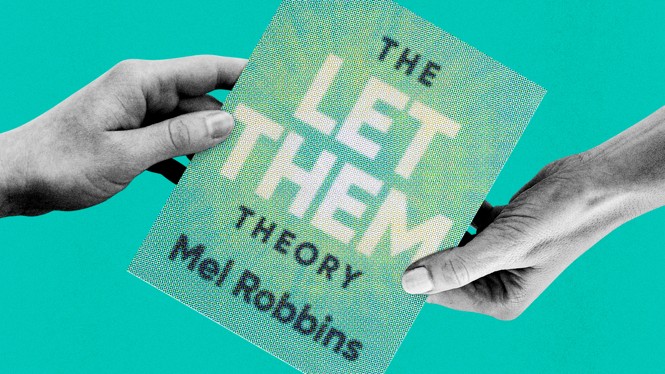
Where Did ‘Let Them’ Come From?
By Olga Khazan
Years before Mel Robbins published her best-selling self-help book, a struggling writer posted a poem with a similar message.
What to Read
Split Tooth, by Tanya Tagaq
You may know Tagaq, an Inuk artist from the Canadian high Arctic, for her innovative improvisational throat singing, or from her appearance on the fourth season of True Detective—but she’s also a writer. Of all the books on this list, this one surprised me the most. Although published as a novel, Split Tooth is a collection of essays, stories, songs, poems, prayers, drawings, and passages lifted from her journals, all inspired by the small Inuk town she grew up in. Memoiristic explorations of lemmings, foxes, childhood violence, and pregnancy give way to a sequence of love stories dedicated to the northern lights, diving into mythology and spirituality. Most exciting is how Tagaq decenters the human race, openly wondering whether it would be so bad if our species died off. Are humans better or more important than any other creatures or nonliving objects? she asks, writing, “Is the air more enlightened than we are?” I love having my assumptions disrupted in this way, and she does it with electric, offhand confidence. — Deb Olin Unferth
From our list: Nine books to reset your view of the world
Out Next Week
 Fat Swim, by Emma Copley Eisenberg
Middlemen: Literary Agents and the Making of American Fiction, by Laura McGrath
Your Weekend Read
The Rise of CliffsNotes Cinema
By Shirley Li
Updating a classic isn’t inherently a bad idea; Guillermo del Toro’s Frankenstein, a dutiful adaptation of Shelley’s 1818 novel, just won three Oscars, and Fennell’s Wuthering Heights has enjoyed an excellent box-office run. Yet most of these projects have been as superficial as Swift’s single [“The Fate of Ophelia”], in which Ophelia survives just by pledging “allegiance to your hands, your team, your vibes”—a cheeky reference to Swift’s fiancé, to be sure, but Ophelia’s problem was never really about the vibes. That reductiveness, though, works far better in a four-minute pop song than in a feature-length film. Call it the rise of CliffsNotes Cinema—watered-down transformations that offer glossy but thin summaries of the originals and strip away the challenging material that helped turn them into cultural mainstays in the first place. These movies make the provocative palatable: Uncomfortable relationships and nuanced characterizations—essentially, what made the stories endure—get lost in the fog of showy filmmaking.
When you buy a book using a link in this newsletter, we receive a commission. Thank you for supporting The Atlantic.
Sign up for The Wonder Reader, a Saturday newsletter in which our editors recommend stories to spark your curiosity and fill you with delight.
Explore all of our newsletters.
The post A ‘Let Them’ Theory of Ideas appeared first on The Atlantic.