In recent years, diversity, equity and inclusion policies have shifted from an internal workplace initiative to a public reckoning. Critics argue that it has strayed from its original purpose, reshaping institutions in ways that are performative at best and discriminatory at worst. President Trump has made dismantling it a central political project, targeting efforts across government, academia and the arts. Even some on the left have begun to question what D.E.I. has become.
But the most revealing critique may come from the people who built it.
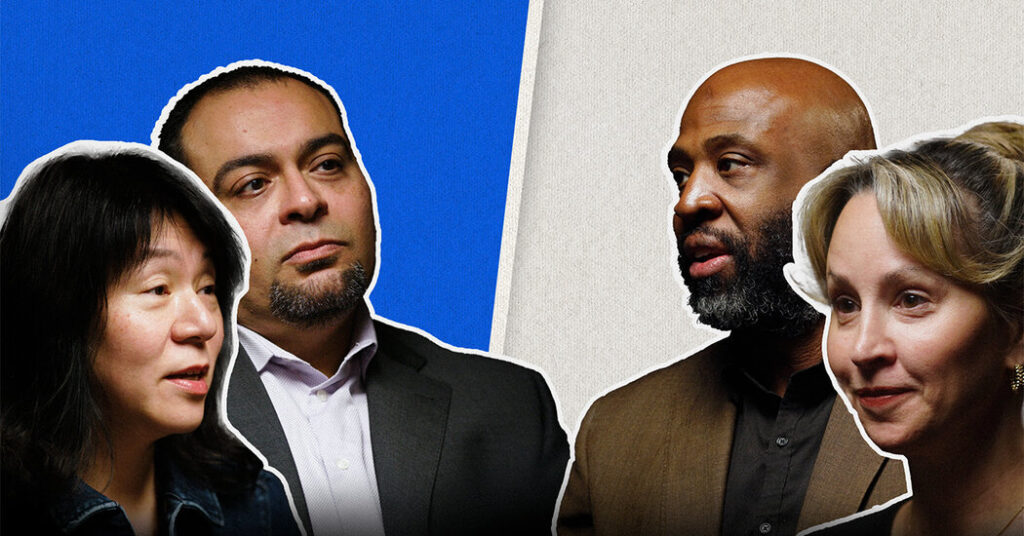
In this episode of “Divided,” we bring together four former D.E.I. leaders to reflect on their accomplishments and failures. Bo Young Lee, a tech executive, and Michael Yassa, a university professor, still see D.E.I. as a worthwhile endeavor and a set of ideals to strive for. Desiree Fixler, a finance executive, and Erec Smith, a professor, once shared that view, but have come to believe D.E.I. is counterproductive.
Will these four insiders be able to agree on where D.E.I. went wrong and what should come next?
Below is a transcript of an episode of “Divided.” We recommend watching it in its original form for the full effect. You can do so using the video player above.
The subjects read prompts from cards which guided their discussion. Bo Young Lee and Michael Yassa are pro-D.E.I., while Erec Smith and Desiree Fixler are anti-D.E.I. The following transcript has been edited for length and clarity.
Bo Young Lee: I’ve been the chief diversity officer of Fortune 500 companies.
Michael Yassa: I served for five years as a diversity officer.
Erec Smith: I was a D.E.I. officer.
Desiree Fixler: I was the chief sustainability officer, and D.E.I. was a component of what I was doing.
Young Lee: OK, first question. Is D.E.I. discriminatory?
Clip of Donald Trump: The tyranny of so-called diversity, equity and inclusion.
Clip of Charlamagne Tha God: Diversity, equity and inclusion.
Clip of Joe Biden: To me, the values of diversity, equality, inclusion are core strengths of America.
Clip of Pete Hegseth: D.E.I.
Clip of Barack Obama: D.E.I.
Clip of Ben Shapiro: D.E.I. innately means that people who are unqualified are going to advance in life by dint of the fact that they are considered a part of a victimized group.
Clip of Trump: You should be hired and promoted based on skill and competence, not race or gender.
Smith: Well, it depends on the D.E.I. you’re talking about. I think with contemporary D.E.I., a lot of the manifestations are discriminatory by nature, but they don’t have to be.
The discriminatory kind is the kind that is really about oppressor versus oppressed. So, it’s inherently discriminatory in that you’re putting people in each category just by looks or identity or something like that.
But when I think of diversity, equity and inclusion, I think of no discrimination whatsoever. It’s more like the ’60s civil rights, classical liberal take on diversity, equity and inclusion.
Fixler: I think it’s completely discriminatory. I think it institutionalizes racism. It’s a direct attack on meritocracy. Everything becomes about your identity. I’m all for equal opportunity, not equal outcome. There’s no place in the workplace for identity politics.
Yassa: When I think about D.E.I., I think about the conceptual ideals behind it — and then there’s the interpretation and the implementation. I think, conceptually speaking, no one would disagree that D.E.I. in principle would be a set of good things to have.
As you mentioned, equality is a good thing to have, but I think the implementation is what makes it very difficult. You mentioned equality of outcome, and I think that may be a myth around what equity is intended to mean.
When we talk about equity, it’s not really equity of outcomes. It’s equity of opportunity, equity of access, equity of information. The key is not to equate everyone at the outcome level.
I would agree, if that were the case, that would be discriminatory. But I think the key is to make sure that everybody has a level playing field and that’s just not the reality that we have. That’s where equity is important.
Fixler: Who decides that, though? Someone has to be in charge. Why can’t you just let the market do it?
Young Lee: Well, here’s the thing. We can assume that the market will drive it, but women have been graduating at the top, with the majority of undergraduate degrees and graduate degrees since 1983 — so, over 40 years. Yet women still make up a tiny small percentage of senior leaders within organizations.
Do we assume that that is because women are simply not as meritorious of success, and somehow going from undergraduate and graduate school to the corporate world, they lose their capabilities?
Or can we say there’s a system in place within corporations that favors certain characteristics that are very gendered and biased?
I actually don’t think that any of us are necessarily disagreeing. My goal is to create more perfect meritocratic organizational systems. Right now, we have systems in place that favor a certain characteristic over another, and the goal is removing those discriminatory biased systems.
Fixler: But how are you doing that? You’re imposing bureaucracy.
Young Lee: Actually, not.
Fixler: A quota system.
Young Lee: No, but D.E.I. has never been a quota system. In my 25 years of doing this work, I’ve never set a quota. I’m looking at a system, and the way that you look at a system is through deep, boring statistical analysis to see: If we hold all things equal, what is the degree to which various different protected classes impact ——
Fixler: What do you mean? What is a protected class? I don’t even understand the language.
Young Lee: Yeah, so that’s the problem. [Fixler makes a surprised face.] No, not you. But the problem is that a lot of people who have become practitioners in the last couple of years don’t know the legacy.
What is a protected class? It’s what is articulated in the civil rights laws of the 1960s and ’70s, and a protected class is gender. It’s not women, it’s gender. A protected class is race.
So, I’ll give you a really good example. If a white man came to me and said, “I am being discriminated against based on my race as a white man,” and there’s data and there is proven documentation of that discrimination, that is a case that D.E.I. would advocate for because race is a protected class.
Smith: I think in academia, that white person would get laughed out of the room.
Young Lee: And that’s a problem.
Yassa: I would agree with this premise in academia, as well. It’s not something that will be considered a case that could be taken up, for example, to an office of D.E.I.
I agree with you that, in principle, that should be the case, but that’s not the implementation. That’s not what’s happening.
I just want to mention one other thing about the meritocracy issue that you mentioned. I think that we’re under the impression that there is this meritocracy that we need to be able to preserve. But the rules that we apply — if somebody’s applying for a job or somebody is going up for a promotion — are ingrained in discriminatory behavior. In general, you have a system that is not actually promoting meritocracy the way that we want.
Fixler: I think that we have made the world much more discriminatory and we’ve moved further from a meritocracy. Every corporation I’ve worked at — and I’ve worked at some of the biggest ones — there was always a quota system.
Fixler: I had a regular mainstream investment banking career. And then I fell for this ideology. I thought that the quota system would create equal opportunities.
News clip: Harvard has, we believe, a hard, specific quota.
News clip: Their boards needed to conform with certain gender, race and sexual orientation quotas.
News clip: Quotas. A few spots would be reserved for minority applicants.
Fixler: But actually, the result was that it institutionalized more discrimination, more racism. Everyone’s looking around like, “Holy [expletive], I’m working so hard, but my identity is going to determine whether or not I get that board seat.”
That’s when the penny dropped for me. Nobody should be imposing a social construct and choosing who is in a seat of power. It should be merit-based.
Smith: [Reading from a card] My work as a D.E.I. officer accomplished …
Nothing. Initially, it accomplished some things. People showed up for workshops that were informative, but then things started to happen — like fewer people would show up or the same five people would show up. So, it wasn’t a great experience. It didn’t accomplish much at all, and that’s my story.
Fixler: We rigged everything, so that’s my story. I was supposed to set diversity targets, and I reported directly to the C.E.O. In a board meeting, I was actually given a script. It said, “For the top management, there should be a gender ratio of 27 percent.” So, I’m looking down like, “27 percent, why 27 percent? I didn’t give that number.”
I mean, aren’t we supposed to be shooting for 50-50 or something like that? The global head of H.R. said, “Well, we’re right now at 27 percent.” And I’m like, “Holy [expletive], you’re rigging the target.”
And they rigged the target because — guess what? The C.E.O.’s comp was linked to D.E.I.
Young Lee: This goes back to something that Michael said — there is what D.E.I. is and then there is what it has become in recent years.
I think that the situation you described is horrible. I would have been the first person to be like, “This is ridiculous, we’re rigging the system.”
I wouldn’t have done the work for as long as I did if I didn’t think that I was having some kind of impact, because my whole goal is to make things better.
Young Lee: I was the first C-suite-level chief diversity officer at Uber Technologies, and I was hired during a particularly intense period of crisis.
News clip: More than 200 claims of sexual harassment, bullying and inappropriate behavior.
News clip: Unfair pay, and other workplace discrimination.
Young Lee: And I think we did a pretty good job.
I’ve brought a very rigorous approach to diversity, equity and inclusion. For the first 30 years of its existence as a career, as a profession, it was a very niche field. There were maybe a few hundred practitioners in all of the United States — and, frankly, we pretty much knew each other.
Then in the last five to six years, that number of practitioners quadrupled in size, quintupled in size. That’s when you got into a lot of the more performative, more symbolic gestures. I think that’s when the work became far less impactful.
Young Lee: I’ve been doing the work since before it was called D.E.I., before it was called D. & I. It was mostly just called Women in the Workplace. That’s actually how a lot of the work began.
I implemented the very first parental leave policy. I implemented the first accessibility, disability, A.D.A. compliance rules.
The most successful elements of a D.E.I. program have become so interwoven into the norms of just what a good workplace looks like that people have forgotten these are the things that D.E.I. does.
Yassa: So I became chief diversity officer in a school affiliated with a major university in 2020. This was just after George Floyd.
Initially, my mandate was based on statistics. There’s fundamentally a problem with the numbers that we’re seeing right now with our faculty, with our graduate students, with our undergraduate students, and we needed these numbers to really reflect the communities that we serve.
When I stepped into that role, I realized that this is not something that a quota system can fix. This is something where we can’t say that we just need to hire more Black people or more Hispanic people. That is not the solution.
The solution is to figure out if there are systemic inequities that are preventing this from happening. So, we found out very quickly that jobs were being advertised through a few venues that were only accessible to certain groups of individuals and not others — they were not visible to certain individuals. By fixing that problem, we start to get a lot more applications from other groups.
But, again, my views on this are nuanced. The reason I want to go back to what Eric said earlier — “accomplished nothing” — I actually align with that view. If D.E.I. efforts are actually successful, then you should not need a D.E.I. officer. It should be ingrained into the culture of the organization that you’re serving.
As soon as I stepped out of that role, everything that we’d done disappeared — all of the initiatives disappeared, the funding for it disappeared, and nobody cared anymore. It just went away, which tells me it was fragile to begin with. It was not set up as a foundational set of elements.
Smith: Performative.
Yassa: Exactly, it’s performative.
Yassa: I wrote an op-ed for Inside Higher Education titled “Confessions of a Reformed D.E.I. Officer.” I talked about some of our successful experiences when it came to hiring initiatives, when it came to improving outcomes for students. But I also spoke out against things that I thought were very performative.
Clip from the University of Utah: We acknowledge this land, which is named for the Ute tribe.
Clip from Stanford: Stanford sits on the ancestral lands of the Muwekma Ohlone Tribe.
Clip from Microsoft: We want to acknowledge that the land where the Microsoft campus is situated was traditionally occupied by the Sammamish.
Yassa: I basically said that I don’t believe in land acknowledgments because I think that they are used as a Band-Aid, as a way to be able to say, “Hey, we did something, we gestured in some way.” But there’s no real substance behind it. What’s the point of all this aside from just making ourselves feel good about saying it and putting it on a website?
Yassa: [Reading from a card] Agree or disagree: I value diversity in my workplace.
Young Lee: I agree with that.
Smith: I value it, yes. I don’t always value the way it’s achieved. I mean, we did talk about quota systems already. They do exist — I’m glad they don’t exist in your world, I am very happy about that — but they do exist in other people’s worlds.
That is something that I don’t value for various reasons. A reason that doesn’t come up very much is how the minority person feels knowing that there was some kind of quota, and how other people may treat him or her based on that. We don’t talk about that enough. That is a thing.
News clip: I don’t want to be seen as being the diversity hire.
News clip: I just graduated from Columbia University. I suspect that I would have gotten in if I were white or Asian, but I don’t actually know.
Clip of Tucker Carlson: To have a Black female surgeon, my first assumption will be: This person had to meet lower standards.
Young Lee: That has come up so much in my career. A lot of women who got promoted to partner or got promoted to managing director, people would come up to them and literally be like, “It must be nice that you got promoted because you’re a woman.” Or “It must be nice that you got promoted because you are Black.”
It did create the idea that they got there out of special treatment. So, a lot of the work that you have to do is actually transparency of the systematic changes that you’ve made.
The single most impactful thing that I’ve ever done to transform how people looked at talent during promotion processes wasn’t to set a quota. It was to simply give every manager on a team a list of people who are eligible for promotion. Here’s the criteria, here’s how long they’ve been enrolled, here’s their performance history. That little mental trick gets people going, “Oh, I didn’t even realize that Sally was eligible for a promotion.”
And I appreciate a workplace that looks like the community that I live in. We live in a diverse society, and I want our workplaces to look like the societies that we live in.
Smith: Racial balancing is what a lot of people would call that.
Young Lee: I would not.
Fixler: Oh my god, I have the big one.
[Reading from a card] Hypothetical scenario, two equally qualified candidates are applying for the same role. One is a racial minority, the other is not. Should their identities be factors in who gets the job?
Smith: Equally qualified.
Young Lee: There’s no such thing.
Smith: Right. Are they clones but one is painted brown?
Fixler: [Laughs.] Well ——
Yassa: That’s why it’s a hypothetical.
Young Lee: I personally could not respond to that hypothetical because I’ve never seen that hypothetical exist in the real world.
Fixler: How about we take this and we turn this because I think we’re all going to agree here. Let’s flip this hypothetical scenario to this: Say you have this great visionary C.E.O., who’s not a biased [expletive]. The policy is: Hire the best. How would you guys feel if in hiring the best, there is a room of 10 executives. They’re all white. They’re all named Bill. But there’s true debate. Would that be OK at your organization?
Young Lee: So, there is actually research that shows I could have eight Asian women around me, and even if there’s ideological differences, we will find the things that we share in common and we’ll build a bond based on that.
Where diversity of thought really comes up is when you are reminded on a daily basis, “This person is somehow different from me. This person is probably not going to have the same life experience as me.”
Fixler: See, that is where I disagree ——
Young Lee: But it’s research.
Fixler: That isn’t research. That’s McKinsey’s research.
Young Lee: No, it’s not McKinsey’s. It’s academic research.
Fixler: A lot of this research has been debunked. Why can’t we just judge people on their performance, their merit, their mind?
Smith: I want you to talk to me before you know who I am, you know what I mean?
Fixler: Yeah.
Smith: And that doesn’t happen a lot. People say, “Oh, you’re different and I have to take that into consideration.” I didn’t tell you that. How come I don’t get a say in how you treat me?
Yassa: But going back to your point, Desiree, if you do have a room that is filled with white men named Bill — in academic circles as well, when you have a group that is very homogeneous, they tend to produce lesser-quality research. They tend to produce far less technologically innovative products. All of those things tend to go down when you have homogeneity.
Fixler: I disagree. A lot of this stuff has been debunked.
Yassa: I think a lot of the racial equity stuff you’re talking about, yes, there’s data for and against it. But the idea that diversity actually enhances the quality of a workplace, when we talk about diversity broadly construed, when it’s really perspective diversity — that has been reproduced thousands of times at this point, across so many different ——
Smith: Perspective diversity. [Nods.]
Yassa: But exactly, perspective diversity. So, you’re going beyond just race, ethnicity, gender. You’re really talking about diversity in the ——
Fixler: But then you’re talking about the quality of the person, and it doesn’t matter what they look like or what they’re named.
Yassa: But that’s where we don’t disagree.
Fixler: My experience as a female is very different from somebody else’s.
Young Lee: I don’t think any of us disagree with the opinion that our experiences, our ideologies, our perspectives are the most important thing.
But someone’s going to look at me, and I’ll tell you, people look at my name and they’re like: She’s a first-generation immigrant, she’s going to be quiet and docile. I have been treated like a stereotypical Asian woman countless times in my life, and I reject that because I’m not.
Young Lee: But then why are you enforcing it?
Smith: A lot of D.E.I. enforces that.
Young Lee: I’m not enforcing any of that.
Smith: I don’t think she is.
Young Lee: I’m not enforcing. You’re projecting how the work gets done, not listening to how I do the work.
Fixler: But if this is the case, it doesn’t matter if everyone in the room kind of looks like each other. You just made the point: We all have different experiences. It’s not based on your image. That is my point: We should not, no one should, be socially engineering any organization.
Smith: Agreed.
Young Lee: I agree.
Yassa: One hundred percent agree. But can we go back to the question, the hypothetical, for a second. I think it is actually a good hypothetical — that’s why it’s a hypothetical, we may not see it out in the real world, right?
But given two similarly or identically qualified individuals of different races or maybe even different genders, which one would you hire? If they’re bringing different perspectives — let’s say they’re bringing a perspective that I don’t have enriched around that table right now — that might make them more qualified. So, it’s in context. It’s not just that the individual is not diverse. Diversity is a quality of the collective.
Smith: [Laughs. Reading from a card] A common misconception about D.E.I. is …
Young Lee: That it’s all about race.
Yassa: Totally agree with that, that it’s all about race.
Smith: That everyone involved wants to tear down Western civilization.
Young Lee: Yes.
Yassa: I like that.
Smith: See, and here’s the thing. In academia, the people I know who are in charge of D.E.I. initiatives and things like that do want to tear down the world and do hate capitalism.
Young Lee: Yes.
Yassa: I’ve seen that too.
Smith: And it’s not even a question. You can’t even say, “Well, here are the merits of capitalism.” You can’t do that.
Young Lee: I used to do this little exercise with all the teams that I would run. I’d periodically do it during a team meeting and go, “Why does our team exist here at the company?” My teams would give me these highfalutin answers.
And I’m like, “No, our team exists to help our organization increase revenue. If you don’t believe our goal is to help increase shareholder value, you’re on the wrong team. Go do this work in a nonprofit.”
I always said we can show that there is a better way to make revenue than simply allowing for a singular identity of talent to flow through an organization.
Smith: That level of pragmatism is missing from so much D.E.I.
Young Lee: I agree. 100 percent, yes.
Fixler: OK, but McKinsey did a study and linked the most diversified companies, looking at board-level or management, as more profitable. And that McKinsey study has been ——
Yassa and Fixler: [Simultaneously] Debunked.
Fixler: Right? It was flawed. It cherry-picked data. There is no linkage between D.E.I. and profitability. Like it or not, all of the propaganda about how diversified the company looks, it actually takes away from the company. I think that the world would be much better, we would have much more debate and we’d have a greater speaking-up culture if D.E.I. ——
Young Lee: You’re attributing way too much to D.E.I. here.
Smith: Something has changed in academia. Because 15 years ago, I was considered a bleeding-heart liberal, and now I’m a Nazi by the same people.
Fixler: I’m called a Nazi, too.
Smith: Something’s changed. I don’t know how the Overton window has shifted that far, but it has shifted.
Smith: In 2019, I heard a keynote address at a conference for rhetoric that teaching standard English to students of color, particularly Black students, was inherently racist. I spoke out against the keynote address.
I said we should not be demonizing standardized English like this. It’s a valuable tool. I was attacked and called a white supremacist.
I realized what this ideology really was. It wasn’t about equality regardless of skin color or sex or ethnicity or whatever. It wasn’t about having everybody get the resources they need to fulfill their dreams.
I still want the world to be a diverse and equal place, but the way it’s being done in too many institutions is not to my liking.
Yassa: [Reading from a card] Agree or disagree: Equity is more important than equality.
Maybe I’ll start with this one. I’m sure all of you have seen these caricatures that show equity versus equality over the fence and all that.
There’s a caricature of equity to try to paint a picture whereby it’s different from equality. It depicts three individuals at varying heights, and they’re all trying to watch a ballgame, but behind a barrier. The barrier, of course, obscures the view from the shortest individual, makes it so the tallest individual has access directly.
To have equality, you provide the same kind of stool for everyone. But you still have an inability of the shortest individual to be able to see the game. With equity, what you do is you provide additional stools to allow even the shortest person to see it.
When we think about the ways that equity has been implemented, in terms of if somebody’s coming from a different background or has not had access, providing them with a differential level of resources that they can get up to that level playing field. That’s a Band-Aid. That is a temporary fix.
If we don’t actually work to resolve whatever systemic inequity there is, then that’s always going to fail.
So, I like to see that whole wall just coming down so that there’s nothing that’s preventing anyone from succeeding. But if there’s this wall and we’re trying to figure out how do we get the right level of access to be able to overcome that wall, the problem is we still have a wall.
Smith: OK, I think there’s a difference between a barrier and an obstacle. A barrier is something that shouldn’t be there, right? We shouldn’t have to overcome it. It should go away. But people look at obstacles and see barriers. A.P. English isn’t a barrier.
Young Lee: Yes, I agree.
Smith: Don’t get rid of it, because people are overcoming it. I think that’s the issue. I think a lot of obstacles are being called barriers.
Yassa: Yeah, I agree.
Young Lee: I would agree with that. I think that people sometimes see rigor and inclusion as being oppositional forces. They’re like, “Oh, we have to remove rigor in order to be inclusive.” And I’m like, “No, no, no, no, no. We keep the rigor there.”
But to your point: What are the systematic barriers that prevent certain populations of people from getting access to A.P. classes? One of them is they don’t offer A.P. classes in lower-income schools. How do we change that? But you don’t change the standards at the A.P. classes once you introduce them into those schools.
Smith: You shouldn’t.
Young Lee: No, you shouldn’t change them at all. And I believe that’s why D.E.I. exists, because there are those barriers.
Fixler: I think this whole equity thing is communist propaganda. Life is unfair. There will always be differences and barriers and obstacles, whatever. And through freedom, as Milton Friedman said, we will get more equality. In my opinion.
Clip of Milton Friedman: A society that aims for equality before liberty will end up with neither equality nor liberty. You can only aim at equality by giving some people the right to take things from others.
Fixler: We just need to work as hard as we can, and things kind of just shake out.
Yassa: Can I just ask? It seems like you’re taking a real hard-line view on this. And I’m just curious, was there ever a time where you believed that some measure of equity was appropriate?
Fixler: 100 percent.
Yassa: And what did that look like for you?
Fixler: So, I was one of the biggest champions of D.E.I., and then I red-pilled in 2020, 2021, because I saw the adverse outcomes. The intentions were good. They were, right? But it wasn’t that we just practice it badly. It was that it is bad. It is harming society.
Smith: That’s where critical social justice comes in. That’s the kind of D.E.I. you’re talking about right now. That is influenced by Marxism, but I don’t think they’re [points at Young Lee and Yassa] doing that.
Fixler: But it’s all the same. It doesn’t matter whether ——
Yassa: No, it’s not. It’s not.
Young Lee: No, you can’t consolidate something that is very complex into these sound bites. You’re saying freedom was better than D.E.I. and that D.E.I. is social engineering. But you don’t think that the previous system was also socially engineered? You don’t think that there was ideology? There was absolutely ideology in those previous years.
Smith: We shouldn’t do that either.
Fixler: I don’t think there’s ideology. There was cronyism and lack of accountability.
Young Lee: But that in and of itself is a system.
Fixler: We haven’t fixed it. We’ve gone to the wrong problem.
Yassa: I agree we haven’t fixed it.
Fixler: We’ve gone to identity politics. And now having a bigger H.R. system and more consultants coming in, there’s less accountability. There’s less transparency.
Fixler: Here we go.
[Reading from a card] Agree or disagree? A company should prevent employees from using language that might be offensive to people of certain backgrounds.
News clip: An initiative to eliminate harmful language like “beating a dead horse,” “turning a blind eye.”
Clip from BBC Ideas: White man: Okurrr! Black woman: And that, my friend, is an example of a microaggression.
Smith: This is the whole microaggression thing, which is really tricky, because a microaggression can be anything, really. You can ask somebody what time it is and they will be like, “Are you testing my ability to tell time because I’m Black?”
Anything can be a microaggression. So, that is a minefield right there. That said, there are some things I don’t want to hear. I don’t want to be called the N-word, you know? So, there is a line, but that line has been moved substantially too far to the other side.
Young Lee: Yeah, I agree. It’s one of the reasons why I have always rejected this idea of including psychological safety into the work that I did. For years, my team was like, “Bo, we have to start addressing psychological safety.”
And I go, “No, because how psychologically safe a person feels has much more to do with their entire life and their trauma and their own self-confidence than anything that I can possibly do — and I’m not going to take responsibility for whether somebody goes to therapy or not.”
Smith: I know D.E.I. officers who would call you a white supremacist for saying that. Many.
Young Lee: Same thing happens with me. You said at one point you were a bleeding heart and now you’re considered a Nazi. I would say that some people would look at me, calling me a capitalist pig.
But I agree with you. There is too much overpolicing of language. But there is a line, wherein we know the N-word is problematic. That should not be in the workplace. Using any kind of racial slur or any gendered language. The B-word or the R-word — you can’t have that in the workplace.
Yassa: I do agree, I think that there’s lines that should not be crossed, but we’ve always had those lines. That’s not a nuance of D.E.I., that’s not a new thing.
I want to go back to the idea of psychological safety, because I think that’s really at the core of this question. One interpretation is that you want to be in an environment where nothing will ever be said that harms you, even given your background — which is ludicrous. I mean, nobody could ever expect to do that.
But the other way to think about psychological safety is the idea that you should be free to challenge others. It should be about being able to have a free exchange of ideas, as long as you’re not directly attacking one another, but be able to challenge ideas.
Fixler: But has D.E.I. promoted a speak-up culture? I would argue it has done the opposite.
Yassa: What I have tried to do in five years as a D.E.I. officer is exactly that.
Fixler: But it hasn’t. The result is that ——
Yassa: Not everywhere.
Young Lee: No, not everywhere. Like, you’re hearing two people who have done this work for an extremely long time and we’re giving you examples of how we’ve done the work.
Fixler: And I’m saying that in the boardroom ——
Young Lee: And I’ve been in the boardroom.
Fixler: There is an echo chamber. In the past, you could do this. You can say, “Line item 27 is wrong. The calculation is wrong.” You see this horrible mistake. But in today’s world, you have to say, “Oh, so sorry. Can you please walk me through line item 27 and explain to me how you calculated that number?”
Young Lee: That is not happening. I literally had my board meeting two weeks ago, and I will tell you that kind of rigor that you’re talking about still exists.
Fixler: I’ve never seen it. It’s gotten worse and worse, and I do not see that. I see much more of a cancel culture. There is very little speaking up.
Young Lee: That’s not what I’m seeing in boardrooms.
Young Lee: [Reading from a card] Agree or disagree: Companies should make statements about social issues and global affairs.
Fixler: Disagree.
Yassa: Disagree.
Smith: Disagree.
News clip: Delta C.E.O. Ed Bastian is now strongly condemning Georgia’s controversial new voting law.
News clip: Hundreds of multinational brands came out in support of Israel.
News clip: Apple, PayPal and Salesforce have criticized, strongly criticized the law.
Young Lee: I’m going to give a more nuanced view, especially since 2020. I had employees come to me and say, “We need to talk about this earthquake” and “We need to talk about this conflict in the Middle East.”
Eventually, the number of requests coming in saying this company should say something became so great that I created a rubric. It said: Does this issue impact our business? Yes or no? If it’s no, we don’t say anything. If it is yes, then do we have expertise to comment on this issue? If the answer is no, we don’t comment on it.
I would say most companies, 95 percent of the time, don’t have the impact of the business and the expertise. But 5 percent of time, I think that there is an opportunity to say something relevant.
Smith: Academia is a very different space because I know people who would say a rubric is a white way of knowing. [Laughs.] So, when it comes to mentioning things like this talking about social events and things like that, it’s a no-brainer. You talk about it, especially if it involves a downtrodden group.
And I think campuses should be neutral.
Yassa: Yeah, I agree. I think, in general, they should remain neutral because their communities are very diverse and they’re going to have many, many different opinions and they are going to be representing only one segment of that and not the others.
The only exception, it’s not truly an exception, just in terms of supporting communities that are impacted by a global event or something that happens to affect a certain group, being able to send a message to those individuals or a message of support to say, “We’re here for you, we realize your families have been impacted by this.”
Fixler: I mean, let’s take climate change as an example. Most companies in 2020, 2021 made pledges to go net zero.
Clip from World Economic Forum: Net zero.
Clip from Unilever ad: Net zero!
Clip from Shell ad: Net zero emissions by 2050.
Clip from United Airlines ad: 100 percent green by the year 2050.
Fixler: Everyone signed up to net zero. Go, Greta Thunberg. Let’s save the environment. But really, what did net zero achieve? It was just image control. It was form over substance.
So, I’m absolutely adamant that businesses should just focus on what they do best, make good products and services and stay completely out of the political.
Young Lee: So, I actually agree with you. There was a similar initiative, it was like 300 different C.E.O.s of large Fortune 1,000 companies all coming together to band together to support D.E.I.
The C.E.O. of my company at the time said to me, “Bo, do you think I should join?” I said, “Absolutely not.” They were like, “Why?” And I said, “Because this is a bunch of symbolic [expletive], and it’s going to achieve absolutely nothing. I’d rather you spend your time focused on your organization supporting the things that needed to happen.”
And you know what? Everybody cares about the shareholder price. So, you get that shareholder price out of the 30s. The C.E.O. did his job, and he did it while also supporting D.E.I., but not engaging in any of this symbolic stuff. Too much of this work has become about virtue signaling.
Fixler: One hundred percent.
General Mills ad: Every day, General Mills serves the world by making food people love. And inclusion is one of our secret ingredients.
Target ad: Shop Black-owned, Mexican-American-owned, Korean- and queer-owned.
Yassa: [Reading from a card] One common D.E.I. practice we can all agree needs to be eliminated is …
Young Lee: Training.
Clip of workplace training video: Hello and welcome to Training on Workplace Harassment.
Smith: Diversity statements.
News clip: Most job applications require a résumé, maybe a few references. But at the University of Washington you’ll also need a one-page diversity statement.
Fixler: I would just say there shouldn’t be any D.E.I.
Smith: Is the Civil Rights Act enough?
Fixler: Yeah, we have laws and enforcement, so that works.
Young Lee: We don’t have enforcement. There’s no enforcement anymore. That’s been dismantled. The E.E.O.C. has completely —
Fixler: That’s not true.
Smith: If that’s the case, then that’s the mission. We need to re-implement.
Fixler: But that’s not true. You work at organizations. You’re telling me you’ve never seen a lawsuit where a woman or said person files.
Young Lee: But in the last two years? It’s not being implemented.
Fixler: Oh, it happens all the time. There are tremendous settlements.
Smith: [Laughs exasperatedly.] Did you go yet?
Yassa: I would say one thing to eliminate is diversity offices.
Young Lee: I don’t disagree with that.
Smith: [Reading from a card] Over the course of this conversation, I’ve changed my mind about …
Oh, everybody’s looking at me?
[Everyone laughs.]
What did I change my mind about? I mean, I kind of already knew this, but I know it more now. There are a lot of people out there doing good work. I appreciate what you two are doing in your respective places, and keep up the good work, if you can.
Yassa: I would say I learned that maybe I underappreciated the degree to which D.E.I. has been misconstrued, misused, maybe even abused — leading to very, very poor and flawed implementations.
In particular, hearing from Desiree about her experience has been really helpful to think about how these things get implemented across different sectors, different industries. I am aware of the flaws and imperfections of it in the academic setting, but hearing about that in the corporate world is illuminating.
Young Lee: Do you want to go ahead?
Fixler: Well, what I appreciate in this conversation is that everyone has been candid. But I do have to, unfortunately, say I haven’t changed my mind about D.E.I. I just think that it is a flawed ideology.
We’ll never progress and get to the really great stuff, the brilliance, if we’re cleansing everything and socially engineering things. I think we just overall lose out on innovation.
Young Lee: What I think I’ve changed my mind about — or not really changed my mind about, but recognize something that I have to do more — is I need to play a larger role in helping to demystify what the work should look like and also helping those who are opposed to the work understand that there is a better way of doing the work that will benefit all people, that will benefit companies.
It will build better meritocracy. It will build more constructive conversation. But I think the loudest voices in the room sometimes are not the ones that are portraying the work in the best manner possible.
So, I think that that is something that I’ll take away from here, is recognizing the need for being more robust about what good versus non-good D.E.I. looks like.
Yassa: Can I just ask a question, maybe building on what Bo just said about good versus not good D.E.I.?
Is there a world — let’s say we can crush the whole thing right now and build it from scratch. What would good D.E.I. look like to you?
Smith: Well, I would take the money that is in D.E.I. departments anyway and use that to fund outreach programs for local high schools, middle schools, things like that. That’s what I would like to see.
Fixler: I’m more of a libertarian. I want to see smaller government, less bureaucracy. So, the best way that we can improve opportunity is through economic growth. One billion people were pulled out of abject poverty since 1990 because of the capitalist system, because of access to fossil fuels.
Smith: I think the market’s powerful.
Fixler: Yes. Absolutely. Let the market shake it out, let’s hire the best with as little intervention as possible.
Young Lee: I agree with you 100 percent in that we want to improve the quality of life for everybody. I think the only place — and I think, truly, what this conversation boils down to — is the mechanism by which we get there.
I think sometimes these conversations get so polarized that you think you’re actually trying to work toward different things. If we could just simply get to the place where we’re having difficult conversations but we’re not attacking character, we’re talking about the mechanisms by which we get there, I think that’s where we’ll get to the best solutions.
Yassa: This was a good example of a difficult conversation.
Opinion Video combines original reporting with creative storytelling to produce visually transformative commentary. Pitch a video guest essay here.
The Times is committed to publishing a diversity of letters to the editor. We’d like to hear what you think about this or any of our articles. Here are some tips. And here’s our email: [email protected].
Follow the New York Times Opinion section on Facebook, Instagram, TikTok, Bluesky, WhatsApp and Threads.
The post D.E.I. Is Discriminatory. Agree or Disagree? appeared first on New York Times.