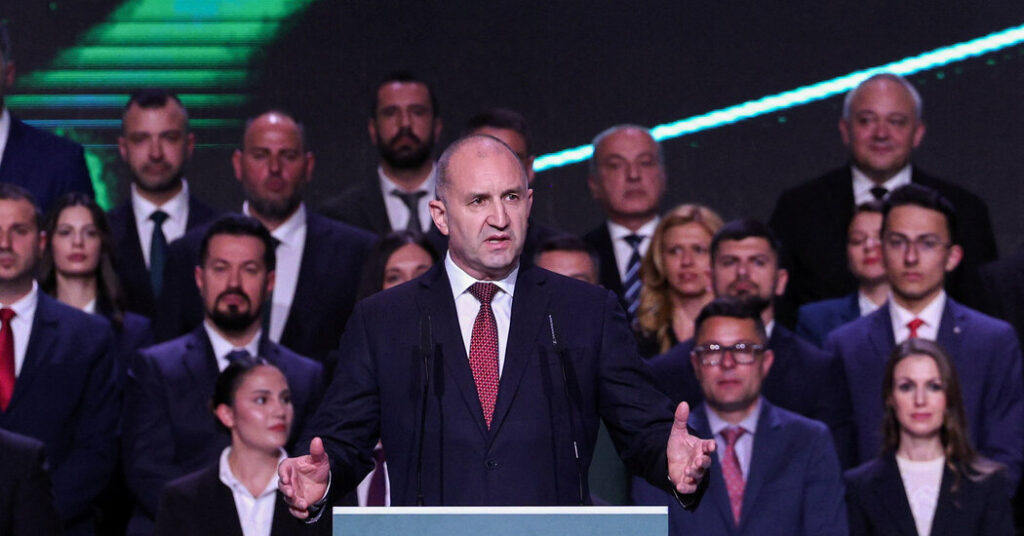
Even after nine years as President of Bulgaria, Rumen Radev, whose coalition won a landslide in parliamentary elections on Sunday, remains something of an enigma.
His resounding win, which will place him at the helm of Bulgaria’s next government, likely as prime minister, has brought a flurry of questions as to what he stands for and where he will take the country.
His critics describe him as pro-Russia, in the pocket of President Vladimir V. Putin. Some have raised the specter that he will be a Trojan horse inside NATO and the European Union, or a disrupter in the style of the outgoing Hungarian leader, Viktor Orban, who used his veto to block policy decisions within the European Union.
Mr. Radev’s supporters dismiss such reports as scaremongering.
“We really take pride in being Europeans. We are Europeans by right,” said Alexander Pulev, a technocrat, former minister and member of Mr. Radev’s economic team. Mr. Radev’s press office referred a request for an interview to Mr. Pulev.
In a country that is both in league with the West yet shares a deep historical affinity toward Russia, Mr. Radev’s biography, appropriately, straddles both realms.
A 62-year-old fighter pilot who left his military career to enter politics in 2016, Mr. Radev’s education and early training was in Bulgaria when it was a loyal Communist satellite of the Soviet Union. But he has served in senior positions since the country became a member of NATO in 2004 and the European Union in 2007.
He trained at the Bulgarian Air Force University in the 1980s and at the Air War College at Maxwell Air Force Base in Alabama in 2003. He served as Commander of Bulgaria’s Air Force in 2014- 2016.
Elected to the largely ceremonial presidency in 2016, he served nearly two terms before resigning last January to lead a new coalition, Progressive Bulgaria, to victory in last weekend’s parliamentary elections, running mainly on promises to clean up corruption.
But it is his Russia-friendly comments while president, and during the election campaign, that have stoked debate about his political leanings.
“He has called for dialogue with Putin’s Russia, opposed sending military aid to Ukraine, denounced the ten-year Bulgaria-Ukraine defense agreement signed last month, and reaffirmed that Crimea is Russian,” said Dimitar Keranov, a visiting fellow at the German Marshall Foundation of the United States in Berlin.
In 2021, Mr. Radev’s reference to Crimea as Russian handed his critics lasting ammunition. He later said that the 2014 annexation violated international law, but the episode clung to him, and he reiterated the statement during the campaign.
On Europe, he has spoken against the European Union’s expansion in the Western Balkans and called for a referendum on Bulgaria’s entry to the eurozone, echoing the far right.
Last year when he welcomed Mr. Orban to Bulgaria’s capital, Sofia, he praised what he called Mr. Orban’s “sober assessment of geopolitical processes.”
“I hope we will develop practical relations with Russia, based on mutual respect and equal treatment,” he told journalists after casting his vote on Sunday. “I believe there will be future steps to finally set the relations between Europe and Russia based on a security agreement. This is extremely important to our future.”
For his sweeping victory, which gave him a majority of seats in the parliament, Mr. Radev drew votes from parties on both the right and left that represent a spectrum of pro-Russian and pro-European sentiment.
In particular, he consolidated the votes from Bulgarians distrustful of the E.U. bureaucracy in Brussels, said Mila Moshelova, an independent Bulgarian analyst.
“We live in a country that has a 60 percent pro-E.U. sentiment, but also we have a very high historical sentiment of approval and closeness of Russia,” she explained. “So he manages to balance both.”
The ties between Russia and Bulgaria run deeper than politics. The two countries share centuries of history and a common Orthodox Christian faith. Mr. Radev has often made speeches referencing the cultural kinship rooted in Russia’s role in helping Bulgaria throw off Ottoman rule in the 19th Century.
For years, under former Prime Minister Boyko Borissov, Bulgaria navigated that tension, trying to placate both Brussels and Moscow. Russia’s invasion of Ukraine made that balance harder to maintain. It became one of the sharpest dividing lines in Bulgarian politics, exposing a country still wrestling with which side of history it stands on.
Bulgarians continue to broadly support the country’s membership in the European Union, with 61 percent in favor and just 16 percent opposed, according to a survey by the Sofia-based Alpha Research agency.
Support for NATO has also grown steadily, from 28 percent in 2017 to 40 percent in 2024. At the same time, perceptions of Russia and its leadership have deteriorated sharply. In 2024, 49.5 percent of Bulgarians held a negative view of Mr. Putin, while positive perceptions had fallen, from 45 percent in 2018 to just 22 percent.
Other surveys show that support for Russia has continued to decline through the course of the war in Ukraine.
Political allies and opponents are now waiting to see whether Mr. Radev will turn his rhetoric into policy once in office.
Bozhidar Bozhanov, one of the leaders of the liberal alliance We Continue the Change-Democratic Bulgaria, said his group would cooperate with Progressive Bulgaria on passing reform legislation, but added that many of Mr. Radev’s candidates for parliament were unknown.
Mr. Radev will eventually have to take positions that will disappoint one or the other side of his supporters, Ms. Moshelova said.
At the same time there is concern that with his large win he will have fewer checks on his decisions.
“With a single-party majority and no coalition partners to constrain him, he has more room than any Bulgarian leader in nearly three decades,” Mr. Keranov said.
Vessela Tcherneva, deputy director of the European Council on Foreign Relations, said she expected Mr. Radev to focus on tackling corruption at home first, in order to meet E.U. democratic standards and receive E.U. funds.
Bulgaria has until August to make reforms to its judicial and anti-corruption institutions if it wants to get money from an E.U. post-Covid recovery fund worth billions of euros, Ms. Tcherneva said.
Even more important are the negotiations that will start next year to set the E.U. budget for the next seven years. As a recipient nation, Bulgaria will need to make efforts to join that discussion, she said.
“This is the tool for the European Commission to make sure that whatever the next Bulgarian government does in the judiciary and in the institutions, it’s toward a reform effort rather than replacing one personal interest with another personal interest.”
European officials congratulated Mr. Radev on his election win, emphasizing shared goals.
“Bulgaria is a proud member of the European family and plays an important role in tackling our common challenges,” Ursula von der Leyen, president of the E.U. commission, said in a statement on social media.
Boryana Dzhambazova contributed reporting from Sofia, Bulgaria.
Carlotta Gall is a senior correspondent, covering the war in Ukraine.
The post Will Bulgaria’s New Leader Cast His Lot With Europe or Russia? appeared first on New York Times.