The point of a road movie is not the destination, but it still matters where you end up. The same is true of a movie: The conclusion can change the whole narrative, delivering catharsis or pathos or recasting a story in a whole new light. Or sometimes, it can just leave you scratching your head.
“Omaha” is that last type of movie, though for obvious reasons it’s hard to describe why without spoiling the whole thing. Directed by Cole Webley from a screenplay by Robert Machoian, it is mostly a road movie in a classic American mode: one father, two kids and a dog in a car, driving against the backdrop of a big sky. But whereas many of these movies are heartwarming, or at least bittersweet, this one is relentlessly gutting. And it’s not clear, by the end, why this story ends where it does, or what it’s intended to mean.
The story centers on a single father (John Magaro), whose life has clearly been on a downward spiral for some time. He’s keeping it together for his children, Ella (Molly Belle Wright) and Charlie (Wyatt Solis), ages 9 and 6. Their mother died recently, and now it seems they’re being evicted — or at least, they’re leaving their home at the crack of dawn. Ella and Charlie don’t quite know what is happening, but Ella starts to realize that this isn’t a vacation, and when their father confirms they’re headed for Nebraska, she thinks they might be moving.
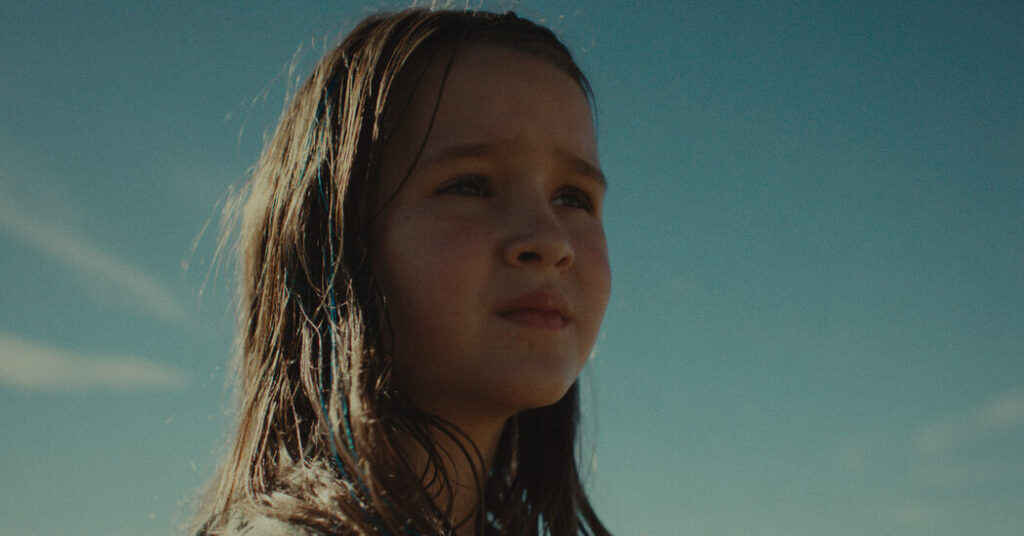
Along with their golden retriever Rex, they drive and drive, singing songs from CDs, watching big trucks go by and making McDonald’s and gas station stops along the way. But the money is starting to run out. Dad doesn’t think the children realize this, and Charlie is mostly oblivious. But Ella sees. And when things start to get more difficult, the worry becomes more deeply etched across her face, especially as they get closer to their destination: Omaha.
I can’t tell you what happens there, but I can tell you that the film takes a left turn. It isn’t an unearned one, emotionally or narratively — we realize it’s been leading there all along — but that choice is then recast by some informative text at the very end that turns the whole story on its head. I was left befuddled about the movie’s message and, indeed, what I was supposed to make of the whole thing. That’s frustrating, and it’s not the sort of feeling you want to have when leaving a movie like this; it overwhelms whatever impression the rest of the movie might have left.
It’s especially exasperating because while there’s not much levity to balance the melancholy in “Omaha,” there doesn’t necessarily need to be. Life in the United States can be hard when you live with economic precarity, and many people are just one unexpected expense away from financial ruin. That’s a story worth telling.
Furthermore, some promising elements in the movie speak to Webley’s skill as a director. His wide shots are often extraordinarily beautiful, tenderly framing the children and their father in a way that tells a story without words. Much work is done dialogue-free in this film, particularly by the always terrific Magaro, as well as by Wright, whose performance is heart-wrenching. We’re largely seeing her father from her perspective, understanding what she understands, and her eyes hold multitudes.
I can imagine a slightly shifted ending for this film — one that doesn’t fundamentally change what happens, but alters how it’s framed a little and brings out the richness of the story it tells. There’s great material packed into “Omaha.” Sometimes redrawing the road map can get you to your destination.
Omaha Rated PG-13 for discussion and depiction of some events that would traumatize any child. Running time: 1 hour 23 minutes. In theaters.
Alissa Wilkinson is a Times movie critic. She’s been writing about movies since 2005.
The post ‘Omaha’ Review: Right Road, Wrong Destination appeared first on New York Times.