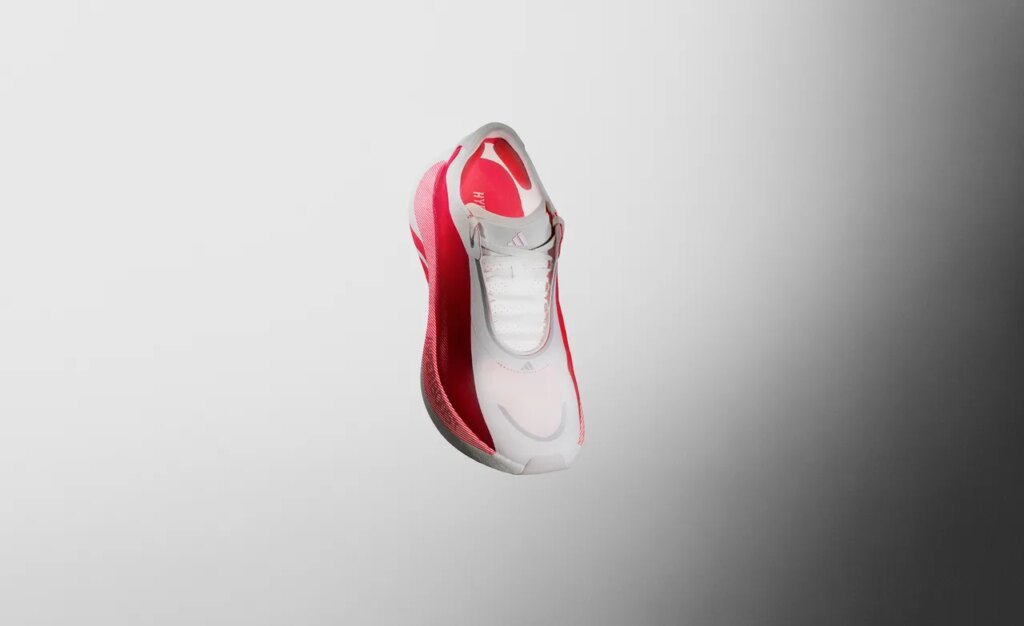
Some running shoes swagger into town, stirring up hype, making big promises. Like the Nike Vaporfly or the Puma Fast-R Nitro 3 Elite, the Adidas Hyperboost Edge ($200) promises to usher in “a new era of road running,” with brand-new supershoe DNA—a giant stack of new super foam, lightweight uppers, and a bold new design.
It certainly looks a lot different than the shoes we might have laced up just a few years back. But what’s really different about these so-called super trainers like the Hyperboost Edge? Here, I’ll break down what’s going on inside the new wave of high-performance running shoes and if they’ll really make you faster.
If you’re not really worried about cutting a minute or two off your mile, don’t forget to check out the rest of our outdoor buying guides, including the Best Running Shoes, the Best Gravel Running Shoes, and the Best Running Socks.
What Is a Super Trainer?
The Adidas Hyperboost Edge joins a growing lineup of running shoes that attempt to translate the high tech of racing “super shoes” into “super trainers,” delivering some of the speed and feel of a race shoe into a more usable everyday package.
The super trainer recipe often pairs a big stack of high-energy, lightweight super foam with a nylon or carbon plate and weight-saving race-style uppers. There’s also a growing trend for plate-free super trainers in response to fears that racking up too many miles in carbon-plated shoes raises your injury risk. But more on that in a mo.
The Hyperboost Edge is Adidas’ first non-plated super trainer and follows in the max-stack footsteps of shoes like the Asics Megablast and the Saucony Endorphin Azura—surprisingly versatile all-round running shoes that can cover most of your weekly miles. This is the shoe sandwich that lets them protect your legs while helping you run farther and faster.
The Midsole Magic
Carbon plates often grab the headlines, but the midsole foam really creates the super shoe magic. When I started running in 2009, the main midsole material was still ethylene-vinyl acetate (EVA), which has been used since the late 1970s and is still used today. EVA is cushioned (to a point), stable, durable, and cheap. But foam technology has bounded on. Gas-infused, supercritical foams, like the polyether block amide (PEBA) Hyperboost Pro in the Edge, are now all the buzz.
Supercritical foams are made by injecting a gas, like CO₂ or nitrogen, under high pressure into the midsole while it’s forming in the mold. In a supercritical state, the gas is not liquid, nor gas, but both at once. When the pressure is reduced, the gas expands inside the foam to create bubbles or cells that give the foam its lighter, bouncier properties.
These gas-injected, supercritical super foams allow shoe designers to stack more foam underfoot for better cushioning, more protection, and higher energy return, and crucially without adding weight. Bigger-stacked running shoes even come in lighter than traditional EVA shoes.
Supercritical foams debuted in carbon race shoes like the Nike Vaporfly 4%, but we’re now seeing super foams designed specifically for training purposes. Shoes like the Adidas Hyperboost Edge’s put a whopping 45 mm stack of expanded, beaded, PEBA-based Hyperboost Pro foam under the heel and 39 mm under the forefoot, while staying under 9 ounces in a US men’s 9.5.
You’re not just getting a higher-energy-returning foam, you’re getting more of it without compromising on weight. When you consider that adding 100 grams to a running shoe increases running energy cost by around 1 percent, that’s a big deal. However, not all foams are created equal.
Sole Searching
While shoemakers stamp midsoles with the branded foam names like ZoomX (Nike), Lightstrike Pro (Adidas) or PWRRUN PB (Saucony), very few brands reveal exactly what’s in their branded foam. To make things more complicated, brands often tweak the foam formula from shoe to shoe. So the Nike ZoomX foam used in the Alphafly isn’t necessarily the same as you find in another Nike daily trainer.
Some shoes also feature what’s called a carrier foam, where only a section of the midsole is made from the top-tier foam and another (often cheaper) foam is used for the bulk of the midsole. That can bring advantages, enhancing stability and durability. But it’s not always 100 percent clear from looking at the shoe what part of the midsole uses the premium foam.
Should You Have a Carbon Plate?
Some super trainers, like the Hoka Mach X3 ($190), have carbon plates. Others, like the Saucony Endorphin Speed 5, have nylon plates. Some, like the Hyperboost Edge, forego the plate. If you dig into the science of carbon-plate shoes, the experts admit that we still don’t 100 percent know how they work. The consensus is that the plate-foam combination produces efficiency benefits.
The plate adds a stiffening element to the midsole and engages more of the midsole foam. As with foams, plates take many different forms, use different blends of materials, and perform differently. There is broad agreement that running in a plated shoe affects your running biomechanics. For example, a carbon plate changes how pressure and stress are spread across the front of your foot and toes.
There’s also a rising tide of noise on social media suggesting that running too often in carbon-plate shoes is a fast ticket to injury. Currently, there’s no research to back this up. That doesn’t mean runners aren’t getting injured in carbon-plate shoes, but there’s no hard evidence to link what scientists call advanced footwear technology with increased injury risk.
Some classic running principles apply—do too much of anything that changes your running too much, too soon, or too often, and you’re asking for trouble. This is where non-plated super trainers come in. While they might not offer the full efficiency gains of carbon-plated race shoes, they still improve running economy while runners report better recovery.
Lacing up a super trainer alongside a more traditional EVA running shoe and a carbon shoe might also provide a more balanced mix of stimuli. Think of it like taking training miles off the road and onto the trail or the track, to reduce the repetitive impact of hammering the asphalt. Switching running shoes changes the load you’re putting through your joints, tendons, and muscles, giving you better odds of being out there enjoying the miles and not crocked on the couch.
Your Guide to Modern Midsole Foams
PEBA (polyether block amide): Very light and bouncy. This foam really comes to life at faster paces with a ride that’s soft but springy with high energy return. Some shoes that use PEBA are the Brooks Hyperion Elite 5 ($266) and the Saucony Endorphin Azura ($150).
ATPU (aliphatic thermoplastic polyurethane): This is a slightly firmer, tougher, more stable alternative to PEBA. ATPU is bouncy, durable, and offers more control. But it’s a little heavier than PEBA. Shoes that use ATPU are the Asics Metaspeed Ray Tokyo ($270) and the Asics Megablast ($225).
TPEE (thermoplastic polyester elastomer): A member of the TPE (thermoplastic elastomer) family, TPEE is known for being more durable than many super foams while still offering extreme softness. It’s much more compressive than the snappier PEBA, but still serves up very-high-energy return. The Saucony Endorphin Elite 2 ($290) uses TPEE.
ETPEE (expanded thermoplastic polyester elastomer): Another member of the TPE foam family, this newer foam compound sits somewhere between TPU and PEBA. It’s lighter than the former and more stable than the latter, with a soft and responsive ride and bounce-back that’s balanced and consistent.
EVA (ethylene-vinyl acetate): This is the OG foam found in running shoes for decades. EVA is moderately soft, not very bouncy, and good for stability. EVA is still often used in more affordable shoes, or as the bottom layer in dual-foam running shoes to add durability and stability. Some shoes now also deploy supercritical EVA to save weight and improve energy return. The Hoka Mach 7 ($145) uses EVA.
Power up with unlimited access to WIRED. Get best-in-class reporting and exclusive subscriber content that’s too important to ignore. Subscribe Today.
The post The Adidas Hyperboost Edge Is Your New Super Trainer appeared first on Wired.