With the Iran war continuing to strangle Middle East oil supplies, public transit agencies looking to add passengers might expect high gas prices to incentivize people to ride the rails more than ever.
Historically, high gas prices do lead to spikes in public transportation use. But the pandemic hit mass transit hard, particularly in California, and the recovery has been slow as a number of people continue to work from home.
Gas prices spiked after the Ukraine war began in 2022 but did not spur major ridership increases in local public transportation, and the question is whether the reaction to high fuel prices from the Iran war will be different.
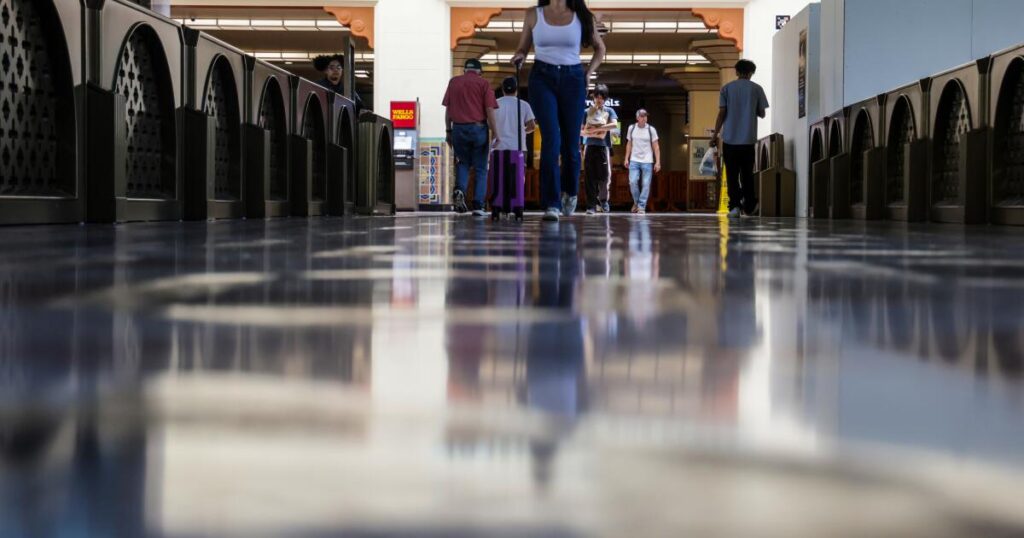
The number of residents who rode their local rail lines in two of California’s major metropolitan cities jumped significantly last month. Although officials believe gas prices may be one factor behind the increase, experts say it’s not yet clear if this is the beginning of a larger trend.
California’s gas prices have risen 30% since the start of the year, according to data from the U.S. Energy Information Administration. In the Los Angeles-Long Beach area, the average price for regular gas jumped from $4.67 in February to $5.93 in March; the average in San Francisco also increased — from $4.83 in February to $5.99, the American Automobile Assn. reported.
At the same time, ridership in each region jumped by about 1 million passengers.
A Times analysis found that the number of Los Angeles Metro riders peaked in March at 6.3 million, an increase from 5.8 million in March of 2025 and 5.7 million during the same month the year before.
About 5.4 million riders hopped on the San Francisco Bay Area Rapid Transit rail system in March, an increase from 4.5 million in the same month in 2025 and 4.1 million in 2024.
The regions’ bus systems have shown small increases in ridership or held steady: S.F.’s Muni grew from an estimated 13 million passengers to nearly 15 million from March 2024 to March 2026. Los Angeles’ Metro has averaged about 20 million riders during the same time period.
For the first two months of the year, Metro’s rail ridership increases were largely driven by weekend riders rather than daily commuters.
“These riders generally choose Metro for leisure trips to avoid traffic congestion and the high cost and inconvenience of parking,” said Maya Pogoda, spokesperson for Metro.
But March was starkly different.
“We saw an 8.6% increase in weekday ridership compared to March 2024, suggesting that more people may be returning to rail for regular, work-related travel — not just occasional trips,” she said.
As it happens, both L.A. and the Bay Area had an exceptionally busy March in terms of local and nationwide events. There was opening day for the Major League Baseball teams in both regions, as well as dozens of No Kings protests — and each had hyper-local events that were near several rail stations.
BART riders — including locals and out-of-towners — rode the rail to attend the five-day Game Developers Conference: Festival of Gaming, which started March 1, as well as the four-day cybersecurity RSAC 2026 Conference, which began March 23, said Alicia Trost, BART’s chief communications officer.
In Southern California, the Dodgers and Angels had a three-game spring training seriesnear the end of the month, and each team’s stadium is just a short walk from a train station. On March 15, Hollywood hosted the Oscars— not far from a stop off the B Line.
Generally, however, getting people out of their cars, even in times of high gas prices, is hard, said Michael Manville, professor of urban planning at the UCLA Luskin School of Public Affairs.
“People are kind of locked into their cars,” Manville said. “Even when they do start to feel the pinch, they don’t necessarily change their travel behavior, they cut back on other things.”
A change in transportation habits would start with lower-income individuals and families, said Ethan N. Elkind, director of the Climate Program at UC Berkeley’s Center for Law, Energy and the Environment.
The last time a war led to a spike in gas prices that was followed by an upswing in the number of people taking public transportation was when Russia invaded Ukraine in 2022 — yet it’s difficult to prove a direct correlation, Elkind said.
For one thing, the hike in fuel prices didn’t last very long, he said.
“It didn’t necessarily lead to any long-term changes,” Elkind said.
To bring about long-term change, L.A.’s Metro has been expanding and recently announced it was testing a people mover at Los Angeles International Airport. The mover is connected to a new LAX/Metro Transit Center and has connections to the system’s C and K lines. There are also four new stops on the A Line in the San Gabriel Valley.
The transit authority has also kicked off “activitations” — shopping or entertainment that’s meant to encourage people to spend some time at stations rather than just pass through. In March, there were eight such events, including the open market at the Glendora station, a night market in Pomona and a violinist who performed for two hours at the 7th and Metro station.
Elkind and Manville said if gas prices remained high for a long period of time, people would start to change their transportation routine.
They might begin with eliminating discretionary trips but then would start “switching over to transit because it now becomes either a necessity because they can’t afford to drive anymore, or they’re just factoring in the additional costs,” Elkind said. “That tips the scale in favor of taking transit, even if that might mean it takes a little longer to get where they need to go.”
With that in mind, there already is a cheaper alternative to gasoline-powered vehicles — electric vehicles. Though new EV sales are declining with Trump in the White House and the elimination of incentives for EV purchases, used ones are now generally more affordable than new or used gasoline-fueled vehicles.
The best way to get more people to use their local transit system, Elkind said, is to have stations that are conveniently located, within walking or biking distance, from homes and businesses.
“That’s where we’ve really failed, largely in California,” because our destinations aren’t oriented around transit, Elkind said. There are exceptions such as the rail system in Koreatown, downtown Los Angeles, West Hollywood, Santa Monica, downtown San Francisco, Oakland and Berkeley.
“But these are little pockets,” he said, “and there’s not enough of them.”
The post California’s rail systems need more riders. High gas prices could be fueling a new surge appeared first on Los Angeles Times.