When Ayatollah Ali Khamenei ruled Iran as the supreme leader, he exerted absolute power over all decisions about war, peace and negotiations with the United States. His son and successor does not play the same role.
Ayatollah Mojtaba Khamenei, the son, is an elusive figure who has not been seen and whose voice has not been heard since he was appointed in March. Instead, a battle-hardened collective of commanders in the Islamic Revolutionary Guards Corps and those aligned with them are the key decision makers on matters of security, war and diplomacy.
“Mojtaba is managing the country as though he is the director of the board,” said Abdolreza Davari, a politician who served as senior adviser to Mahmoud Ahmadinejad when he was president and knows Mr. Khamenei.
“He relies heavily on the advice and guidance of the board members, and they collectively make all the decisions,” Mr. Davari said in a phone interview from Tehran. “The generals are the board members.”
This account of Iran’s new power structure is based on interviews with six senior Iranian officials, two former officials, two members of the Revolutionary Guards, a senior cleric familiar with the inner workings of the system and three individuals who know Mr. Khamenei well. Nine other individuals with ties to the Guards and the government also described the command structure. They all spoke on the condition they not be identified because they were discussing sensitive matters of state.
Mr. Khamenei, who was selected by a council of senior clerics as the new supreme leader, has been in hiding since American and Israeli forces bombed his father’s compound on Feb. 28, where he also lived with his family. His father, wife and son were all killed. Access to him is extremely difficult and limited now. He is surrounded mostly by a team of doctors and medical staff who are treating the injuries he sustained in the airstrikes.
Senior commanders of the Guards and senior government officials do not visit him, fearing that Israel may trace them to him and kill him. President Masoud Pezeshkian, who is also a heart surgeon, and the minister of health have both been involved in his care.
Though Mr. Khamenei was gravely wounded, he is mentally sharp and engaged, according to four senior Iranian officials familiar with his health. One leg was operated on three times, and he is awaiting a prosthetic. He had surgery on one hand and is slowly regaining function. His face and lips have been burned severely, making it difficult for him to speak, the officials said, adding that, eventually, he will need plastic surgery.
Mr. Khamenei has not recorded a video or audio message, the officials said, because he does not want to appear vulnerable or sound weak in his first public address. He has issued several written statements that have been posted online and read on state television.
Messages to him are handwritten, sealed in envelopes and relayed via a human chain from one trusted courier to the next, who travel on highways and back roads, in cars and on motorcycles until they reach his hide-out. His guidance on issues snakes back the same way.
The combination of concern for his safety, his injuries and the sheer challenge of reaching him has resulted in Mr. Khamenei’s delegating decision making to the generals, at least for now. Reformist factions, as well as ultra-hard-liners, are still involved in political discussions. But analysts say that Mr. Khamenei’s close ties to the generals, whom he grew up with when he volunteered to fight in the Iran-Iraq war as a teenager, have made them the dominant force.
President Trump has said that the war, along with the killings of layers of Iran’s leaders and security establishment, has ushered in “regime change” and that the new leaders are “much more reasonable.” In reality, the Islamic republic has not been toppled. Power is now in the hands of an entrenched, hard-line military, and the broad influence of the clerics is waning.
“Mojtaba is not yet in full command or control,” said Sanam Vakil, the director of the Middle East and North Africa for Chatham House who has contact with people in Iran. “There is, perhaps, deference to him. He signs off or he is part of the decision-making structure in a formal way. But he is presented with fait accompli presentations right now.”
The speaker of the Iranian Parliament, Mohammad Bagher Ghalibaf, a former Guards general and the lead negotiator with the United States in Pakistan, said in a television address on Saturday that the U.S. proposal for a nuclear deal and peace plan and Iran’s response had been shared with Mr. Khamenei and his views taken into account when making decisions.
The Rise of the Guards
The Revolutionary Guards, formed as protectors of the 1979 Islamic Revolution, have steadily amassed power through top political roles, stakes in key industries, domination of intelligence operations and cultivation of ties with militant groups in the Middle East that share Iran’s enmity toward Israel and the United States.
But under the elder Mr. Khamenei, they still had to mostly adhere to his will as a singular religious figure who also served as commander in chief of the armed forces. He empowered the Guards, and over time they became the tool and pillar of his rule.
Mr. Khamenei’s killing on the first day of the war created a void and an opportunity. The Guards rallied behind Mojtaba in the succession struggle that ensued and played an instrumental role in his selection as Iran’s third supreme leader.
The Guards have multiple levers of power. The commander in chief is Brig. Gen. Ahmad Vahidi. Gen. Mohammad Bagher Zolghadr, the newly appointed head of the Supreme National Security Council, is a former hard-line commander of the Guards. Gen. Yahya Rahim Safavi, a commander, has served as the top military adviser to both father and son supreme leaders.
“Mojtaba is not supreme; he might be leader in name, but he is not supreme the way his father was,” said Ali Vaez, the Iran director of the International Crisis Group who has extensive contacts in Iran. “Mojtaba is subservient to the Revolutionary Guards because he owes his position and he owes the survival of the system to them.”
The officials interviewed say the generals view the war with the United States and Israel as a threat to the regime’s survival, and after five weeks of fierce fighting, the generals are confident that they have contained the threat. At every juncture, they have taken the lead in deciding strategy and the use of resources.
They have upended the global economy by closing the Strait of Hormuz and have used any gains in the war as leverage to outmaneuver political rivals at home. The elected president and his cabinet have been sidelined and told to focus only on domestic affairs, such as providing a steady flow of food and fuel, and to make sure the country is functioning, according to knowledgeable officials.
The foreign minister, Abbas Araghchi, has been marginalized in the negotiations that he led with the United States before the war, the officials said. Mr. Ghalibaf, the speaker of Parliament, has taken the lead instead.
The newly minted supreme leader has followed along, rarely if ever objecting to the generals, they said.
It was the Guards who came up with the strategy for Iran’s attacks on Israel and the Persian Gulf states, along with the closing of the strait to maritime traffic. They were the ones who agreed to a temporary cease-fire with the United States and approved back-channel diplomacy and direct negotiations with the United States. They tapped Mr. Ghalibaf from among their own ranks to lead the talks with Vice President JD Vance in Islamabad.
For the first time, several military generals from the Guards were part of the Iranian delegation negotiating with the United States.
Iranian officials and three others individuals who know Mojtaba Khamenei said in interviews from Tehran that his deference to the Guards was partly because he was new to the leadership role. He lacks the political stature and religious clout that made his father such a singular force. And it is partly because of his deep personal ties to the Guards.
When Mr. Khamenei was 17, he volunteered to fight in the Iran-Iraq war. He was deployed to a brigade of the Guards called the Habib Battalion. The experience shaped him, and he made lifelong bonds. As they grew and aged, many members of the battalion rose into influential military and intelligence roles.
Mr. Khamenei completed his studies at a theological seminary, reaching the rank of ayatollah, considered a scholar and jurist of the Shiite faith. He worked at his father’s compound, coordinating military and intelligence operations for his father, a role that further cemented his ties to the generals and intelligence chiefs.
Among Mr. Khamenei’s close friends from the Habib Battalion is the Guards’ former intelligence chief, the cleric Hossein Taeb; and Gen. Mohsen Rezaei, who commanded him in the 1980s and has been called back from retirement. Mr. Ghalibaf is also a longtime friend.
For years, Mr. Khamenei, Mr. Taeb and Mr. Ghalibaf met once a week for long working lunches at the ayatollah’s compound, according to Iranian officials and the three individuals who know Mr. Khamenei personally. They became known as the “triangle of power.” The trio was accused by a more moderate cleric, Mehdi Karroubi, of intervening in the 2009 presidential election in which he was a candidate and rigging the results in favor of the incumbent president, Mr. Ahmadinejad. Mr. Karroubi lost, and the election upset led to months of upheaval, protests and violence.
These personal relationships are now playing heavily into the dynamic between Mr. Khamenei and the generals. They are on a first-name basis and view one another as peers, not superior and subordinate, said Mr. Davari.
Differences Emerge
The generals are not the only voices at the table. Iranian politics have never been monolithic, and the system is designed to have parallel power structures. Disagreements and divisions have always been common and, in many instances, public among Iranian political figures and military commanders. Mr. Pezeshkian and Mr. Araghchi also have seats on the National Security Council.
But under the current collective leadership, it is the generals who prevail and currently there are no signs of disarray among them.
On Tuesday, as the Iranian and American negotiating teams prepared to fly to Islamabad to meet for a second round of talks, the generals pulled the plug. For days differences had simmered over whether Iran should continue talks with Mr. Vance if Mr. Trump maintained a sea blockade on Iran. Already, some 27 Iranian ships had been turned around while trying to enter or exit Iranian ports.
Mr. Trump had fired off a series of social media posts about forcing Iran to give in to all his demands, and he had renewed threats to bomb the country’s power plants and bridges if Iran did not agree to a deal. The United States then seized two ships belonging to Iran, further infuriating the generals, who thought the move amounted to a violation of the cease-fire, officials said.
The commander in chief, General Vahidi, and several other generals argued that talks were futile because the blockade showed Mr. Trump was not interested in negotiations and wanted to pressure Iran to surrender, according to officials and two members of the Guards who were briefed on the meeting.
The officials said Mr. Pezeshkian and Mr. Araghchi disagreed. Mr. Pezeshkian warned of the dire economic losses from the war, estimated by the government to be about $300 billion, and the need for sanctions relief for reconstruction. Disagreements also emerged over how far Iran should push with its closure of the strait.
The generals won, and the talks fell apart.
Mr. Trump extended the cease-fire but is keeping the blockade in place until, he said, Iran’s “fractured leaders” present their own peace proposal. What happens next is not clear. Nor is it clear whether the Guards will allow enough concessions to the United States on Iran’s nuclear program for a peace deal to materialize, including on the two contentious issues: freezing enrichment and giving up the 400-kilogram stockpile of highly enriched uranium.
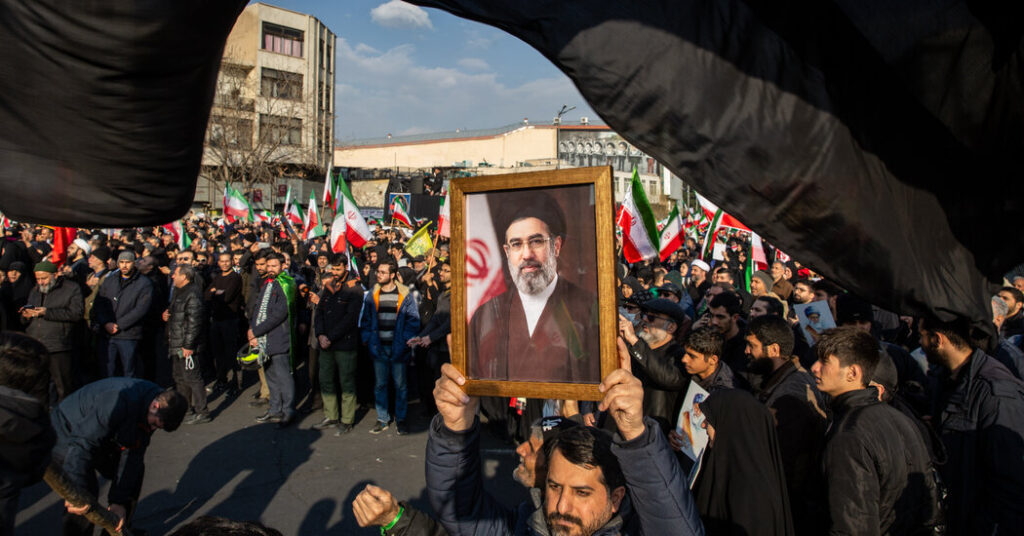
A hard-line fringe faction in Iran, while not dominant, has opposed making any concessions, believing that if Iran continued fighting it would defeat Israel and the United States. Supporters of the hard-liners have filled the streets with rallies at night, waving flags and pledging their blood for the Islamic republic. When Mr. Araghchi posted on social media at one point that Iran was opening the strait, the hard-liners attacked him, accusing the negotiating team of betraying their supporters.
The firebrands are supporters of Saeed Jalili, an ultra-hard-line presidential candidate, who has been sidelined from making decisions but still has some influence, including over state television, which his brother runs. Some demanded that Mr. Khamenei make a video or audio message to confirm to the public he was on board with the negotiations with Washington. At a rally in Tehran, crowds addressing Mr. Khamenei chanted, “Commander, give us the order and we will follow.”
Mr. Ghalibaf addressed the nation on state television on Saturday night local time, assuring Iranians that Mr. Khamenei was involved. He struck a defiant but pragmatic tone, saying that Iran had gained military achievements, including shooting down an American fighter jet, but that now it was time to leverage those gains in diplomatic negotiations.
“Sometimes, I see our people say we destroyed them,” Mr. Ghalibaf said. “No, we did not destroy them; you need to understand this. Our military gains do not mean that we are more powerful than the United States.”
Farnaz Fassihi is the United Nations bureau chief for The Times, leading coverage of the organization. She also covers Iran and has written about conflict in the Middle East for 15 years.
The post A New Era and New Leadership: The Generals Who Are Running Iran appeared first on New York Times.