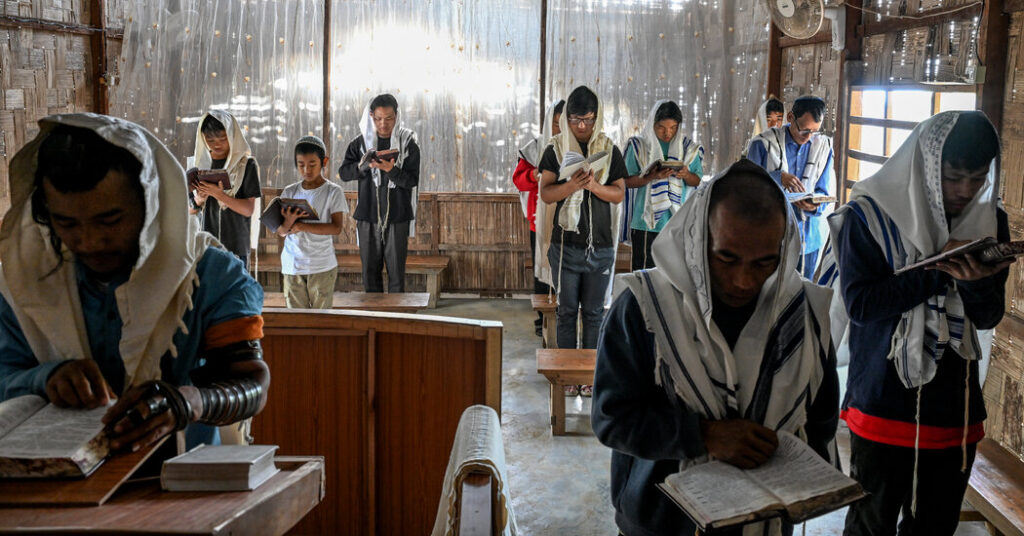
Of all the world’s tribes, the B’nei Menashe are as lost as they come.
A few thousand can be found in a far corner of India, at the kibbutz of Ma’oz Tzur, where a subtropical breeze blew past the mezuza at Shimon Ngamthenlal’s door recently. He shuffled about his bamboo hut, tending to a collection of writings about Judaism, printed in English and Hebrew. In the background, women on woven stools were chopping foraged greens for his family’s lunch — Southeast Asian, and just about kosher.
This lonely outpost in India’s remote northeast, flush against Myanmar, is home to a community that believes itself to be one of the Ten Lost Tribes of Israel: children of Manasseh, a king of Judah who was exiled about 2,800 years ago. There are about 10,000 of the B’nei Menashe spread between the Indian states of Manipur and Mizoram and, increasingly now, Israel itself, 3,600 miles to the west.
For generations, they have been teaching their children how their ancestors wandered from the ancient Middle East across Asia to find refuge in the jungle. They are more interested in their religion than in arguments about their historical origin.
“We have faith in the Torah,” said Mr. Ngamthenlal, his face framed by payot, the sidelocks worn by some Orthodox Jewish men. An aliyah, or homecoming, is finally in their sights. “We have good faith in the Israeli government. They promised that all the B’nei Menashe will go to Israel by 2030,” he said. “We all have our passports ready.”
Nearly half the community has already moved to Israel, piecemeal, since the 1990s. But on Thursday, with Operation ‘Wings of Dawn,’ Israel itself will fly about 250 more of the Menashe, via Delhi, to Tel Aviv. The rest are to follow soon after.
Some of the earliest groups made their homes in places like Hebron in the West Bank and in Israeli settlements in Gaza, before 2005. In November last year, the Israeli government agreed to help the remaining 5,800 or so immigrate en masse, including 1,200 this year, and is covering some of the cost.
Benjamin Netanyahu, Israel’s prime minister, has called the funding “an important and Zionist decision that will also strengthen the North and Galilee” regions of Israel, parts of which were taking rocket fire from Hezbollah fighters in Lebanon last week.
Israel is eager to replenish a work force that has been thinned out by the wars that began with the Hamas attack of Oct. 7, 2023. Israelis called to military duty or displaced by rocket attacks, Palestinians from the West Bank barred from their regular work and a reduced flow of migrant labor from countries like Nepal and Thailand have hurt the economy.
The Menashe themselves insist on putting faith first. Benjamin Haokip, another resident of the Manipuri kibbutz, said, “We follow Judaism, and here we cannot follow all our customs.” Some prayers require a minyan or quorum, which is hard to find in the hills. Others require knowledge gained through cultural experience and foodstuffs that can’t be found locally. “We want to go to Israel for our religion,” he said.
The principal appeal of moving is to worship among fellow Jews in Israel, Mr. Haokip said, even if it is not the only reason. Manipur’s lush hills are in one of the poorer parts of India. The state’s per capita economic activity was worth about $1,200 a year, according to data for 2023-24, the most recent available. Israel’s is more than $55,000.
“We want to go to Israel, 90 percent for our religion, but yes, other things are better there, too — like education,” Mr. Ngamthenlal, the Hebrew teacher, said.
Most of the Menashe in India work on family farms or as day laborers. Their kin who have made it to Israel tend to drive trucks or work in construction and factories. Most urge those still in India to join them.
Jessica Thangjom, a Menashe who lives in Israel, works for an organization that helps others from the tribe make the leap. “Transitioning” is the tough part, she wrote in a message. To go from their agrarian lifestyle “to a technologically sophisticated environment is not an easy journey.”
In Manipur, the Menashe are classified as a Kuki people. The languages they speak belong to the Tibetan-Burmese family and conventional anthropology traces their roots back to what is now Chinese territory. Most Kukis first converted to Christianity early in the 20th century, under the influence of American missionaries.
It was in the 1970s that a couple of maverick Israeli anthropologists visited northeastern India and observed that some of their pre-Christian customs resembled Judaic practices. The Kuki chants had a familiar music, their folk tales seemed to recall the escape from Egypt and, in times of calamity like earthquakes, they called out a local phrase that sounded like “Manasseh!” That was how they came to be regarded as the Menashe.
Among those convinced were the family of W.L. Hangshing, a retired income-tax official in New Delhi who serves as the president of the B’nei Menashe Council of India. His father migrated to Israel years ago and lived his last years there. Mr. Hangshing acknowledged that the historical evidence available to support his community’s claim can seem thin, but the dispersion of the Menashes was so ancient, “you won’t find any trace of it now, not even in D.N.A.” (Some lost tribes have established a thread of genetic inheritance, including the Lemba of southern Africa.)
“We’re called the Lost Tribes, and lost means lost!” said Mr. Hangshing. Scientists who have sought biological proof of ancestry were misguided, he said: “Only God can do that.”
His fellow tribe member, Mr. Haokip, 37, said family elders had told him the tribe was from Israel. A few other small communities in India better documented attestations of their Jewish descent, but the Menashe have transmitted their beliefs strongly.
Split By War
Across Manipur’s central valley from the kibbutz, another community of Menashe lives in the town of Kangpokpi. The drive between the two places should take less than four hours — in peacetime. But in May 2023, Manipur was split along jagged lines by terrible bloodletting between Kukis and the majority Meitei people who inhabit its lowlands. It remains violent: This month at least five people, including two children, were killed along the road from Churachandpur.
“After the Kuki-Meitei violence, life has become more difficult,” said Mr. Haokip, who came with his wife and children to the kibbutz after being driven from their homes by mob violence.
For the three years since, it has been virtually impossible for either group to make the same journey across the lowlands. Kukis said that the hatred between the groups is too fierce and there have been tit-for-tat killings for years.
Daniel Hangshing (a distant relation of W.L. Hangshing) lives hardly a block from a synagogue in Kangpokpi. To prove his suitability for emigration to Israel he had to bring his whole family on a two-and-a-half-day voyage, by taxi and train, to a neighboring state to meet with rabbis. “There they talked to us through an interpreter who came from Israel, for 40 minutes,” he said.
This Mr. Hangshing isn’t a frequent visitor to the temple in his own neighborhood, though the children of his extended family go often and he practices a Sabbath ceremony at home every Friday. He is firm in his beliefs: “India is our birthplace, and Israel is our destiny. That is our promised land. We have to go there.” He is learning Hebrew on the Duolingo app.
So, the Hangshings will be leaving one war-torn territory, crisscrossed by no-go zones, for another. Daniel Hangshing said: “We know that Israel is a place in turmoil, but we have to go there and die there. We are not bothered about the war.”
Hari Kumar covers India, based out of New Delhi. He has been a journalist for more than two decades.
The post A Lost Tribe in India Makes Its Exodus to Israel appeared first on New York Times.