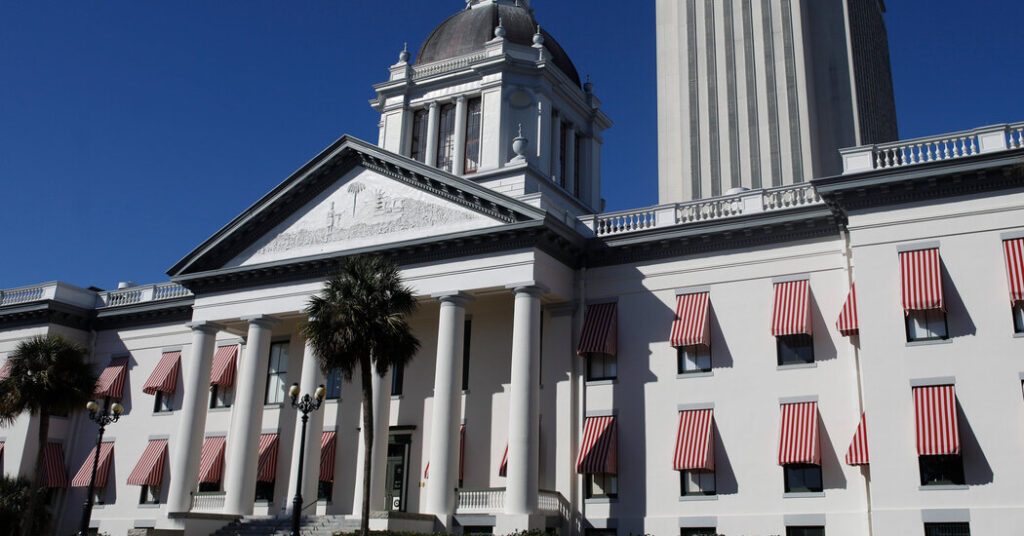
Frustrated Republicans looked Wednesday to rebound from another setback in a nationwide redistricting chess match, as the high-stakes contest turned to Florida and the courtroom.
A Democratic victory on Tuesday in Virginia, where voters approved a change to the state’s House map that could give the party up to four more seats in the midterms, left Republicans with little to show for a tit-for-tat they started last year in Texas at the urging of President Trump.
Republicans are holding out hope that Virginia’s top court might reverse Tuesday’s result. And they are eying a chance to gain ground by redrawing the House map in Florida, where they control the governor’s office and hold supermajorities in the Legislature. But there is growing doubt in the party about its broader strategy.
“The two sides spent hundreds of millions dollars to get back to where they started, and in general, it’s turned out to be a net loser for Republicans,” said C. Stewart Verdery Jr., a Republican consultant.
Among the Republicans voicing unhappiness with the Virginia result was Mr. Trump. “Let’s see if the Courts will fix this travesty of ‘Justice,’” the president wrote Wednesday on social media.
Mr. Trump sought to discredit the legitimacy of the vote, falsely claiming that Republicans had been winning “until the very end” when there was a “massive ‘Mail In Ballot Drop!’” Mail-in ballots overwhelmingly favored redrawing the map, but the “Yes” side pulled ahead late Tuesday after several populous Democratic strongholds reported their votes, which were mostly cast in person.
Democrats were celebrating the outcome, which delivered them a new House map with just one safely Republican seat. The state’s 11-member congressional delegation currently consists of six Democrats and five Republicans. Nationally, Democrats have drawn about even with Republicans in the gerrymandering fight.
Representative Hakeem Jeffries of New York, the Democratic minority leader, said in a statement late Tuesday that his party had showed it was not going to “roll over and play dead.” Democrats would instead “hit back hard” against Republican power plays, he said.
Speaker Mike Johnson, Republican of Louisiana, argued in a statement that the margin in the Virginia referendum — three percentage points as of Wednesday afternoon — showed that Democrats had carried out an “egregious” gerrymander in a politically split state. He vowed his party would fight the new map in court.
The Virginia Supreme Court allowed the referendum to take place after reviewing complaints arguing that the vote was set improperly and that wording in the ballot question was misleading. But the court said it would review the issue after the vote. In an order last month, the court wrote that it had “grave concern” about the redistricting process.
If the Virginia result holds, Republicans appear to have dwindling avenues to land another significant blow in the gerrymandering battles. One, in Florida, carries major risks.
Although Gov. Ron DeSantis of Florida, a Republican, has pointed to a perceived census undercount as a rationale to draw new maps, any redistricting in the state would be all but certain to face court challenges. And new Republican-leaning districts could spread Republican voters too thinly and put some incumbents in greater danger of losing seats.
“It’s risky what the Florida Republicans want to do,” said John Couvillon, a pollster who has worked with Republican candidates. He added that the current political environment posed particular perils for an aggressive gerrymander aimed at securing short-term benefits.
Mr. DeSantis has called state lawmakers for a special redistricting session. But, less than a week before the start of the session, which was delayed, he has yet to unveil a new map for legislators to consider.
Florida state lawmakers have shown little interest in redistricting and are not expected to propose their own maps.
“All of these redistricting initiatives are toxic,” said Carlos Curbelo, a Republican former congressman from South Florida, adding that his party risked both weakening Republicans’ chances in certain districts and eroding faith in American democracy.
Although Florida may attract much of the attention in the short term, a case before the U.S. Supreme Court could have a far more significant impact on redistricting.
The court is hearing a challenge to a key provision of the Voting Rights Act that effectively prohibits racial gerrymandering. Should the court completely strike down that provision, as it appeared poised to do during oral arguments, multiple states could attempt to quickly redraw their maps. And the Supreme Court’s move could give Mr. DeSantis another justification to draw new maps in Florida.
Still, it is unclear when the court will issue a ruling in this term, which ends in late June or early July. A late ruling, after dozens of states have completed their primaries, would make it difficult for many states to draw new maps before the midterms.
After Republicans redrew the map in Texas to potentially add five Republican seats, Democrats in California responded by redrawing their state’s map to potentially add five Democratic seats. Three other states — Missouri, North Carolina and Ohio — redrew their maps to potentially add Republicans seats. (Ohio was required under its state Constitution to redraw its map.)
As the dust was settling in Virginia, it was not clear how the referendum might affect the plans of the five Republicans in the state’s congressional delegation. Nor was it clear how many of them might run in the state’s one remaining Republican-leaning House district.
The district covers territory now represented by Representatives Ben Cline and Morgan Griffith, and neither has signaled what they plan to do next.
Some Virginia Republicans may announce their decisions only after the party has exhausted its efforts to counter the redistricting plan in the courts. But Representative Jen Kiggans, a Republican from Virginia Beach, plans to run for re-election in the Second Congressional District, according to her campaign manager, Joe Link. The district now has a Democratic lean.
L. Louise Lucas, the Democratic president of the Virginia State Senate, posted an image on social media depicting Ms. Kiggans, Mr. Cline and two other House Republicans from Virginia — John McGuire and Rob Wittman — working at a McDonald’s. “Thank you McDonalds for hiring those facing federal job losses,” Ms. Lucas wrote.
Jeff Ryer, chairman of the Virginia Republican Party, said late Tuesday that the Virginia Supreme Court could still erase the Democratic gerrymander. “For the sake of Virginia, we will hope and pray that they do,” he said.
But many Republicans appeared exasperated with their party.
“If you’re going to pick a fight, at least win it,” said Ari Fleischer, who was a White House press secretary for President George W. Bush, in a social media post. “The other side will always fight back. All this was foreseeable and avoidable. We should not have started this fight.”
Nick Corasaniti is a Times reporter covering national politics, with a focus on voting and elections.
The post With G.O.P. in Dismay, Redistricting Fight Turns to Florida and the Courtroom appeared first on New York Times.