President Trump has vowed to secure a “far better” agreement with Iran than one struck by President Barack Obama more than a decade ago.
That agreement, commonly known as the 2015 Iran nuclear deal, was designed to prevent Iran from acquiring a nuclear weapon. It required Iran to limit its nuclear program in return for economic sanctions relief.
Mr. Trump withdrew from that deal during his first term in office, reimposing sanctions and leading Iran to dramatically increase its nuclear activity. Mr. Trump attacked Iran last June and again this year to block its progress toward a potential atomic bomb, which Iran denies seeking.
Critics say that Mr. Trump could have avoided a costly war had he left the 2015 agreement, formally known as the Joint Comprehensive Plan of Action, in place. They also warn that Mr. Trump may wind up accepting terms little better than the ones Mr. Obama secured more than a decade ago.
In a social media post on Monday, Mr. Trump trashed the 2015 agreement as “one of the Worst Deals ever made having to do with the Security of our Country,” and “a guaranteed Road to a Nuclear Weapon” for Iran. He also ridiculed it for delivering $1.7 billion in cash-filled pallets to Tehran.
Why did President Obama want a deal with Iran?
Iran has insisted that its decades-old nuclear program is for peaceful purposes such as research, medicine and energy. But once established, a peaceful program can be expanded for military use.
By the time Mr. Obama took office in 2009, Western officials saw ominous signs that Iran’s theocratic regime was interested in nuclear weapons. Mr. Obama, who campaigned on ending the Iraq War, was reluctant to use force, and also worried that Israel could strike Iran’s nuclear sites and drag the United States into another war. In 2013, he offered to negotiate the matter with Tehran, which saw an opportunity to free itself from punitive U.S. and European economic sanctions.
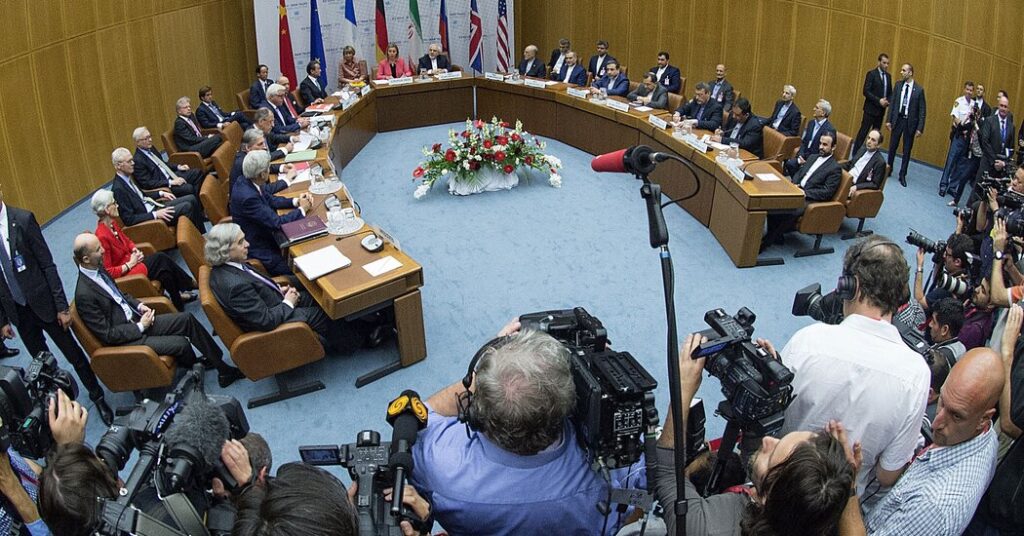
The Obama administration led several other powers — Russia, China, Britain, France, Germany and the European Union — through 20 months of negotiations with Tehran. Their goal was to keep Iran at least a year away from having enough nuclear material to fashion a bomb. (Constructing a nuclear device could take at least several more months, experts believe.)
That one-year boundary was meant to give the United States and its allies plenty of time to respond to any Iranian dash toward a bomb. Before the agreement, the United States estimated that Iran could be within two to three months of that threshold.
Some Obama officials also hoped that diplomacy would be its own reward. A nuclear deal could promote positive change in Iran by empowering moderates who favored better relations with the West, they said, and by removing sanctions that had disconnected Iran’s economy from the outside world.
What did the Obama deal require Iran to do?
The Joint Comprehensive Plan of Action required Iran to give up most of its nuclear material, sharply limit its nuclear activity, accept international monitoring, and forswear nuclear weapons.
Under the deal, Iran shipped 98 percent of its uranium stockpile out of the country. Iran previously had enough uranium to fashion eight to 10 atomic bombs once fully processed; afterward it was left without enough for even one.
Iran also dismantled two-thirds of its centrifuges, the devices that process, or enrich, uranium to a potent form usable for nuclear energy or weapons. It also agreed to operate no more than 5,060 centrifuges at a time, using only its least-advanced models for a decade. No uranium was to be enriched or stored at Iran’s deeply buried Fordo facility for 15 years.
The deal barred Iran from enriching uranium until 2030 beyond a level of 3.67 percent — enough for research and medicine but not bombs. Iran also disabled a nuclear reactor that produced plutonium waste that could be used for weapons.
To ensure compliance, Tehran agreed to allow the International Atomic Energy Agency to keep a close watch, including monitoring by cameras and inspectors of its uranium stockpile and centrifuge use.
What did opponents of the deal say?
Critics say the 2015 agreement was fatally flawed because it allowed several key provisions to expire, or “sunset,” after 15 years, including limits on Iran’s enrichment and stockpile of uranium.
Opponents of the deal often say that it effectively granted Iran a green light to expand its nuclear activities after 2030. Obama officials insist that Iran never would have agreed to longer limits, and that the agreement bought the world valuable time, including for future negotiations to extend the deal.
And contrary to Mr. Trump’s past assertions that Iran has never promised not to develop a nuclear weapon, the agreement’s preamble includes an Iranian pledge “that under no circumstances will Iran ever seek, develop or acquire any nuclear weapons.”
What did Iran get in return?
The United States and its European allies lifted the many sanctions they had placed on Iran over more than a decade to punish it for nuclear activity. Sanctions were removed from Iran’s oil, shipping, banking and insurance industries. The United States also removed its “secondary” sanctions, which targeted any third country that transacted with Iran — removing a major obstacle to Iran’s ability to do business with the rest of the world.
Iran was allowed to resume legal oil sales, accept overseas investment and make foreign purchases, including long-awaited upgrades for its dilapidated commercial airliner fleet.
Iran also gained access to long-frozen foreign assets. At the time the deal was concluded, the U.S. Treasury Department estimated that Tehran could withdraw about $50 billion from overseas accounts, although the deal’s critics insist the real figure was closer to $100 billion.
It is difficult to assess how Iran used any of those billions. Critics of the deal, including many Republicans and Prime Minister Benjamin Netanyahu of Israel, argue that Iran sent much of the money to its foreign proxies, including Hamas, Hezbollah and the Houthis of Yemen.
Iran has complained bitterly that it never saw many promised economic benefits. Iranian officials say that is partly because conservative opponents of the agreement intimidated foreign trade partners and investors with warnings that they could face political or even legal jeopardy for doing business with Tehran.
What about the “pallets of cash”?
Few issues animate Mr. Trump and other deal critics as much as the U.S. shipment to Tehran of $1.7 billion in cash a few months after the nuclear deal was agreed upon.
While that amount pales next to the at least $50 billion in Iranian foreign assets unfrozen under the deal, the image of a U.S. plane transporting large, cash-filled wooden pallets carries unseemly and even criminal connotations.
Fueling the criticism is the timing of the delivery of the first and most discussed payment, in January 2016, when the United States announced that Iran was in compliance with its major initial obligations under the nuclear deal.
Iran also released several long-held American detainees, leading to charges that Mr. Obama had paid a “ransom” for their release.
The connection between the cash and the prisoner release is ambiguous but difficult to deny entirely. The nuclear deal contained no mention of the $1.7 billion.
Before Iran’s 1979 Islamic Revolution, the country’s government had paid the United States to purchase weapons. But the United States refused to deliver the arms after that government was overthrown, and Iran had long demanded reimbursement.
In September 2016, a State Department legal adviser told Congress that Iran had originally paid $400 million into a U.S. arms sales account that accrued $1.3 billion in interest as its fate was disputed over decades. The money was subject to a binding international arbitration case that U.S. officials expected to lose.
The Obama administration agreed to send Iran a first installment of $400 million, reflecting the original payment. Cash was required because U.S. sanctions limiting Iran’s access to the global financial system remained in place, and it was converted to foreign currencies, including Swiss francs, because direct U.S. dollar transactions with Iran remained illegal.
The remaining $1.3 billion was delivered in later installments.
While Obama officials denied they had paid Iran a ransom, they acknowledged withholding the cash until the Americans were freed.
Allegations that their release was contingent on the money’s delivery remain unproven.
Michael Crowley covers the State Department and U.S. foreign policy for The Times. He has reported from nearly three dozen countries and often travels with the secretary of state.
The post What Was the 2015 Iran Nuclear Deal? appeared first on New York Times.