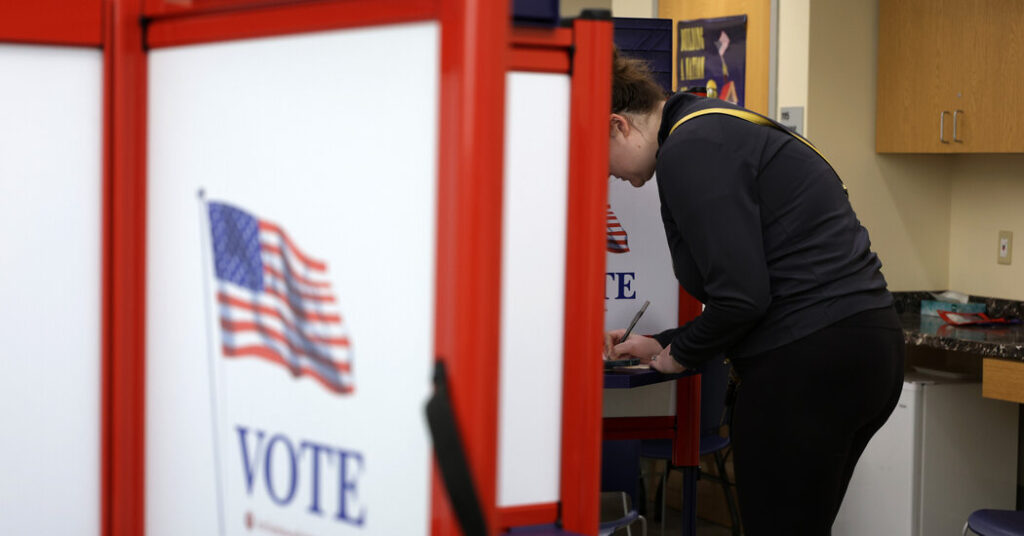
Virginia voters approved a referendum on Tuesday to redraw the state’s congressional map, according to The Associated Press, allowing Democrats to flip as many as four Republican-held seats in the U.S. House. The vote provides a significant boost to the party’s effort to win control of the chamber this fall.
The statewide referendum will enact a map that is as extreme a political gerrymander as exists in the United States. The new lines, drawn by Democratic state legislators and approved by Gov. Abigail Spanberger, are intended to deliver 10 of Virginia’s 11 House seats to Democrats, up from the six they now control.
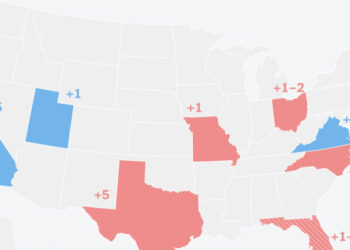
The outcome was the latest twist in the nation’s redistricting arms race, which President Trump and Texas Republicans began last year as they sought to defend the party’s slim House majority.
The Virginia vote, combined with California’s move last year to hand Democrats more seats, means that the clash over gerrymandered maps in the midterm elections has now arrived at a rough draw. The final question marks are Florida, where Republicans may push for more seats on the state’s map, and the Supreme Court, which is set to issue a major decision on the Voting Rights Act that could set off a final scramble to redraw maps before the midterms.
Democrats in Richmond and Washington engineered the Virginia redistricting push last fall to combat the Republican efforts in red states. It required Democrats in the General Assembly to vote twice to undo a 2021 state constitutional amendment that created an independent redistricting commission and then have the measure be approved in Tuesday’s referendum for it to go into effect for the midterms.
Tens of millions of dollars, much of it in so-called dark money, flowed into the Virginia referendum, inundating voters with advertising and mailers. The Democratic “Yes” side raised far more cash, but Republican “No” backers spent heavily late.
Democratic anxiety peaked in the final weeks. Republicans urging “No” votes ran advertising that featured old footage of former President Barack Obama and Ms. Spanberger lamenting the ills of political gerrymandering. At the same time, Mr. Obama appeared in ads and videos supporting the referendum, creating a potentially confusing split screen for voters.
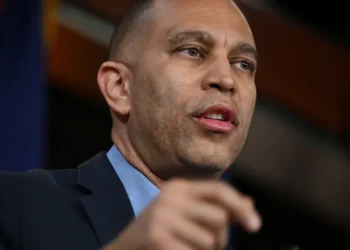
Leaders in Congress were acutely aware of the stakes. Representative Hakeem Jeffries of New York, the Democratic minority leader aiming to become speaker, pushed for the referendum, and a nonprofit group aligned with him dedicated at least $38 million toward the effort. Speaker Mike Johnson, seeking to hold his Republican majority, appeared at events opposing the referendum.
Especially in the final stretch, Democrats hammered the idea that the election was an opportunity for voters to voice their opposition to Mr. Trump.
“No state has been as negatively impacted by the Trump policies as Virginia,” Representative James Walkinshaw, a Democrat whose district covers Northern Virginia, said in a recent interview.
Mr. Trump, however, remained quiet on the referendum until the eve of the election, when he called into a Virginia radio host’s streaming channel and appeared on a conference call with supporters from the state. If House Democrats won a majority in the midterm elections, he warned, “it’s going to be a disaster.”
“I don’t know if you know what gerrymandering is, but it’s not good,” he said on the call.
The Virginia referendum would set a new map for elections through 2030, then revert authority for congressional map drawing to the nonpartisan redistricting commission that voters approved in 2021.
Even before Virginia voters approved the new map, Democrats in the state announced bids for the still-theoretical congressional districts and began campaigning in them.
No new district has received as much attention as the lobster-shaped Seventh, which stretches from deeply Democratic suburbs along the Potomac River out to conservative rural areas to the west and south.
At least half a dozen candidates have already begun campaigns, including Dorothy McAuliffe, whose husband, Terry, served as governor; Dan Helmer, a state legislator who was an architect of the redistricting push; J.P. Cooney, a deputy to Jack Smith, the special prosecutor who twice indicted Mr. Trump; and Olivia Troye, a former national security aide to Vice President Mike Pence who has become a Trump critic.
The referendum’s passage cements Virginia’s status as a solidly blue state. Republicans have not won the state in a presidential election since 2004, have not won a Senate race there since 2002 and have elected just one G.O.P. governor, Glenn Youngkin, since 2009. Ms. Spanberger carried the state in November by 15 percentage points as Democrats won 64 out of 100 seats in the state House of Delegates.
Theodore Schleifer contributed reporting.
Reid J. Epstein is a Times reporter covering campaigns and elections from Washington.
The post Virginia Passes New House Map in a Midterm Victory for Democrats appeared first on New York Times.