The sun poked above the horizon one bright March morning in the sprawling suburbs of Long Island. A fleet of federal vehicles began their daily search for immigrants.
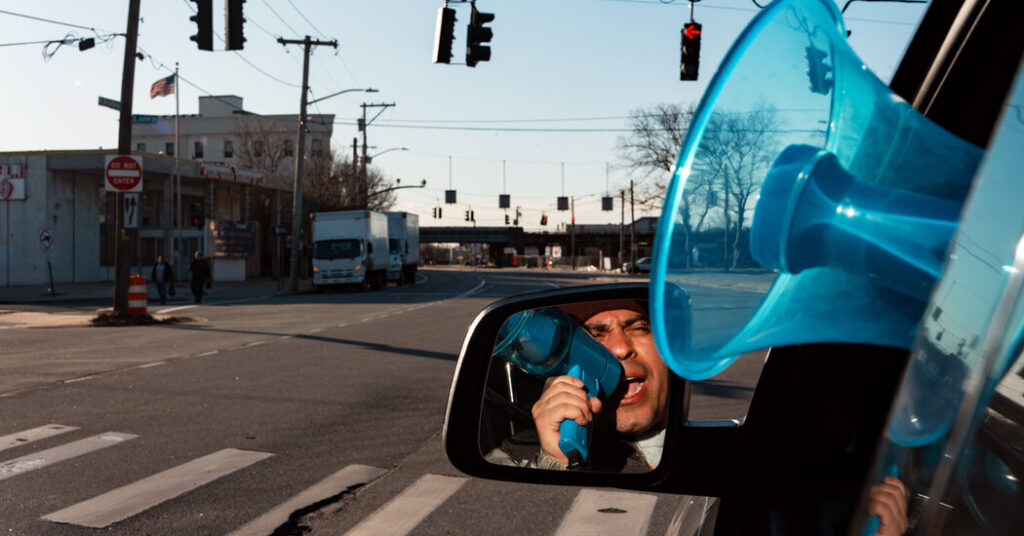
They were followed, as usual, by Osman Canales, the roving neighborhood watch leader who has 100,000 Facebook followers and an entourage of secret lookouts. With one hand on the wheel of his black Jeep Grand Cherokee and another gripping a bullhorn, he telegraphed a warning:
“ICE is here!” Mr. Canales shouted in Spanish. “Stay home!”
President Trump’s immigration crackdown has played out most graphically in big cities run by Democrats, where aggressive tactics by federal agents have dominated headlines and fanned partisan debate. But in those cities, immigrant arrest rates have been erratic, spiking and plummeting.
The rhythm of detentions has been more steady in car-dependent places like Long Island, where agents have the advantage of stealth and where immigrants live far from the eye of news cameras. Just east of New York City’s jampacked boroughs, the arrest rates since last August have been consistently higher than in the city and the Hudson Valley.
The detention rate on Long Island has been about 60 percent higher than in the city and Hudson Valley since Mr. Trump took office. The rate remains slightly lower than in the rest of the country.
The expansive roads of Long Island have been fertile terrain for agents to capture migrants without the scrutiny that has often accompanied officials’ actions in big cities. Residents must drive for miles to get to work or to go grocery shopping, allowing officers to detain them during traffic stops beyond the critical eye of observers.
“It’s harder to say something when you’re in your car driving in a suburban area,” said Serena Martin, an immigration advocate and the executive director of New Hour for Women and Children, an organization that helps mothers, women and children whose lives have been affected by incarceration. “It’s not that people care any less. We just aren’t on the street walking in the way that people in urban areas have the ability to do to quickly mobilize, to take the photos, to take the video.”
On Long Island, Immigration and Customs Enforcement agents arrested about 12 people a day in early March, compared with about one a day in 2024. Nationwide, ICE agents were making more than 1,000 arrests per day in early March, compared with about 300 a day in 2024.
Deep-blue cities such as Chicago, Minneapolis and New York have vowed not to work with ICE, and protesters there have foiled large immigration operations by leaping quickly into action in substantial numbers. Federal agents in Manhattan have sometimes struggled to carry out arrests. Activists have chased them during a street raid, barricaded a garage where they were parked and staged a protest at a hotel where they were staying.
The pace of immigration arrests in the New York City area has remained at an elevated level since last summer — a contrast to the operations in Chicago and Minneapolis, where arrests skyrocketed for a month or two and then calmed down.
Arrests in Illinois fell from about 70 a day in October 2025 to about 10 a day at the beginning of March. In Minnesota, they fell from more than 80 a day in January to just about three a day. At the same time, arrests in the New York City area went from about 30 a day in January to about 28 a day in early March.
The Department of Homeland Security declined to discuss operations, but officials suggested that cities choosing to cooperate with ICE have less crime.
“Partnerships with law enforcement are critical to having the resources we need to arrest criminal illegal aliens across the country,” D.H.S. said in a statement. “We have had tremendous success when local law enforcement work with us.”
In Nassau County, the Long Island county closer to New York City, federal agents are aided by a partnership between local police and the Trump administration that empowers law enforcement officers to assist in enforcing immigration laws and transfer people into ICE custody. The agreement is known as Section 287(g) of the U.S. Immigration and Nationality Act. And Nassau County isn’t alone.
A growing number of 287(g) agreements have been adopted across the country since Mr. Trump returned to office. In January 2025, 133 state and local agencies had agreements, according to a study by the American Civil Liberties Union. Since then, ICE has announced agreements with at least 1,000 agencies.
Bruce Blakeman, the Nassau County executive who is the Republican nominee for New York governor and an ally of Mr. Trump’s, has vowed to fight a proposal by Gov. Kathy Hochul, a Democrat, to ban officers from working with ICE through 287(g) agreements. Mr. Blakeman has passed several policies to help federal agents, including the deployment of local detectives to assist with deportations.
“Because of the county’s cooperation with ICE, we have removed over 2,000 illegal migrants with criminal records ranging from attempted murder, to rape, to car jacking and drug dealing,” said Chris Boyle, a spokesman for Mr. Blakeman. “It is a safer county.”
ICE agents have turned Nassau County’s fire stations into rest stops, pulling into parking lots to take a break from patrolling. Sandra Valencia, who runs a youth leadership program on Long Island through Rural & Migrant Ministry, an advocacy group, said that agents park outside schools after classes are released, frightening parents.
“Children of Republican parents have intimidated our kids,” Ms. Valencia said in Spanish. “They showed up to school with American flags.”
Latinos on Long Island have accused ICE of discrimination. In a lawsuit filed April 8, five residents of Latino descent said that agents unlawfully stopped and arrested them based solely on their race and ethnicity, with no regard for their immigration status, in violation of federal laws and regulations. The agency did not respond to an inquiry about the litigation.
Long Islanders have made plans in the event of their own arrest, asking family members to take care of relatives or property left behind. One woman who is living in the country illegally and spoke on the condition of anonymity because she feared reprisal said that in June, she decided to pack a bag with blankets, mittens, hats and a sleep sack for her 1-year-old baby in case they wound up in a frigid detention center.
Teenagers said they have felt shocked to see families unravel around them. Some said they worried that losing a parent or a sibling would risk their academic pursuits or deplete their family’s income.
Fernanda Mejia, 16, is the daughter of a bagel store worker who was detained in June while agents were searching for another person. In a tearful plea to the Republican-controlled Nassau County Legislature in July, she said that she was heartbroken to lose her father and urged the governing body to stop helping ICE arrest migrants like him. She said her father had no history of criminal behavior, and The New York Times found no evidence of a criminal background.
“My name is Fernanda Mejia,” she said, her voice trembling as she approached the lectern while wearing a ruffled skirt and a pink bow in her hair. “My dad was taken by ICE.”
Howard J. Kopel, the presiding officer, cut her off, drawing protests from audience members who demanded to hear more. When Fernanda finished speaking, Mr. Kopel was terse.
“I wish you good luck,” Mr. Kopel said. “I hope it works out. All right, next.”
Mr. Kopel declined an interview request through a spokeswoman.
Fernanda’s father had been deported to El Salvador. In her messy bedroom, piled with stuffed animals, makeup brushes and Polaroids, she keeps the gifts he sent from detention — a bracelet that he spooled together with broken rosaries and a necklace made out of beads shaped from bread.
Many adults around Fernanda barely go outside. Some depend on Facebook posts from Mr. Canales, the neighborhood watch leader.
On that bright March morning, Mr. Canales drove for hours before he found out agents had quietly arrested someone. He stopped for lunch at a Mexican restaurant, where the owner thanked him with a free torta and lamented a lack of customers.
Defeated, Mr. Canales finished eating, climbed back into his Jeep and braced for the next day.
Sheelagh McNeill contributed research.
Ana Ley is a Times reporter covering immigration in New York City.
The post Trump’s Immigration Crackdown Pervades Long Island Suburbs appeared first on New York Times.